


📋 Table of Contents
- TL;DR Summary
- How Big Is the Ethereum L2 Ecosystem in 2026?
- The Four Major L2s Compared: One Table
- Deep Dive: Strengths and Weaknesses of Each L2
- Which Layer 2 Should You Choose in 2026?
- How to Move Assets to Layer 2
- What Can You Do on L2: DeFi and DEXes
- Common Misconceptions
- FAQ
- About the Author
TL;DR Summary
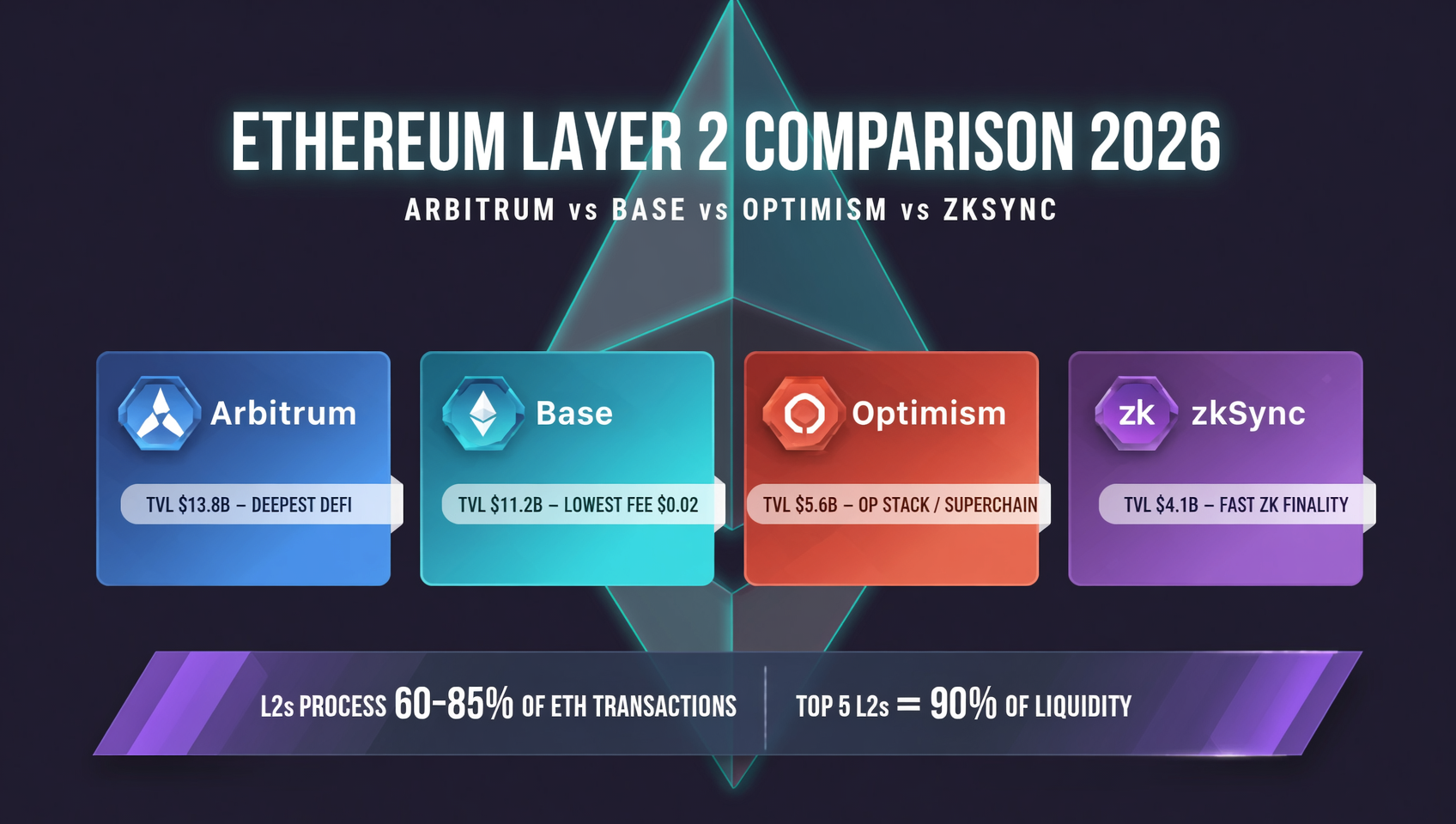
In 2026, using Ethereum basically means using Layer 2. The four major L2s — Arbitrum, Base, Optimism and zkSync — hold the bulk of all L2 value (the top five absorb ~90% of liquidity), median fees are as low as $0.02-$0.05 (100-1000x cheaper than mainnet), and they already process 60-85% of Ethereum-related transactions. How to choose: Arbitrum for DeFi depth, Base for the lowest fees and biggest consumer flow, Optimism for OP Stack interoperability, zkSync for fast ZK finality. For high-frequency operations, moving to an L2 is almost always the right call; for large funds, pay close attention to bridge security.
How Big Is the Ethereum L2 Ecosystem in 2026?
L2s have become the mainstream way to use Ethereum in 2026. L2BEAT data for July 2026 puts total Layer 2 total value locked (TVL) at about $45B, with Arbitrum at roughly $17.7B (rank #1), Base at $7.3B (rank #2) and Optimism at $6.0B (rank #3) — the top chains hold the vast majority of value, and the top five absorb roughly 90% of liquidity.1
Volume matters even more: L2s now process 60-85% of Ethereum-related transaction volume. Since EIP-4844 (Dencun, March 2024) introduced blob data, L2 fees have fallen 80-90% overall, and most major L2s now have median fees between $0.001 and $0.05 — "L2 is expensive" is long gone.
If you are not yet familiar with how Layer 2 works, start with our complete Ethereum guide: from smart contracts to Layer 2, which explains rollups and state channels clearly.2
The Four Major L2s Compared: One Table
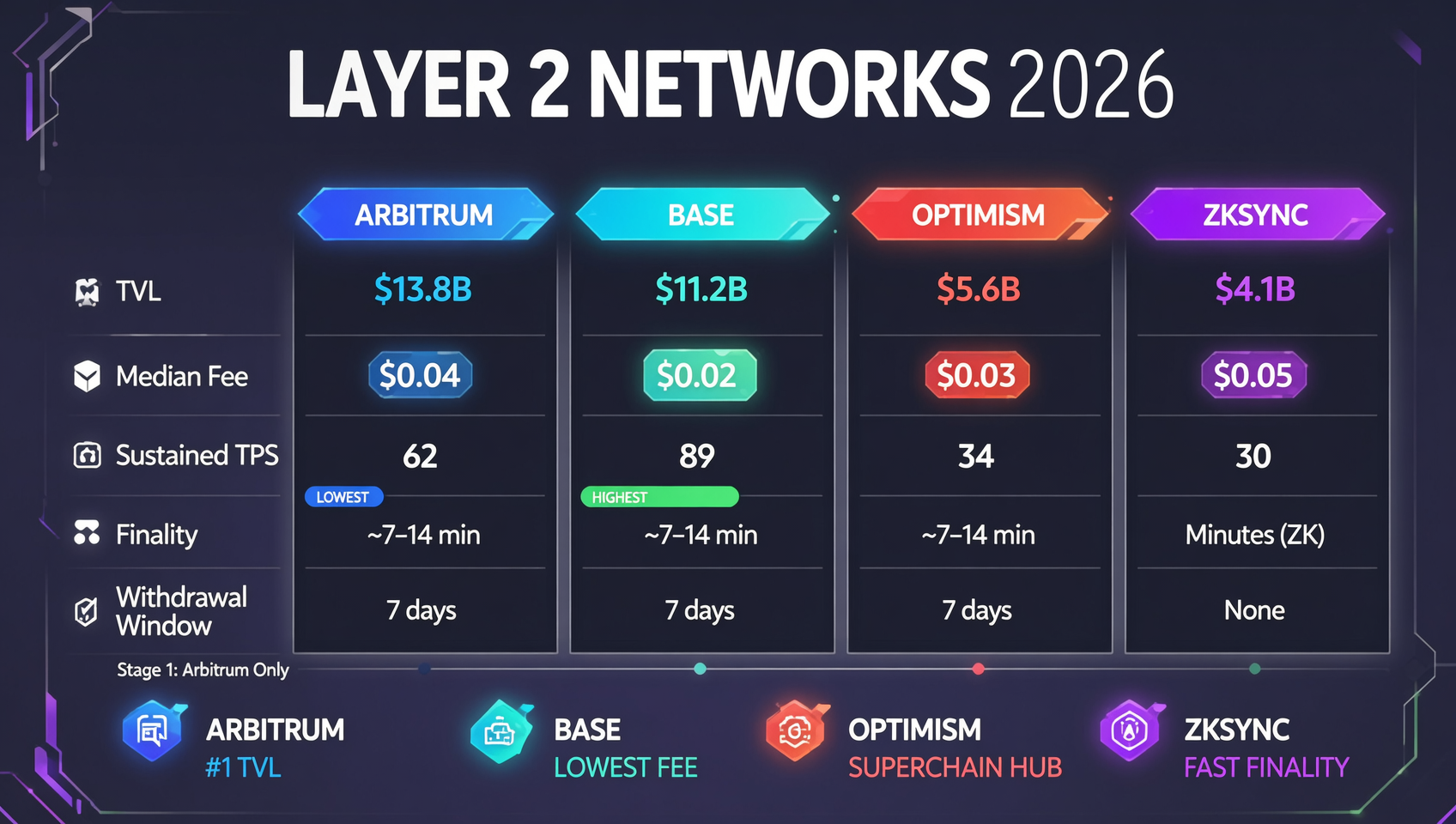
Arbitrum, Base, Optimism and zkSync differ clearly in TVL, fees, speed and positioning. The table below uses April 2026 data (L2BEAT / growthepie / Chainspect):
| Metric | Arbitrum One | Base | OP Mainnet | zkSync Era |
|---|---|---|---|---|
| Type | Optimistic | OP Stack | Optimistic | ZK Rollup |
| TVL (Apr 2026) | ~$13.8B | ~$11.2B | ~$5.6B | ~$4.1B |
| Median fee | ~$0.04 | ~$0.02 | ~$0.03 | ~$0.05 |
| Sustained TPS | ~62 | ~89 | ~34 | ~30 |
| Soft confirm / finality | 1-2s / ~7-14min | 1-2s / ~7-14min | 1-2s / ~7-14min | Minutes |
| Withdrawal challenge | ~7 days | ~7 days | ~7 days | None |
| Operator | Arbitrum Foundation | Coinbase | Optimism Foundation | Matter Labs |
| One-line positioning | DeFi depth king | Consumer flow entry | Superchain hub | ZK pioneer |
Note: TVL fluctuates by month — July 2026 L2BEAT shows Arbitrum ~$17.7B, Base ~$7.3B, Optimism ~$6.0B, with a stable ranking of Arbitrum > Base > Optimism. Always check L2BEAT for live data.3
Deep Dive: Strengths and Weaknesses of Each L2
Arbitrum One: The "Institutional-Grade" L2 with the Deepest DeFi
Arbitrum is the highest-TVL L2 in 2026 and the only large L2 at L2BEAT Stage 1 (permissionless fraud proofs). Built by Offchain Labs and live since 2019, it is the flagship of the optimistic rollup line.
✅ Pros: deepest and most complete DeFi ecosystem, long-standing #1 TVL, BOLD permissionless validation since late 2025, preferred by institutions and market makers
❌ Cons: fees slightly higher than Base, actual TPS not the highest, user base skews toward DeFi veterans
Why choose it: if you do DeFi lending, deep DEX trading or stablecoin yield, Arbitrum's liquidity depth and composability are the best among all L2s today. Its ~$0.04 median fee is offset by lower slippage on large trades.
Base: The Fastest-Growing L2 Backed by Coinbase
Base is the lowest-fee and highest-throughput major L2 in 2026. Launched by Coinbase in 2023 on OP Stack, it cold-started on the exchange's tens of millions of monthly active users and reached #2 in TVL by 2026.
✅ Pros: ~$0.02 median fee (lowest of the four), ~89-200 sustained TPS (highest), Coinbase compliance backing and distribution, fastest-growing ecosystem
❌ Cons: still Stage 0 on L2BEAT (multi-proof system rolling out), DeFi depth below Arbitrum, relies to a degree on a single corporate entity
Why choose it: beginners, small high-frequency transactions, and DEX/NFT/social apps get the smoothest, cheapest experience on Base, and its compliance profile appeals to retail users in the US and Europe.
OP Mainnet: The Command Center of the Superchain
Optimism's strategic value lies in the OP Stack and Superchain ecosystem, not in its single-chain TVL. OP Stack is an open modular L2 framework used by Base, World Chain, Mode, Unichain and many others — OP Mainnet is the flagship chain of that ecosystem.
✅ Pros: big open-source influence via OP Stack, native ETH gas, mature governance, deeply aligned with Ethereum's core roadmap
❌ Cons: standalone TVL below Arbitrum/Base, mid-pack TPS, smaller direct user base
Why choose it: developers and cross-chain interoperability enthusiasts will appreciate the Superchain's unified bridging and shared-sequencer vision; for everyday users the experience is close to Base.
zkSync Era: The Fast-Finality Leader on the ZK Track
zkSync Era is the leading ZK rollup, using zero-knowledge proofs for minute-level finality with no 7-day challenge window. Developed by Matter Labs and live since 2023, it differs fundamentally from the optimistic route in its trust model.
✅ Pros: fast (minute-level) finality, no withdrawal challenge period, native ETH gas, ZK is widely seen as an endgame direction
❌ Cons: slightly higher per-transaction cost (~$0.05), proof-generation latency, ecosystem and TVL notably smaller than the top three
Why choose it: users who care about fast finality and withdrawal speed (cross-chain arbitrage, institutional settlement) fit zkSync well, and the ZK technical direction is more future-oriented.
Which Layer 2 Should You Choose in 2026?
The rule is "match the L2 to your need, then check the data." In 2026 all four top L2s are nearly free to use, so the real differentiators are ecosystem depth, speed and security:
| Your use case | First pick | Second pick | Why |
|---|---|---|---|
| DeFi lending / market-making / yield | Arbitrum | Base | Deepest TVL, best composability |
| Beginners / small high-freq trades | Base | Arbitrum | Lowest fees, highest TPS, easiest onboarding |
| Developers / interoperability | Optimism | Base | OP Stack ecosystem, Superchain |
| Fast withdrawals / institutional | zkSync | Arbitrum | ZK minute-level finality, no challenge window |
| Exchange withdrawals & savings | Any L2 supported | — | Exchange direct-withdrawal channel is easiest |
For a non-urgent simple transfer, compare live fees between mainnet and L2 — when mainnet is very quiet in 2026 it can occasionally be cheaper than an L2. See our Ethereum gas fee saving guide for details.4
How to Move Assets to Layer 2
There are two routes to an L2 — "exchange direct withdrawal" and "cross-chain bridge" — and the direct withdrawal is the safest. On major exchanges like Binance and OKX, just pick the Arbitrum, Base, Optimism or zkSync network when withdrawing, and the fee is usually only $0.5-$5 with arrival in minutes — no manual on-chain transaction needed.
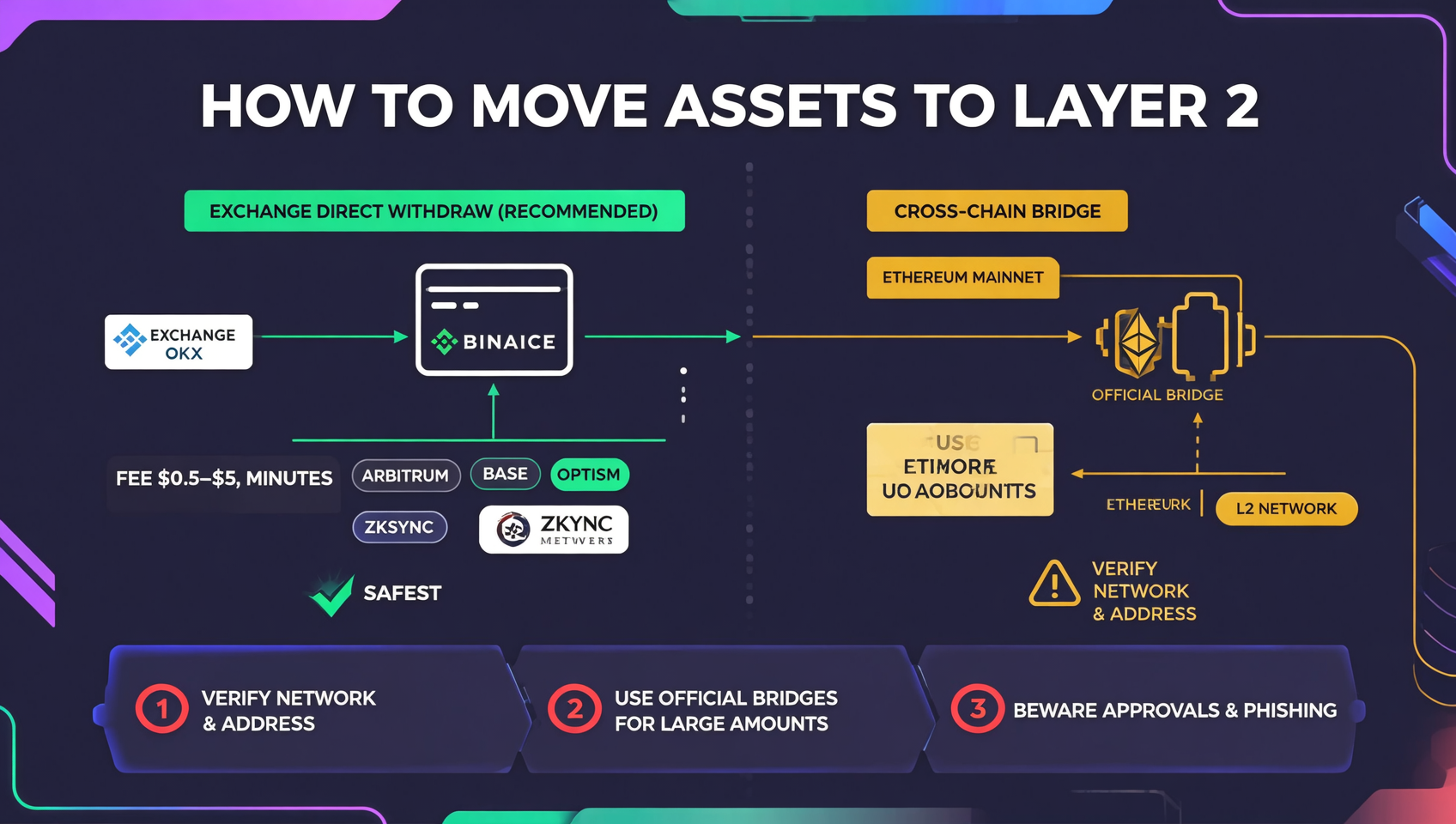
The second route is a cross-chain bridge: use official bridges (Arbitrum Bridge, Base Bridge) or mainstream aggregators (LayerZero, Across, Stargate) to move ETH/USDC from mainnet. Three cautions:
- Verify the network and address — choosing the wrong network can permanently lose funds; double-check before confirming
- Use official bridges for large amounts — aggregators have more complex approvals and a larger risk surface
- Watch for approvals and phishing — bridges are a hotspot for hacks, with major cross-chain bridge losses in 2025; read our cross-chain bridge security guide before operating5
What Can You Do on L2: DeFi and DEXes
L2 DeFi is already the main battleground. Arbitrum and Base host a huge share of DEX, lending and stablecoin applications at fees 90%+ cheaper than mainnet. The mechanics (automated market makers, impermanent loss) are the same as on mainnet — see our complete DeFi guide 2026 and liquidity pools & impermanent loss guide.
For DEXes: Uniswap and GMX have the best depth on Arbitrum, while Base's Aerodrome is growing fast. To understand how DEXes differ from centralized exchanges, read our CEX vs DEX comparison.
Common Misconceptions
- ❌ "L2 is a temporary solution; mainnet is the real thing" — in 2026 L2s process 60-85% of volume; they are the mainstream way to use Ethereum
- ❌ "ZK is always better than Optimistic" — ZK has faster finality but is pricier per transaction with a smaller ecosystem; optimistic rollups have richer ecosystems but a 7-day challenge window
- ❌ "All bridges are the same" — official bridges are safer than aggregators; don't cheap out with large funds
- ❌ "Higher TPS means a better chain" — all top L2s have enough throughput in 2026; the competition has shifted to ecosystem and security
- ❌ "Once you're on an L2 you're always cheap" — L2 fees also spike briefly during big events (airdrops, liquidations), just like mainnet
FAQ
Q: What is the best Ethereum Layer 2 in 2026?
It depends on your use case. Choose Arbitrum for the deepest DeFi (TVL $13.8B, the only Stage 1 L2); Base for the lowest fees ($0.02) and largest consumer flow; Optimism for OP Stack interoperability; zkSync Era for fast ZK finality.
Q: How much cheaper is a Layer 2 than mainnet?
Typically 100-1000x cheaper. An ERC-20 transfer is ~$0.50 on mainnet but ~$0.02 on Base and ~$0.04 on Arbitrum; plain ETH transfers run $0-$0.33 on mainnet versus $0.001-$0.05 on L2s. EIP-4844 cut L2 fees 80-90%.
Q: Arbitrum or Base — which should I choose?
DeFi users choose Arbitrum; beginners and high-frequency small users choose Base. Arbitrum leads in TVL and is the only Stage 1 large L2 with the best DeFi depth; Base has the lowest median fee ($0.02), the highest sustained TPS, and Coinbase distribution and compliance backing.
Q: What is the difference between optimistic rollups and ZK rollups?
The difference is trust assumptions and finality. Optimistic rollups (Arbitrum/Base/Optimism) assume transactions are valid and rely on fraud proofs, so withdrawals carry a ~7-day challenge window; ZK rollups (zkSync/Linea) verify with zero-knowledge proofs and reach finality in minutes, though per-transaction costs are a bit higher.
Q: How do I send ETH from an exchange to a Layer 2?
The preferred route is exchange direct withdrawal. On Binance, OKX or Coinbase, pick the Arbitrum/Base/Optimism network when withdrawing at a very low fee; or use official bridges and mainstream bridges (LayerZero, Across) from mainnet. Always confirm the destination network.
Q: Are Layer 2 networks safe? What about bridge risk?
Mainstream L2s inherit Ethereum mainnet security, but bridging carries risk. Optimistic rollups have a 7-day withdrawal challenge window, and bridges are a hotspot for hacks. Use official bridges for large amounts and verify addresses/networks before transacting — see our cross-chain bridge security guide.
Q: How big is the Layer 2 ecosystem in 2026?
Total TVL is about $45B. Per L2BEAT in July 2026: Arbitrum ~$17.7B, Base ~$7.3B, Optimism ~$6.0B. L2s process 60-85% of Ethereum-related transactions and are the mainstream way to use Ethereum.
About the Author
CoinVado Research is CoinVado's content research team, focused on blockchain education, on-chain data analysis, and cryptocurrency investment education. We are committed to verifiable data and never fabricate information, helping beginners build sound crypto knowledge.
⚠️ Risk Disclaimer: This article is for educational purposes only and does not constitute investment advice. L2 TVL, fees and security change in real time with network upgrades and market conditions — always rely on authoritative tools (L2BEAT, growthepie) for live data. Cryptocurrency markets are extremely volatile; cross-chain and on-chain operations carry asset-loss risk. Manage your risk.
Recommended exchanges:
📚 Continue Learning:
- What is Ethereum? Complete Guide 2026
- Ethereum Gas Fees Too High? 2026 Practical Saving Guide
- What is Gwei? Complete Ethereum Gas Fee & Gwei Indicator Guide
- DeFi 2026 Complete Guide: Decentralized Finance from Beginner to Advanced
- Cross-Chain Bridge Security Guide
📖 Further Learning:
- On-chain Guide: Learn Blockchain from Zero — more blockchain education and on-chain tutorials
Footnotes:
Footnotes
-
Source: L2BEAT total L2 TVL data, July 2026 ↩
-
Source: Ethereum.org "Layer 2" official documentation, 2026 ↩
-
Source: L2BEAT TVL snapshot, April 2026; Eco.com "Best Ethereum L2s in 2026: Fees, TVL, TPS Compared" ↩
-
Source: Portals.fi "Cheapest EVM Chain to Swap on 2026"; Coinpaprika L2 fee data, 2026 ↩
-
Source: growthepie L2 fee and activity data, April 2026; Chainalysis "2025 Crypto Crime Report" bridge security data ↩