


TL;DR Key Takeaways
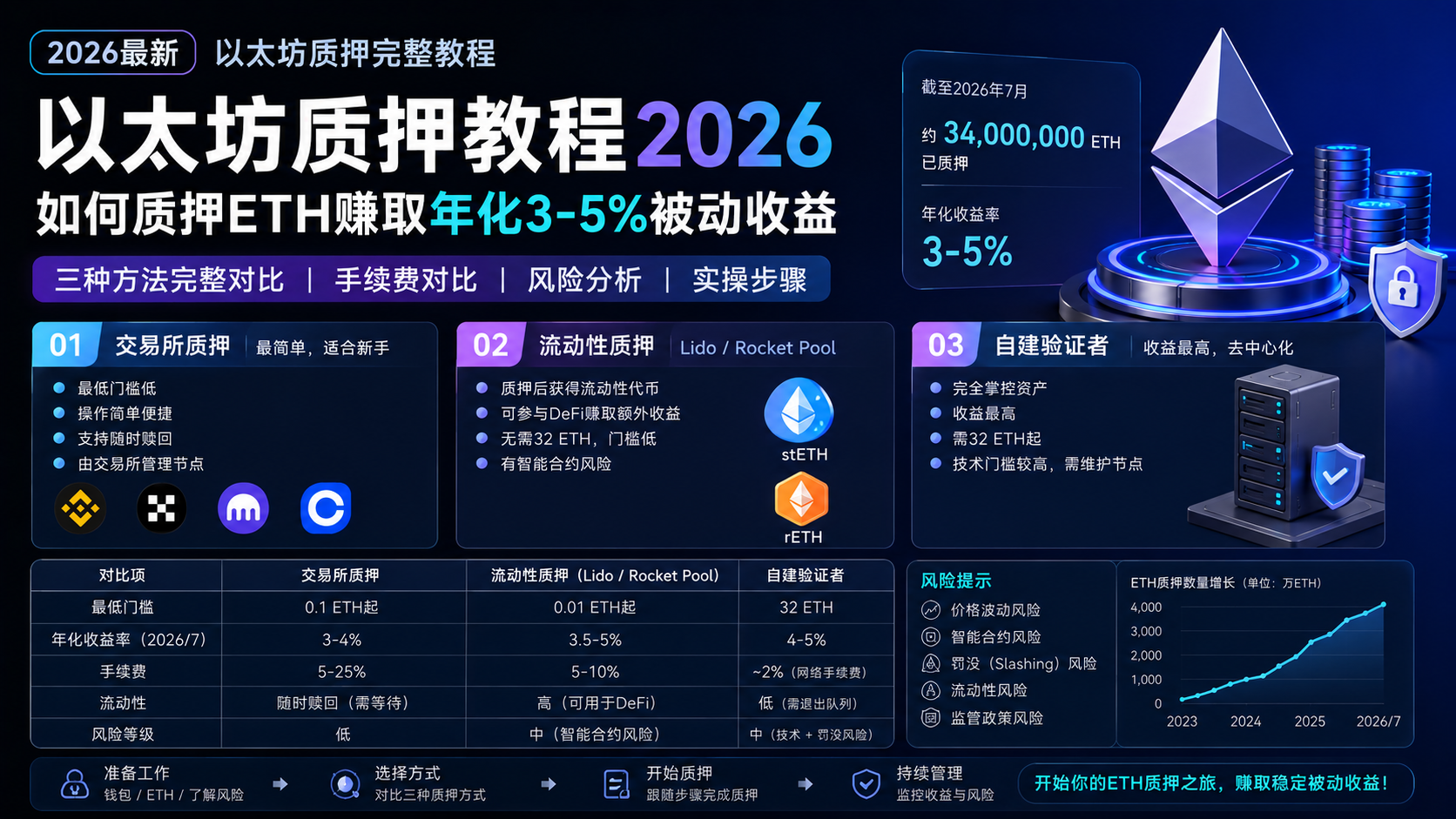
- Ethereum staking lets you lock your ETH to help secure the PoS network while earning 3-5% APY in passive income. Three main methods: exchange staking (easiest but highest fee), liquid staking (flexible, DeFi-compatible), and solo validator staking (maximum returns but requires 32 ETH + technical skills)
- As of July 2026, ~34 million ETH (28% of circulating supply) is staked, worth over $115 billion, with current staking APR of approximately 3.5%1
- Beginners should start with exchange staking (minimum 0.1 ETH, one-click setup), advanced users choose Lido liquid staking (get stETH for DeFi), big holders with tech skills go solo for maximum returns
What Is Ethereum Staking?
Ethereum staking (ETH staking) is the process of locking your ETH into the Beacon Chain to participate in block validation and network security, earning ETH rewards in return. In September 2022, Ethereum completed "The Merge," transitioning from Proof-of-Work (PoW) to Proof-of-Stake (PoS), making staking the network's native security mechanism.
ETH staking is fundamentally an economic incentive system — you deposit ETH as "collateral," the network randomly selects validators to propose and attest to new blocks, honest validators earn newly issued ETH and transaction fees as rewards, while dishonest or offline validators face slashing.
Key Ethereum staking statistics as of July 2026:
| Metric | Data |
|---|---|
| Total ETH staked | 34M ETH (28% of supply)1 |
| Staked value (USD) | ~$115B |
| Current APR | ~3.5% (dynamic) |
| Active validators | ~1.07 million |
| Minimum stake | 0.01 ETH (liquid staking) |
Why Stake ETH in 2026?
Three compelling reasons — passive income generation, inflation hedge, and network participation.
From a yield perspective, the 3-5% APR may not seem high, but ETH staking rewards are protocol-issued with zero counterparty risk. Among crypto investment options, ETH staking comes closest to a "risk-free rate" benchmark.
From a network security perspective, higher staking participation means greater security — an attacker would need to control over 33% of staked ETH (~$38B) to compromise the network. The staking ratio rising from 15% (2023) to 28% (2026) reflects growing community confidence in Ethereum's long-term trajectory.
From an investment strategy perspective, staking allows you to earn 3-5% compound growth on your ETH holdings without selling, which may have tax advantages (varying by jurisdiction). At current rates, your ETH balance grows 15-27% over 5 years through compound staking alone.
Three ETH Staking Methods — Full Comparison
Method 1: Exchange Staking (Recommended for Beginners)
The simplest approach — deposit ETH on Binance or OKX, find the ETH staking product under Earn, and activate it with zero technical steps.
Pros & Cons:
| ✅ Pros | ❌ Cons |
|---|---|
| One-click setup, no technical knowledge needed | Platform fee is high (15-20% of rewards) |
| Minimum 0.1 ETH | No direct validator key control |
| Usually offers one-click withdrawal | Platform credit risk exposure |
| Auto-compounding supported | stETH not available for DeFi use |
Step-by-step:
- Register: Use Binance referral link or OKX referral link for fee discounts
- Complete KYC verification and deposit ETH
- Find staking: Binance "Earn" → "ETH Staking" / OKX "Earn" → "ETH Staking"
- Choose flexible or fixed term, confirm your amount and start earning
Method 2: Liquid Staking (Recommended for Advanced Users)
Liquid staking converts your ETH into a liquid receipt token (e.g. stETH via Lido, rETH via Rocket Pool) that can be used across DeFi.
Pros & Cons:
| ✅ Pros | ❌ Cons |
|---|---|
| Earn dual yields (staking rewards + DeFi yields) | Smart contract risk (audited but not zero) |
| Minimum 0.01 ETH — nearly no barrier | Protocol fee ~10% of rewards |
| Swap stETH back to ETH anytime on DEXes | stETH depeg risk during market crashes |
| Usable as collateral on Aave, Compound | Requires wallet and Gas fees |
Step-by-step:
- Set up MetaMask or another Web3 wallet, deposit ETH
- Visit Lido.fi or Rocket Pool
- Connect wallet, enter ETH amount to stake
- Confirm the transaction (Gas: ~$3-15 on Ethereum mainnet)
- Receive stETH or rETH — use it in DeFi protocols
Method 3: Solo Staking (Recommended for Big Holders + Tech Skills)
Solo staking offers the highest returns but requires exactly 32 ETH and reliable server infrastructure.
Pros & Cons:
| ✅ Pros | ❌ Cons |
|---|---|
| Maximum returns (no protocol/platform fee deduction) | Requires 32 ETH (~$108,800) |
| Full control over validator keys | Requires technical operations skills |
| Contributes to Ethereum decentralization | Server + bandwidth costs |
| Choose your client and location | Manual client updates needed |
Step-by-step:
- Prepare 32 ETH and a 24/7 server (DAppNode or VPS recommended)
- Generate validator key pair (using Staking Deposit CLI)
- Deposit 32 ETH to the Deposit Contract
- Run execution client (Nethermind/Erigon) + consensus client (Prysm/Lighthouse)
- Monitor validator performance on beaconcha.in
Three-Method Comparison Table
| Dimension | Exchange Staking | Liquid Staking | Solo Staking |
|---|---|---|---|
| Min ETH | 0.1 ETH | 0.01 ETH | 32 ETH |
| Net APR | 2.5-3.5% | 3-4.5% | 3.5-5% |
| Technical difficulty | ⭐ Very Low | ⭐⭐ Medium | ⭐⭐⭐⭐⭐ High |
| Liquidity | ❌ Locked | ✅ Tradable stETH | ❌ Exit queue |
| Platform fee | 15-20% | 10% | None |
| Best for | Beginners | DeFi users | Tech-savvy whales |
ETH Staking Risks and Mitigation
1. ETH Price Volatility
The biggest risk isn't technical — it's ETH price fluctuations. Staking at $3,500 with a decline to $2,000 means yield (~$70-175/year per ETH) cannot offset the 30%+ principal loss. Only stake ETH you plan to hold long-term, and avoid concentrating your entire portfolio in a single asset.
2. Slashing Risk (Solo Validators Only)
Actual probability is ~0.01% with average penalty of 1-2 ETH. Update clients regularly, use reliable hardware and network, and never run dual validators with the same key.
3. Liquid Staking Depeg Risk
stETH traded at ~0.95 ETH during the 2022 market panic. In 2024-2026, depeg has been much smaller (0.99-1.01 ETH range). Choosing high-liquidity pools (Curve stETH/ETH) reduces slippage risk.
4. Smart Contract Risk
Lido and Rocket Pool are audited by multiple firms (Sigma Prime, Trail of Bits, etc.). Diversifying across protocols rather than concentrating in one reduces overall smart contract exposure.
Recommended Staking Strategies
🟢 Beginner Strategy (Small Capital, Zero Tech)
- Hold 0.1-10 ETH → Use exchange staking (Binance or OKX)
- Register with Binance referral for fee discounts
- Enable auto-compounding for compound growth
🟡 Intermediate Strategy (Mid Capital, DeFi Experience)
- Hold 10-32 ETH → Use Lido or Rocket Pool liquid staking
- Deposit stETH on Aave for additional lending yields (dual yield)
- Monitor the stETH/ETH peg ratio — buy at discount, sell at premium
🔴 Advanced Strategy (32+ ETH, Technical Background)
- 32+ ETH → Solo validator + partial liquid staking for diversification
- Use different client combinations (e.g. Nethermind+Lighthouse) for slashing risk mitigation
- Simplify operations with DAppNode and continue learning via the On-Chain Guide
Frequently Asked Questions
What is the minimum ETH required for staking?
Solo staking requires exactly 32 ETH. Exchange staking starts from 0.1 ETH, and liquid staking via Lido from 0.01 ETH. Small investors should use exchange or liquid staking.
What is the current ETH staking APR?
As of July 2026, ETH staking yields approximately 3-5% APR depending on total stake, about 3.5% currently. Exchange staking nets ~2.5-3.5%, liquid staking nets ~3-4.5% after fees.
Can I withdraw my staked ETH anytime?
Solo validators and exchange staking have exit queues (~4-7 days). Liquid staking allows near-instant ETH conversion but with potential slippage and depeg risk.
Is it safe to stake on Binance or OKX?
Small amounts for convenience — fine on top exchanges. Large amounts — use liquid staking or solo staking where you control the keys.
How common is slashing for solo validators?
~0.01% of validators with average penalty of 1-2 ETH. Following best practices practically eliminates risk.
Disclaimer: This content is for educational purposes only and does not constitute investment advice. Cryptocurrency investment carries risk, and staking ETH still faces price volatility, smart contract risk, and liquidity risk. Please make your own informed decisions.
Footnotes
-
Source: beaconcha.in Ethereum Staking Dashboard, ETH staking data, July 2026 ↩ ↩2