


📋 Table of Contents
- TL;DR Summary
- The Reality: Gas Fees Are Already Cheap in 2026
- Mainnet vs Layer 2: Fee Comparison
- When to Transact Cheapest: Off-Peak Windows
- How to Check Real-Time Gwei: Tools
- 6 Practical Saving Methods
- Common Misconceptions
- FAQ
- About the Author
TL;DR Summary
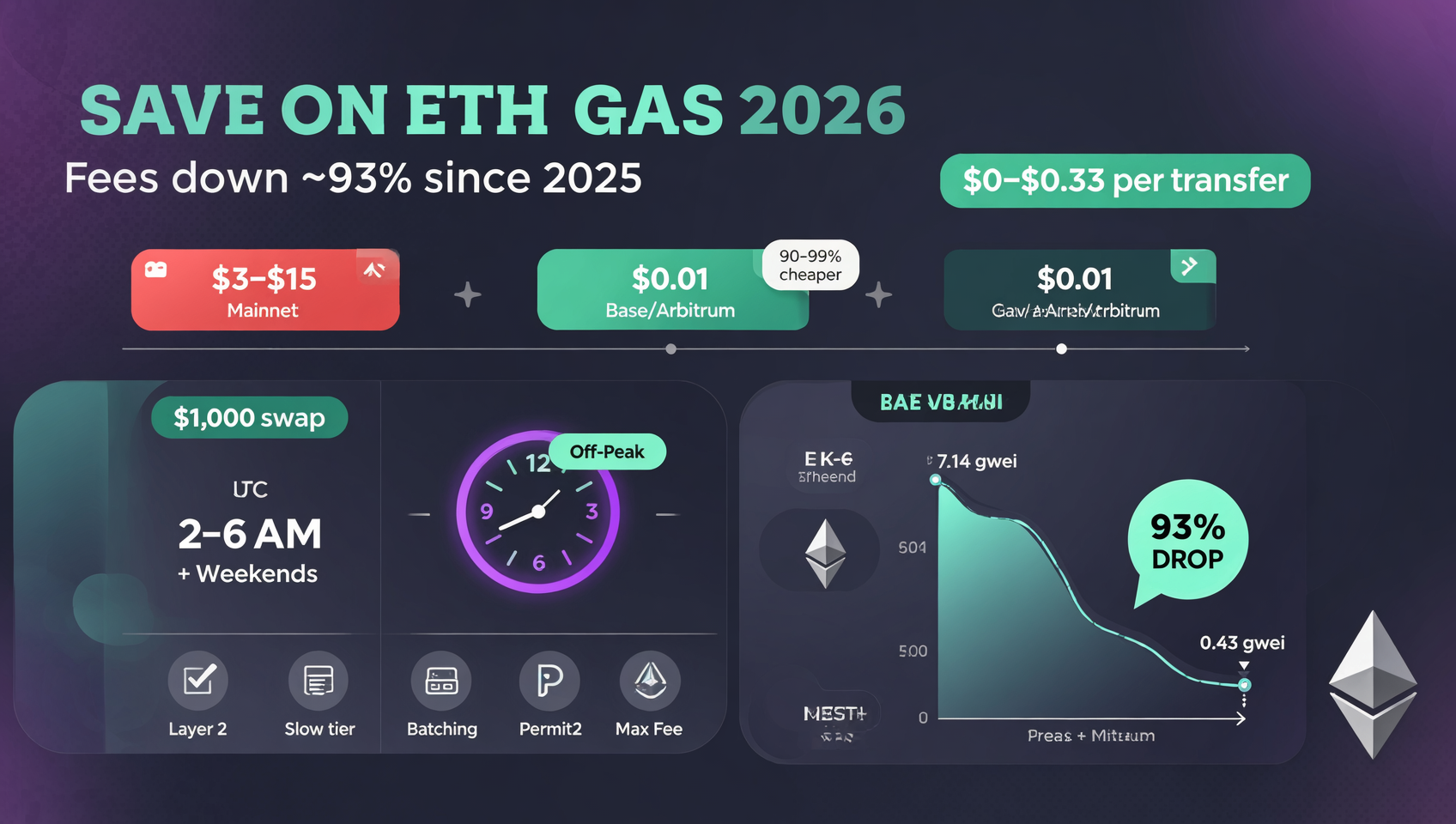
Ethereum gas fees have already fallen to historic lows in 2026, but there is still room to save. Mainnet gas dropped from ~7.14 Gwei in early 2025 to ~0.43-0.50 Gwei in early 2026 (a ~93% decline); a plain transfer now costs $0-$0.33. The most effective combo: move heavy operations to Layer 2 (save 90-99%), transact off-peak (2-6 AM UTC and weekends), and batch operations. Big events (airdrops, NFT launches) can still spike fees instantly — always judge "is it expensive" against a live gas tracker.
The Reality: Gas Fees Are Already Cheap in 2026
Many people's "gas is too expensive" impression dates from the 2021-2022 peak. The 2026 reality is very different:
| Metric | Jan 2025 | Jan 2026 | Change |
|---|---|---|---|
| Mainnet avg gas price | ~7.14 Gwei | ~0.43-0.50 Gwei | ~93% lower |
| Plain ETH transfer | — | $0-$0.33 | Historic low |
| L2 per-transaction fee | — | $0.001-$0.01 | Negligible |
Why fees fell so much:
| Factor | Effect |
|---|---|
| EIP-4844 (Blob fees) | L2 data priced separately, freeing mainnet capacity |
| Pectra / Fusaka upgrades | Higher block capacity and data availability |
| L2s absorb 60-70% of volume | Mainnet congestion sharply reduced |
But note: fees can spike in an instant. Big events (NFT launches, token listings, airdrops, liquidation cascades) can push Gwei from below 1 to above 100 within minutes. Always check live data rather than relying on impressions.1
Mainnet vs Layer 2: Fee Comparison
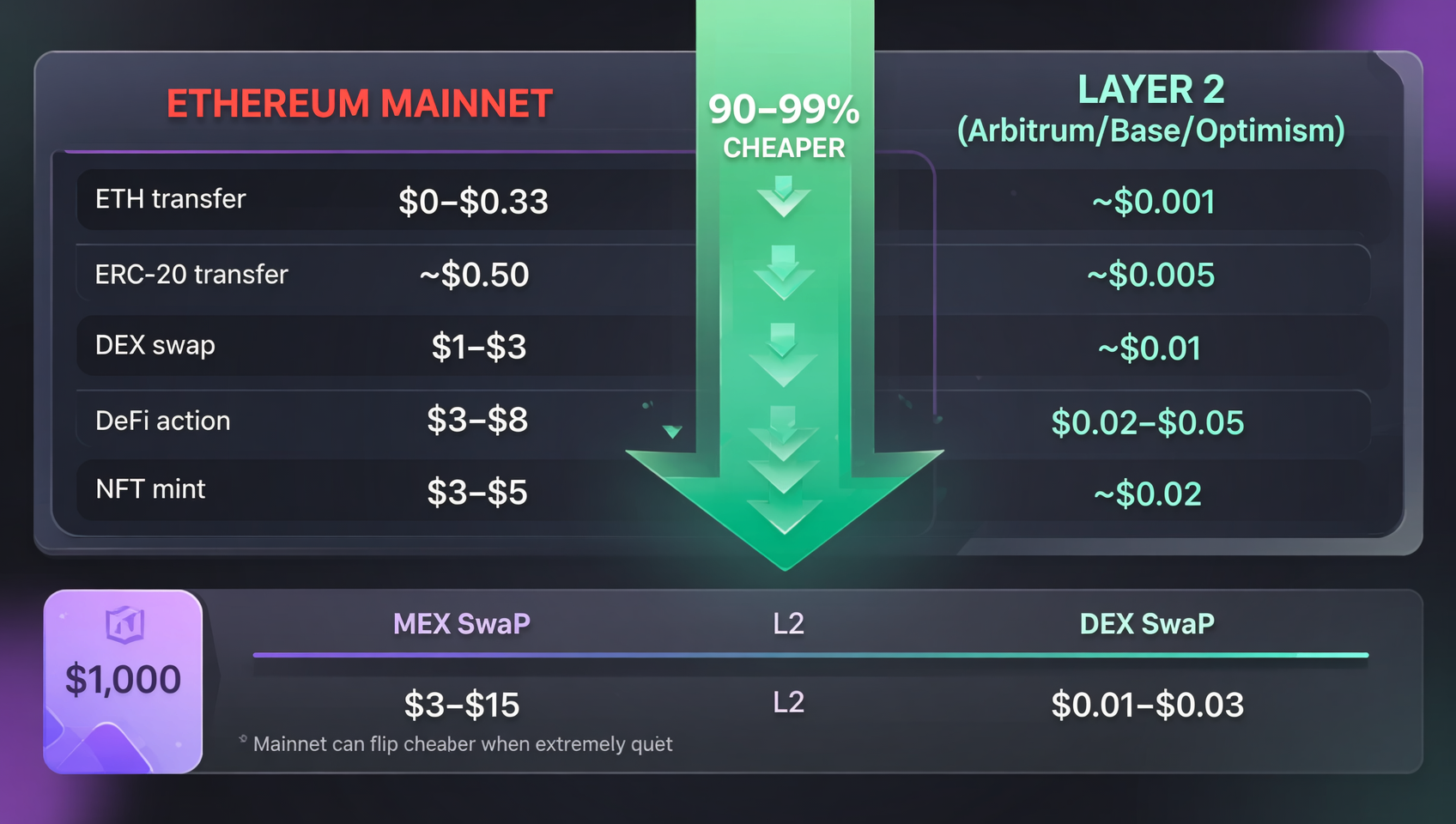
A $1,000 swap (May 2026 data):
| Network | Fee | vs mainnet |
|---|---|---|
| Ethereum mainnet | $3-$15 | Baseline |
| Base | ~$0.01 | ~100-300x cheaper |
| Arbitrum | ~$0.01-$0.03 | ~100-300x cheaper |
| Optimism | ~$0.01-$0.03 | ~100-300x cheaper |
Per-operation costs (Coinpaprika, Jan 2026):
| Operation | Mainnet | L2 | Savings |
|---|---|---|---|
| ETH transfer | $0-$0.33 | ~$0.001 | 90%+ |
| ERC-20 transfer | ~$0.50 | ~$0.005 | ~99% |
| DEX swap | ~$1-$3 | ~$0.01 | ~99% |
| DeFi action | $3-$8 | $0.02-$0.05 | ~99% |
| NFT mint | $3-$5 | ~$0.02 | ~99% |
A fun 2026 reversal: when mainnet is extremely quiet (e.g., a Dec 2026 snapshot), a mainnet transfer (
$0.0017) can be 3-5x cheaper than L2 ($0.0055-0.0079). So for simple transfers compare live; for high-frequency DeFi/swaps, L2 is almost always the answer.2
When to Transact Cheapest: Off-Peak Windows
Fees vary through the day; choosing the right window saves 50-70%:
| Window | Fee level | Advice |
|---|---|---|
| 2-6 AM UTC | 🟢 Lowest | Both US & EU markets offline — best window |
| Weekends (UTC mornings) | 🟢 Low | Sat/Sun mornings especially cheap |
| Weekdays 12-18 UTC | 🔴 Highest | US & EU overlap — avoid (Tue-Thu worst) |
| Event spikes | 🔴 Peak | Airdrops/NFT/token launches — avoid |
Academic research (Jan-Mar 2026) shows peaks cluster at 11-18 UTC, with the single most expensive hour at 15 UTC (10 AM ET), costing ~$0.22 more per transaction than the overnight baseline. The cheapest combination = a weekend, in the early UTC morning.3
How to Check Real-Time Gwei: Tools
| Tool | Feature | Best for |
|---|---|---|
| Etherscan Gas Tracker | Most popular; standard/fast/rapid tiers + history charts | Everyone |
| Blocknative | Mempool-based probabilistic estimates | Advanced users |
| ultrasound.money | Burn rate + base-fee trends | On-chain researchers |
| Wallet (MetaMask etc.) | Estimated fee on the confirm screen | Everyday users |
The "slow/normal/fast" tiers in wallets are computed from roughly the 25/50/75th percentiles of recent block tips — if not in a hurry, pick "slow" and save.4
6 Practical Saving Methods
- Move heavy operations to Layer 2 (most effective): swaps, DeFi, NFT to Arbitrum / Base / Optimism — usually 90-99% cheaper. The one-time bridge cost ($1-15) pays back quickly
- Transact off-peak: 2-6 AM UTC + weekends, 50-70% cheaper than peak
- Pick the "slow" tier: for non-urgent transactions, sharply reduces the priority fee
- Batch operations: combine transfers/approvals into one batch contract, spreading the 21,000-gas fixed cost — per-item costs can drop 40-60%
- Avoid repeated approvals: use approval systems like Permit2 instead of paying an approval fee every time
- Set a sensible Max Fee: don't get packaged at a peak-hour price, but don't set it so low the tx never confirms
In one line: keep high-frequency operations on L2; for low-frequency operations, off-peak + slow tier + batching is the highest-value combo in 2026.5
Common Misconceptions
- ❌ "Gas is always expensive" — in 2026 a mainnet transfer costs under $0.33, and L2 is nearly free
- ❌ "L2 is always cheaper than mainnet" — when mainnet is extremely quiet it can be the reverse; compare live for simple transfers
- ❌ "Set gas very low to save" — too low means a stuck transaction, which costs more time and fees to fix
- ❌ "Peak hours don't matter" — peak is 50-70% more expensive; it adds up over several transactions
FAQ
Q: Are Ethereum gas fees high right now?
In 2026 they are at historic lows. Mainnet gas fell from ~7.14 Gwei (Jan 2025) to ~0.43-0.50 Gwei (Jan 2026, ~93% lower); plain ETH transfers cost $0-$0.33. But big events (airdrops, NFTs, token listings) can push Gwei from below 1 to above 100 in moments — check the live gas tracker.
Q: Which is cheaper, mainnet or Layer 2?
Layer 2 in the vast majority of cases — usually 100-1000x cheaper. A $1,000 swap: Base/Arbitrum ~$0.01-0.03 vs mainnet $3-15. But in 2026, when mainnet is very quiet it can flip (mainnet transfer ~$0.0017 vs L2 ~$0.006); compare live for simple transfers.
Q: When is the cheapest time to transfer?
2-6 AM UTC + weekends (especially Sat/Sun mornings). Avoid weekdays 12-18 UTC (Tue-Thu worst), when US and EU traders overlap and fees run 50-70% higher than the quietest hours.
Q: How do I check real-time Gwei?
Most use Etherscan Gas Tracker (etherscan.io/gastracker), which shows standard/fast/rapid tiers; power users can use Blocknative and ultrasound.money; wallets (MetaMask) show the estimated fee on the confirm screen.
Q: What is the most effective way to save on gas?
Move heavy operations to Layer 2 (90-99% savings) + transact off-peak (2-6 AM UTC + weekends) + batch operations. For simple transfers, compare mainnet vs L2 live.
Q: Why does my low-gas transaction get stuck?
Because your bid is too low for validators to pick up. 2026 fees are low, but congestion or big events raise the bar. Use the wallet's "speed up" feature or wait for fees to fall. Check the tracker's minimum viable rate before setting.
About the Author
CoinVado Research is CoinVado's content research team, focused on blockchain education, on-chain data analysis, and cryptocurrency investment education. We are committed to verifiable data and never fabricate information, helping beginners build sound crypto knowledge.
⚠️ Risk Disclaimer: This article is for educational purposes only and does not constitute investment advice. Gas fees and network conditions change in real time — always rely on authoritative tools (e.g., Etherscan Gas Tracker) for live data. Cryptocurrency markets are extremely volatile; manage your risk.
📚 Continue Learning:
- What is Gwei? Complete Ethereum Gas Fee & Gwei Indicator Guide
- What is Ethereum? Complete Guide 2026
- Ethereum Staking: Complete How-To Guide
Footnotes:
Footnotes
-
Source: Coinpaprika "Ethereum gas fees in 2026"; Etherscan Gas Tracker historical data, 2026 ↩
-
Source: Portals.fi "Cheapest EVM Chain to Swap on 2026"; Coinpaprika L2 fee data, 2026 ↩
-
Source: arXiv "On-chain Peak Shaving" (Jan-Mar 2026 data); Trust Wallet Academy ↩
-
Source: Etherscan Gas Tracker; Ethereum.org wallet gas-estimation docs ↩
-
Source: Coinpaprika L2 savings analysis; Trust Wallet "How to Save Gas Fees on Ethereum," 2026 ↩