


TL;DR Summary
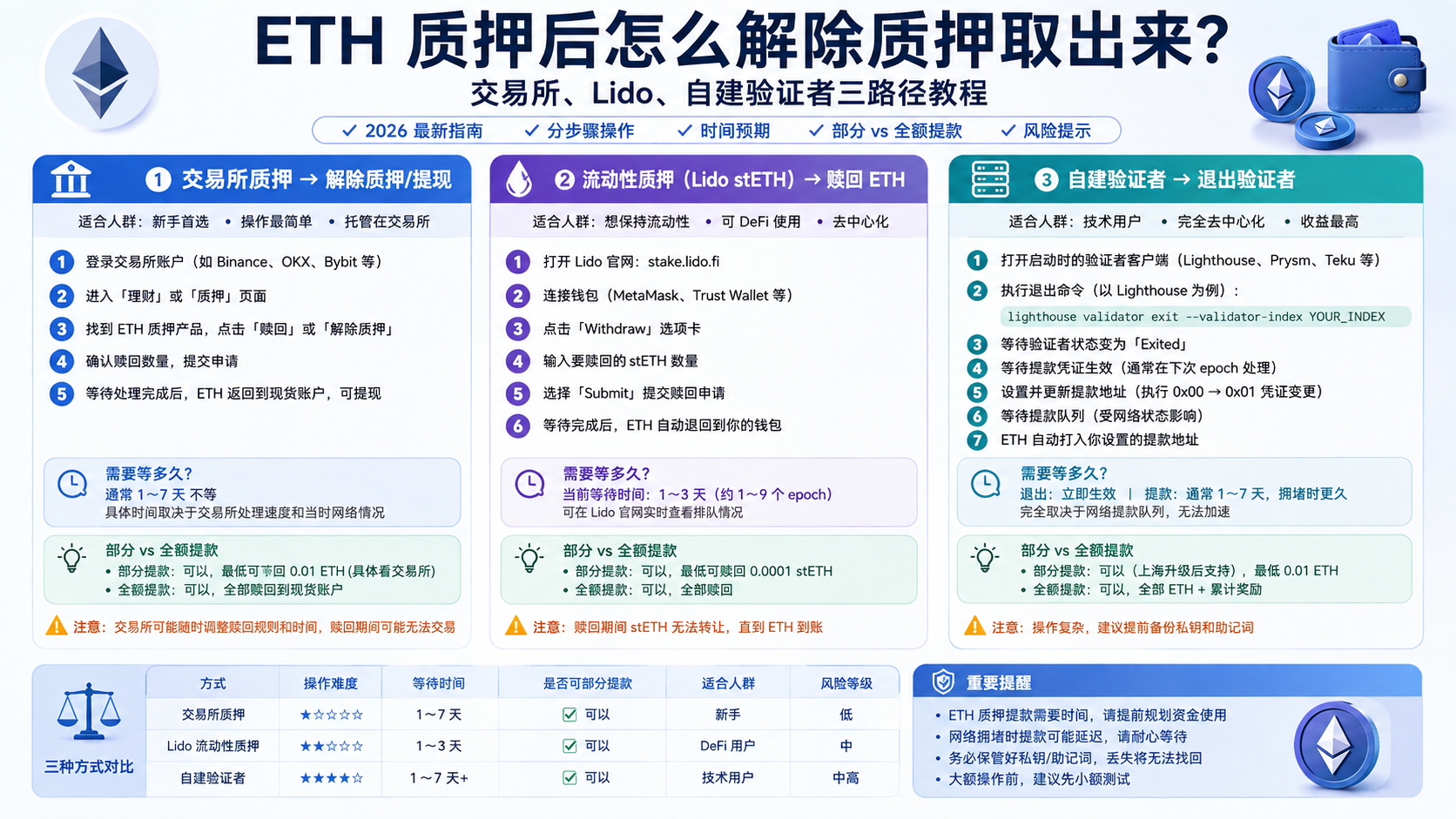
Whether you can unstake your ETH, how, and how long it takes depends entirely on how you staked it. Three paths map to three withdrawal methods: ① Exchange staking (Binance/OKX) → click "Redeem" in the Earn section, usually hours to days; ② Liquid staking (Lido's stETH, etc.) → either swap to ETH on a DEX (instant, rate ≈ 1:1) or use the protocol withdrawal queue (exact 1:1 redemption, about 1–5 days); ③ Solo validator → first exit the validator into the exit queue, then wait for the full withdrawal — the exit queue is essentially zero right now, and it takes about 7–8 days after exiting. Remember two counter-intuitive rules: partial withdrawals (rewards only) are automatic, while a full withdrawal (principal + all rewards) requires you to act, and liquid staking tokens like stETH can always be swapped back to ETH on a DEX, but the price may be slightly below 1:1.
First, Figure Out How You Staked
"Unstaking" isn't one single action — it depends on which route you took when you staked. Staked ETH only became withdrawable after the Ethereum Shapella upgrade (EIP-4895) in April 20231. Before that, your ETH was locked no matter which method you used.
Identify which of these you are:
| How you staked | Your receipt / entry point | How to withdraw |
|---|---|---|
| Exchange staking (Binance/OKX) | The "staking product" in your exchange account | One-click redeem on the platform |
| Liquid staking (Lido's stETH, Rocket Pool's rETH, etc.) | stETH/rETH tokens in your wallet | DEX swap or protocol withdrawal |
| Solo validator (32 ETH minimum) | Your own validator node + keys | Exit validator + on-chain withdrawal |
The most common point of confusion is applying exchange thinking to on-chain staking: when you stake with Lido, you receive stETH — a receipt token that can be bought and sold on decentralized exchanges (DEXs) directly. You don't need to "redeem through a platform." This is the biggest difference between exchange staking and on-chain liquid staking.
Path 1: Exchange Staking → One-Click Redeem
If you staked ETH on an exchange like Binance or OKX, you withdraw it in the same Earn section — no chain interaction, no private keys.
- Open the app or website and go back to the product where you staked (on Binance: "Earn" → "ETH Staking"; on OKX: "Earn" → "ETH Staking");
- Find the "Redeem / Withdraw" entry and enter the amount you want to withdraw;
- Confirm, and the ETH (plus any earned rewards) returns to your spot account.
Timing and caveats: exchanges usually have a redemption waiting period — hours to days, so always check what the product page shows in real time. Some fixed-term staking products have a lock-up period; you may not be able to redeem early, or an early redemption forfeits that period's rewards. Read the "redemption rules / lock-up" on the product page before deciding how much to withdraw. For the full exchange staking flow, see the Ethereum Staking Guide.
Path 2: Liquid Staking (Lido stETH / Rocket Pool rETH) → Swap or Request Withdrawal
The stETH/rETH in your wallet isn't "frozen ETH" — it's a receipt token you can trade directly, which gives you two ways out:
Option A: Swap directly on a DEX (fastest, instant)
- Go to a DEX like Curve or Uniswap, or use the built-in swap in your wallet, and swap stETH for ETH;
- Confirm the transaction and the ETH lands in your wallet immediately.
The tradeoff is the rate isn't exactly 1:1 — stETH normally trades around 0.999–1.001 ETH2, and can deviate further in extreme panic. For small amounts when you want ETH right now, this is the easiest route.
Option B: Protocol withdrawal queue (exact 1:1)
- Go to Lido's official withdrawal page (stake.lido.fi) and submit a withdrawal request; your stETH is burned;
- The system processes requests first-in-first-out, normally completing in about 1–5 days2;
- Claim your ETH once it's ready.
How to choose in one line: swap on a DEX when you want it fast (accept a small rate loss), or queue the withdrawal when you want an exact 1:1 and aren't in a hurry. Rocket Pool's rETH works the same way, with slightly different mechanics.
Path 3: Solo Validator → Exit the Validator + On-Chain Withdrawal
For a solo validator (32 ETH minimum), "getting your ETH out" has two steps: first exit the validator (stop validating), then wait for the full withdrawal.
- Sign a "voluntary exit" message with your validator keys;
- Your validator enters the exit queue. Good news: as of July–August 2026, the exit queue is essentially zero, so initiating an exit takes almost no time3;
- After the exit completes, your ETH is sent to your withdrawal address via the full-withdrawal process, arriving in about 7–8 days3.
⚠️ Two solo-validator-specific reminders: ① the validator must stay online during the exit, or it will incur offline penalties — don't turn off your machine as soon as you exit; ② your withdrawal address must have been set to the 0x01 execution-layer format when you deposited; if it's still the old 0x00 format, you need to perform a "BLSToExecutionChange" first, or the withdrawal won't happen automatically1. For a systematic review of solo-validator prerequisites, see the Ethereum Staking Guide.
Key Concept: Partial vs Full Withdrawals
This is the pair of terms beginners mix up most. In one line: a partial withdrawal only sends the "excess rewards" to you (automatic, no action needed), while a full withdrawal takes out the "32 ETH principal + all rewards" at once (requires you to act).
| Partial withdrawal | Full withdrawal | |
|---|---|---|
| What you get | Rewards above 32 ETH | 32 ETH principal + all rewards |
| Automatic? | ✅ Automatic, no action needed | ❌ Requires you to initiate the exit |
| Validator state | Keeps validating | Exits the validator set |
| Timing | Batched on a network-wide sweep (about a few days per cycle) | About 7–8 days after exit |
What this means in practice: if you just want to "take out the interest and spend it", you don't need to exit your validator — partial withdrawals automatically send rewards to your address. Only when you want to "pull out the principal too and stop staking entirely" do you go through a full withdrawal.
How Long Does Unstaking Actually Take? A Timeline
Here are the three paths' wait times in one table, so you can match your situation:
| Staking method | Withdrawal method | Approximate wait |
|---|---|---|
| Exchange staking | One-click redeem | Hours to days (per platform) |
| Lido stETH | DEX swap | Instant (rate slightly fluctuates) |
| Lido stETH | Protocol withdrawal | About 1–5 days |
| Solo validator | Exit + withdrawal | Exit queue ≈ 0 + about 7–8 days |
Data note: these are typical values as of July–August 2026. Ethereum's exit queue is dynamic — it once backed up to tens of days in September 2025 and has now cleared to near zero3. Always check beaconcha.in or each platform's live figures for the actual wait time.
Before You Unstake, Think Through These Three Things
"Getting it out" isn't the hard part — the hard part is not thinking it through and regretting it after.
- Withdrawn ≠ immediately sellable. After a full withdrawal, your ETH still has to be sent back to an exchange and sold — more fees and more steps. If you want to "cash out", count the full cost of the whole chain.
- Are you still earning rewards while you wait? Partial withdrawals don't stop your validator from earning; but a full exit stops your ETH from earning staking rewards. Before exiting, confirm: "Do I really want to stop earning this roughly 2.6% APR?"4
- Don't confuse "selling stETH at a discount" with "redeeming". If you sell stETH on a DEX at a discount because you need cash, that's selling a receipt — not a 1:1 redemption. Both get you ETH, but the former may lose a bit of the rate.
Conclusion: Remember This One Rule
Whether you can unstake your ETH, how, and how long it takes depends only on how you staked it: one-click redeem on an exchange, swap-or-queue for stETH, or exit-then-withdraw for a solo validator. Identify your path first, then follow the matching steps. When private keys, withdrawal addresses, or exit signatures are involved, only operate on a device and wallet you trust — never hand your private key to anyone.
⚠️ Risk notice: This is Ethereum staking and withdrawal education, not investment advice. Staking, exiting, and withdrawal rules and wait times are subject to live on-chain data and each platform's terms — always verify before acting.
FAQ
Organized by real search habits so you can quickly find your situation.
Can I unstake my ETH at any time?
It depends on how you staked. Exchange staking (Binance/OKX) lets you click "Redeem" in the Earn section, though some products have lock-up periods. Liquid staking (Lido's stETH) can be swapped to ETH on a DEX anytime, or redeemed via the protocol queue in about 1–5 days. Solo validators must first exit the validator, then wait about 7–8 days for the full withdrawal. Staked ETH only became withdrawable after the Shapella upgrade in April 2023.
How long does unstaking ETH take in 2026?
Exchange redemption usually takes hours to days; Lido stETH swaps are instant on a DEX, while protocol withdrawals take about 1–5 days; solo validators wait about 7–8 days after exiting. As of July–August 2026, Ethereum's validator exit queue is essentially zero, so initiating an exit is near-instant — but the full withdrawal still takes about a week after that. Check beaconcha.in and each platform's live figures.
What's the difference between unstaking on an exchange vs Lido?
The key difference is the asset form. With exchange staking, your ETH is locked on the platform, and you withdraw by clicking "Redeem" in the Earn section. With Lido, you receive stETH, a receipt token that can be traded on DEXs — so you can swap it back to ETH anytime (with slight rate fluctuation), or use Lido's withdrawal queue for an exact 1:1 redemption.
What's the difference between partial and full withdrawals?
A partial withdrawal is automatic and only sends the rewards above 32 ETH to your address while the validator keeps validating. A full withdrawal requires you to actively exit the validator and withdraws the entire 32 ETH principal plus all rewards — after which you stop earning staking rewards. Choose partial to only take profits; choose full to exit entirely.
Can I swap stETH back to ETH directly? Will I lose money?
Yes. You can swap stETH for ETH on DEXs like Curve or Uniswap, instantly. The tradeoff is the rate isn't exactly 1:1 — stETH normally trades between 0.999–1.001 ETH, and can deviate more in extreme panic. Use Lido's withdrawal queue for an exact 1:1 redemption; swap on a DEX when you want it fast and accept a small rate difference.
When does my ETH arrive after a solo validator exits?
After exiting the validator, your ETH is sent to your withdrawal address via the full-withdrawal process, usually within about 7–8 days. This requires your withdrawal address to be in the 0x01 execution-layer format; if it's still the old 0x00 format, you must perform a BLSToExecutionChange first, or the withdrawal won't happen automatically. The validator must also stay online during exit or it will be penalized.
About the Author
CoinVado Research is the content research team at CoinVado, focused on blockchain technology education, on-chain data analysis, and crypto investment literacy. We are committed to verifiable, non-fabricated data, helping newcomers build sound crypto knowledge and risk awareness.
⚠️ Risk notice: This is Ethereum staking and withdrawal education, not investment advice. On-chain actions are irreversible, and staking and exiting involve smart contracts and validator rules — always verify before acting and only risk assets you can afford to lose.
📖 Related reading:
- Ethereum Staking Guide 2026 — how to stake ETH for yield (three methods compared)
- Ethereum Complete Guide 2026 — from smart contracts to Layer 2 in one read
- Complete Crypto Wallet Guide 2026 — hot, cold, and exchange wallets compared
- On-Chain Guide (CoinVado) — more on-chain data and crypto education
Disclaimer: This content is for educational purposes only and does not constitute investment advice. Crypto investing carries risk, and ETH staking and exiting still involve price, smart-contract, and liquidity risks — make decisions based on your own circumstances.
Footnotes
-
ethereum.org, "How do Ethereum withdrawals work?" (https://ethereum.org/) — the Shapella upgrade (EIP-4895) activated April 12, 2023, enabling partial and full withdrawals; full withdrawals require 0x01 withdrawal credentials, otherwise a BLSToExecutionChange is needed first. Verified 2026-08-18. ↩ ↩2
-
Lido official withdrawal documentation (https://lido.fi/how-lido-works/withdrawals) — stETH can be redeemed 1:1 via the protocol withdrawal queue (normally about 1–5 days) or swapped on a DEX (rate fluctuates, normally about 0.999–1.001 ETH). Verified 2026-08-18. ↩ ↩2
-
beaconcha.in validator queue data (https://beaconcha.in/) — Ethereum's validator exit queue was essentially zero in July–August 2026 (near-instant exit initiation), with full withdrawals still taking about 7–8 days after exit. Verified 2026-08-18. ↩ ↩2 ↩3
-
beaconcha.in Ethereum staking dashboard (https://beaconcha.in/) — live data on total ETH staked and APR. Verified 2026-08-18: roughly 40 million ETH staked (~33% of circulating supply), APR around 2.6%. ↩