
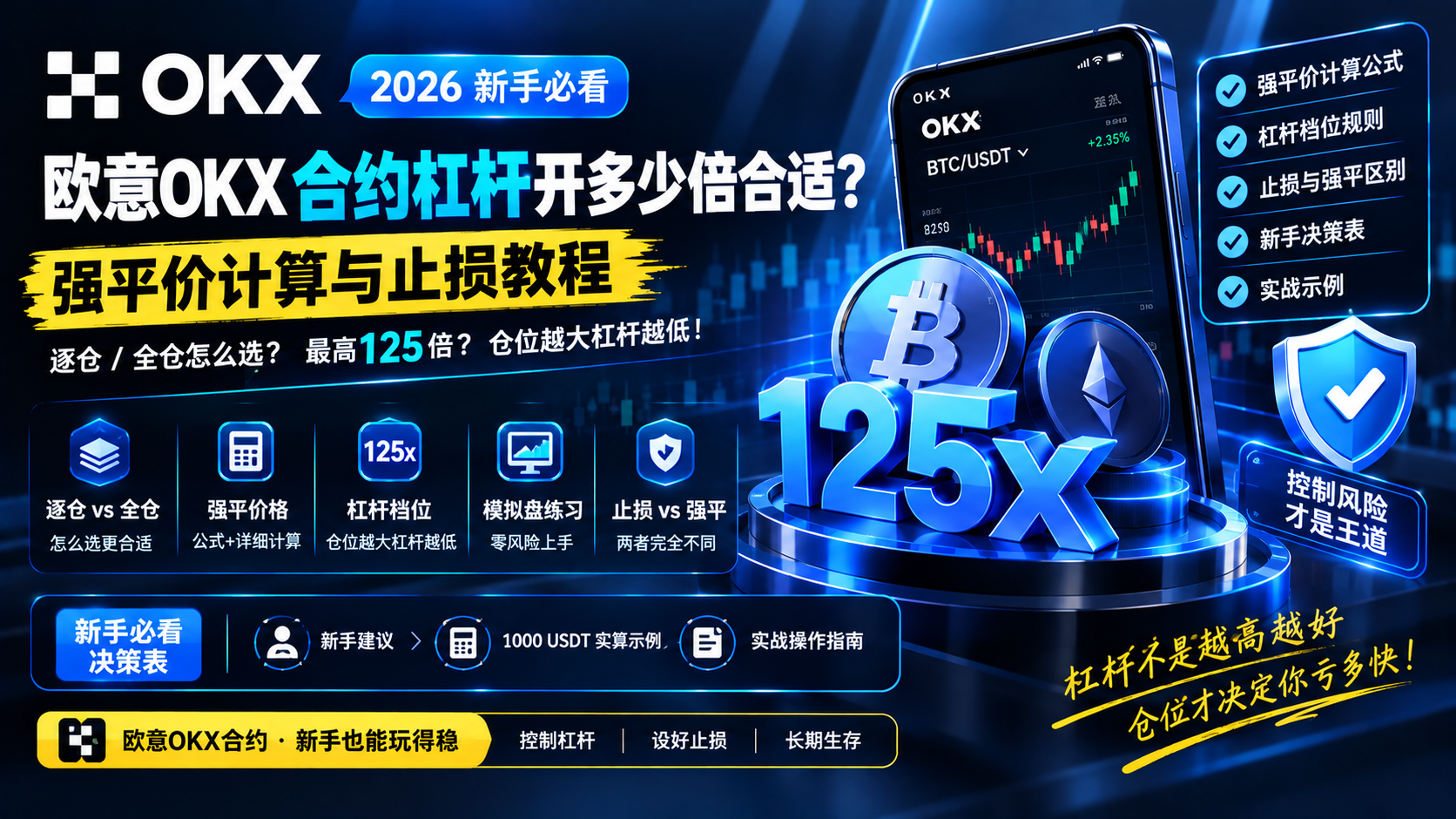
OKX Futures Leverage: How Much Is Right? 2026 Beginner's Liquidation Price Calculation & Stop-Loss Guide
How much leverage should you use on OKX futures? This article explains: how to choose between isolated and cross margin, how to calculate liquidation price (with the correct formula), OKX's maximum 125x leverage but tiered position limits where larger positions get lower leverage, how to practice on demo trading, and why stop-loss and liquidation are two different things. Key conclusion: leverage doesn't determine how fast you lose, position size does. Includes a beginner decision table and a 1,000 USDT worked example.
Table of Contents
- TL;DR One-Sentence Summary
- First, Distinguish Three Terms: Margin, Notional Value, Liquidation Price
- What Leverage Actually Changes: A Table to Understand Liquidation Distance at Each Multiple
- Using 1,000 USDT as an Example: The Difference Between 10x and 5x
- OKX Max 125x, But Larger Positions Get Lower Leverage
- Decision Table: What Leverage Should You Use
- Isolated or Cross Margin: Beginners Default to Isolated
- When Liquidation Actually Happens: OKX's Tiered Liquidation Mechanism
- Stop-Loss ≠ No Liquidation, Practice on Demo First
- 5 Most Common Beginner Mistakes
- FAQ Frequently Asked Questions
- Summary: Remember This One Sentence
TL;DR One-Sentence Summary
Conclusion first: Beginners should use 1-5x leverage, isolated margin, keep single-trade notional position under 20% of total account funds, and set stop-loss before the liquidation price. Because the leverage knob doesn't control "how fast you earn" but "how far you are from liquidation": at 10x leverage, a price move of about 9.5% against you triggers liquidation; at 20x, only about 4.3%; at 50x, only about 1%. And what determines how fast you lose is never leverage, but the notional value of the position—for the same 10,000 USDT position, a 3% drop means a 300 USDT loss, regardless of the leverage used. One point most tutorials don't emphasize: OKX perpetuals support up to 125x leverage1, but the larger the position, the higher the tier, and the lower the allowed leverage—for beginners, this is actually protection.
First, Distinguish Three Terms: Margin, Notional Value, Liquidation Price
What truly determines risk in leveraged trading is "notional value," not the leverage multiple itself. The relationship between the three terms in one sentence:
Notional Value = Margin × Leverage Multiple
Liquidation Price = The mark price at which losses consume the margin until only the "maintenance margin" remains
- Margin: The actual money you put up for this position. Opening 10x with 1,000 USDT means the margin used is 1,000.
- Notional Value: The actual position size you control. 1,000 × 10x = a 10,000 USDT position. A 3% price drop means a loss of 3% of the notional value, i.e., 300 USDT.
- Liquidation Price: The price at which losses consume the margin until only the "maintenance margin" remains. At this point, the exchange forcibly closes your position, commonly known as liquidation.
Once you distinguish these three terms, the following conclusions become natural: High leverage = using the same capital to control a larger notional value = liquidation price is closer to you. The root of risk is notional value; leverage only determines how much margin you use to carry that notional value.
What Leverage Actually Changes: A Table to Understand Liquidation Distance at Each Multiple
Every time leverage doubles, your liquidation distance halves. Below is a key comparison table. The rough estimate column uses the simplest formula "liquidation distance ≈ 100% ÷ leverage multiple"; the actual liquidation point is even closer because OKX's first-tier maintenance margin rate is about 0.5%, plus fees and funding costs2 (the following are simplified values for isolated margin, one-way long, ignoring fees, with an entry price of 100,000 as a convenient assumption):
| Leverage | 1,000 USDT Margin Can Open | Rough Estimate: Adverse Move of 1/Leverage Wipes Out Margin | Actual Liquidation Distance (Including ~0.5% Maintenance Margin Rate) |
|---|---|---|---|
| 2x | 2,000 USDT | 50% | ≈ 49.5% |
| 3x | 3,000 USDT | 33.3% | ≈ 32.8% |
| 5x | 5,000 USDT | 20% | ≈ 19.5% |
| 10x | 10,000 USDT | 10% | ≈ 9.5% |
| 20x | 20,000 USDT | 5% | ≈ 4.3% |
| 25x | 25,000 USDT | 4% | ≈ 3.3% |
| 50x | 50,000 USDT | 2% | ≈ 1% |
| 100x | 100,000 USDT | 1% | ≈ 0.5% |
| 125x | 125,000 USDT | 0.8% | ≈ 0.3% |
Two key points:
- The "actual liquidation distance" is always slightly closer than the rough estimate. The rough formula treats 1/leverage as the line of death, but the real rule is: liquidation triggers when losses reduce margin to only the "maintenance margin," and with fees and funding costs, the real liquidation point is even earlier. The "estimated liquidation price" shown on the order page is the accurate number.
- Tiers above 50x have no practical meaning for small accounts. A liquidation distance of 1% or less means a one-minute spike can wipe you out, leaving you no time to react.
Correct liquidation price formula (isolated margin, single coin, ignoring fees):
Long liquidation price = Entry price × (1 − 1/leverage + maintenance margin rate)
Short liquidation price = Entry price × (1 + 1/leverage − maintenance margin rate)
Using 1,000 USDT as an Example: The Difference Between 10x and 5x
For the same notional position, different leverage multiples mean exactly the same speed of losing money; the only difference is the liquidation price location. This is the most valuable sentence in this article, calculated directly for you:
Method A: 10x leverage, open a 10,000 USDT notional long
- Margin used: 1,000 USDT (assuming BTC price 100,000, equivalent to buying 0.1 BTC)
- 3% drop (to 97,000): loss of 300 USDT, margin remaining 700
- ~9.5% drop (to 90,500): liquidation
Method B: 5x leverage, same 10,000 USDT notional long
- Margin used: 2,000 USDT
- 3% drop (to 97,000): loss of 300 USDT, margin remaining 1,700
- ~19.5% drop (to 80,500): liquidation
See the difference? At a 3% drop, both methods lose 300 USDT, not a cent more or less. What 5x gives you over 10x is not "slower losses" but moving the liquidation price from 90,500 to 80,500—you pay an extra 1,000 USDT margin to buy a wider survival space.
The reverse also holds: if you use 10x but only open 5,000 USDT notional (margin 500), a 3% drop only loses 150—it's much safer than opening 5x with 20,000 USDT notional (3% drop loses 600). So remember: "low leverage + large position" can absolutely be more dangerous than "high leverage + small position." To judge risk, always first look at the notional value as a proportion of your account, then check whether the liquidation distance can withstand the coin's normal volatility.
OKX Max 125x, But Larger Positions Get Lower Leverage
OKX implements a "tiered maintenance margin rate system" (tiered position system): the larger the notional value of the position, the higher the tier, the higher the maintenance margin rate, and the lower the maximum allowed leverage. This is to prevent large positions from impacting market liquidity during liquidation13. Three official facts:
First, the maximum leverage is 125x, but not all coins can offer it. Perpetual contracts for major coins like BTC and ETH support up to 125x; some products like X contracts max out at 10x. The circulating claims of "OKX max 20x/50x" are outdated or specific to certain coins.
Second, tiers are determined by the notional value of the position, not account balance. In isolated margin mode, each contract and each direction is calculated separately for contracts and tier; in cross margin mode, all positions of the same coin are combined. The larger the position, the higher the tier, and the higher the maintenance margin rate.
Third, the maintenance margin rate increases with tier. OKX's first-tier maintenance margin rate is about 0.5%, and higher tiers are higher. This is also why the "actual liquidation distance" in the table is closer than the rough estimate—the higher the tier, the thicker that "buffer cushion."
💡 One sentence to understand tiered positions: Small positions can use high leverage, large positions can only use low leverage. This is not a restriction, it's protection—if a large position used high leverage, liquidation would dump massive sell orders.
Decision Table: What Leverage Should You Use
There is no "most suitable multiple," only a multiple that matches your position, timeframe, and discipline. Find your situation:
| Your Situation | Suggested Leverage | Additional Conditions | Rationale |
|---|---|---|---|
| First time with futures, learning the process | 1-3x | Isolated margin; notional ≤ 20% of account; use money you can afford to lose | Goal is to learn mechanics, not to profit |
| Spot holder, short-term swing | 3-5x | Isolated margin; notional ≤ 30% of account; must have stop-loss | Normal swing retracements are ±5-10%, liquidation line must be outside the volatility range |
| Want to hedge spot holdings | 1-2x | Short; position corresponds to hedge ratio | Purpose is to lock risk, not amplify returns |
| Disciplined day trader | 5-10x | Isolated margin; single-trade risk ≤ 1-2% of account | Stop-loss must be before liquidation price |
| Betting on short-term hotspots, spike markets | Above 10x | Notional ≤ 10% of account; accept possible liquidation anytime | Very small margin for error, not recommended for beginners |
| Want to win back losses with high leverage | Not suitable | —— | Leverage amplifies results, doesn't fix bad judgment |
In one sentence: The leverage you use depends on how short a distance you're willing to let the market "shake you out." A liquidation line too close is a math problem; not being able to hold a position is a mindset problem—solve the math problem first.
Isolated or Cross Margin: Beginners Default to Isolated
Isolated margin caps the maximum loss of a single trade at the margin allocated to that position; beginners should default to it. The real difference between the two is "how far the damage spreads when things go wrong":
| Comparison | Isolated Margin | Cross Margin |
|---|---|---|
| Margin source | Only the money allocated to this position | Entire account balance shared |
| Maximum loss | Until that position's margin reaches zero | Theoretically can drag down the entire account |
| Volatility resistance | Weak (liquidation price closer) | Strong (liquidation price farther) |
| Suitable for | Beginners, trial and error, single-trade strategies | Mature strategies, hedge portfolios |
The reason beginners should choose isolated margin is simple: it gives you a physical cap when you forget to set a stop-loss—even if you forget, losses are capped at that margin. Cross margin has a farther liquidation price, but the cost is that one misjudgment can affect the entire account.
There's also an easily overlooked official rule: On OKX, adjusting leverage only affects new positions; existing positions must be closed and reopened to apply new leverage; and when the price is less than 2% from the liquidation price, the system prohibits raising leverage above 20x2. So decide your leverage before opening an isolated position—if you want to adjust after opening, you can only reopen.
When Liquidation Actually Happens: OKX's Tiered Liquidation Mechanism
Liquidation is triggered by the mark price, first partially reducing the position, then cycling down tiers—it doesn't wipe everything out at once. OKX's liquidation mechanism has several details beginners don't know23:
- It uses the mark price, not the last traded price. The mark price is a weighted average of the index price and recent trade prices, preventing a single exchange's spike from wrongly liquidating you.
- The trigger line is "maintenance margin rate ≤ 100%." In isolated margin mode, when the maintenance margin rate ≤ 300%, the system issues a reduction warning; ≤ 100% triggers forced reduction/liquidation.
- Tiered liquidation, not a one-click wipe. Large positions are first partially reduced to a lower tier; if after reduction the new tier requirements are still not met, the cycle continues until they are. For example, a 110 BTC position in tier 2 (tier 2 cap 100 BTC) would first reduce 10 to move to tier 1, rather than liquidating everything.
- Liquidation incurs a liquidation fee + liquidation penalty. When liquidated, you pay the Taker fee for the current tier plus an additional liquidation penalty to cover slippage and bankruptcy losses—much more expensive than closing manually.
Stop-Loss ≠ No Liquidation, Practice on Demo First
Setting a stop-loss does not guarantee you won't be liquidated. Stop-loss and liquidation are two independent mechanisms2: a stop-loss is an order you place to close a position; liquidation is forced closure by the platform when the maintenance margin rate reaches 100%. If the price spikes violently, the stop-loss order doesn't fill, or slippage is large, liquidation may trigger before the stop-loss.
So the correct approach is:
- Set the stop-loss before the liquidation price, keeping the decision to close in your own hands rather than the liquidation engine's;
- Don't set the stop-loss too close to the liquidation price, otherwise during violent volatility liquidation will beat the stop-loss;
- Beginners should practice on a demo account first. OKX offers demo trading (testnet) where you can place orders, set stop-losses, and experience liquidation with virtual funds in real market conditions, without risking real money.
To first understand the difference between spot and futures, see What's the Difference Between Spot and Futures; for order placement details, see OKX Spot and Futures Trading Complete Guide.
5 Most Common Beginner Mistakes
- Treating leverage as a return multiplier. 10x leverage is not "earn 10x faster," it's "liquidation is about 10x closer." How much you earn is determined by notional value and direction; leverage only determines whether you survive to that moment.
- Using low leverage with a large position. 3x on the full account is far more dangerous than 10x on 10% of the account. Risk depends on the notional value as a proportion of the account, not the multiple itself.
- Not setting a stop-loss, only watching the liquidation price. The liquidation price is the last line of defense, not a target. Stop-loss should be before the liquidation price, keeping the decision to close in your own hands.
- Ignoring the continuous drain of funding fees and trading fees. Perpetual contract funding rate settlement cycles are not fixed (8/4/2/1 hours); long-term holding repeatedly pays funding fees that continuously eat into margin, making the actual liquidation point earlier than estimated. To reduce fee costs, see OKX Rebate and Invitation Code Guide.
- Wanting to adjust leverage after opening an isolated position. On OKX, adjusting leverage only affects new positions; after opening an isolated position, to lower leverage you must close and reopen—decide before opening.
FAQ Frequently Asked Questions
What is the maximum leverage on OKX futures?
OKX perpetual futures support up to 125x leverage (limits vary by coin; major coins like BTC and ETH support higher multiples, while some products like X contracts max out at 10x). However, the actual maximum available leverage is limited by position tiers: the larger the notional value of the position, the higher the tier, and the lower the allowed leverage. Always refer to OKX's official tier table for real-time limits.
What is the most suitable leverage for OKX futures?
There is no fixed number; it depends on position size and stop-loss discipline. Beginners are advised to use 1-5x, isolated margin, and keep single-trade notional position under 20% of the account. Swing traders with stop-loss discipline can use 3-5x. Core principle: leverage determines the distance to liquidation, notional position determines how fast you lose money—evaluate them separately.
How much does the price need to drop to liquidate a 10x leverage position on OKX?
Roughly 10% (100% ÷ 10), but actual liquidation triggers at around 9.5%. Because the first-tier maintenance margin rate is about 0.5%, liquidation occurs when losses eat into the margin until only the maintenance margin remains, so the real liquidation point is slightly closer than the rough estimate. Always refer to the 'estimated liquidation price' shown on the order page.
Should I choose isolated or cross margin?
Beginners should choose isolated margin, which caps losses at the margin allocated to that position. Cross margin has a farther liquidation price and stronger resistance to volatility, but a mistake in one position can affect the entire account balance. Note that on OKX, adjusting leverage only affects new positions; existing positions must be closed and reopened to apply new leverage, so decide your leverage before opening.
Does setting a stop-loss guarantee I won't get liquidated?
No. Stop-loss and liquidation are two independent mechanisms. A stop-loss is an order you place to close a position; liquidation is forced closure by the platform when the maintenance margin rate ≤ 100%. If the price spikes violently, the stop-loss order doesn't fill, or slippage is large, liquidation may trigger before the stop-loss. So don't treat stop-loss as liquidation insurance—the key is low leverage + position management.
Does OKX have a demo account for practice?
Yes. OKX offers a demo trading (testnet) feature where you can practice placing orders, setting stop-losses, and experiencing liquidation with virtual funds in real market conditions, without risking real money. Beginners are advised to first familiarize themselves with isolated/cross margin, liquidation price display, and take-profit/stop-loss on the demo account before trading with real funds.
Summary: Remember This One Sentence
Leverage determines how far you are from liquidation, position size determines how fast you lose—beginners should use 1-5x, isolated margin, notional value not exceeding 20% of the account, and set stop-loss before the liquidation price; no matter how fancy the numbers, they can't replace position management.
Fill in the prerequisite knowledge in order: first see What's the Difference Between Spot and Futures to decide whether to touch futures, then see OKX Spot and Futures Trading Complete Guide to learn order placement, and finally come back to this article to set your leverage. No account yet? Register on OKX with invitation code 60895497.
Transparency statement: The registration link in this article is CoinVado's referral link. Registering through the link does not increase your costs; we may receive a commission from the platform to maintain the website.
No OKX account yet? Register on OKX (invitation code: 60895497), for registration, KYC, and first deposit process see OKX Registration Complete Guide. You can also use Binance (invitation code: BINANBT); both support futures trading.
📚 Further Reading: On-Chain Guide —— A free tutorial site for learning blockchain and on-chain data from scratch.
Disclaimer: This content is for learning reference only and does not constitute investment advice. Futures trading involves leverage and is far riskier than spot, potentially leading to total loss of principal. Please make decisions carefully based on your own situation.
Footnotes
-
OKX official "What is the Leverage Gradient Maintenance Margin System" (https://www.okx.com/zh-hant/help/what-is-the-leverage-gradient-maintenance-margin-system): OKX implements a tiered maintenance margin rate (tiered position) system; the larger the notional value of the position, the higher the tier, the higher the maintenance margin rate, and the lower the maximum available leverage; perpetual contracts support up to 125x, subject to each contract's tier table. Verified 2026-09-13. ↩ ↩2
-
OKX official "How to Calculate Futures Liquidation Price? What Are the Conditions for Liquidation?" (https://www.okx.com/zh-hans-ae/help/how-to-calculate-the-price-what-are-the-conditions-for-strong-flat): Liquidation is based on the mark price; isolated margin maintenance margin rate ≤ 300% warning, ≤ 100% triggers liquidation; liquidation charges Taker fees and a liquidation penalty; stop-loss and liquidation are independent mechanisms; adjusting leverage only affects new positions, and when less than 2% from the liquidation price, raising leverage above 20x is prohibited; funding rate settlement cycles can be 8/4/2/1 hours. The "actual liquidation distance" column in this article is simplified based on a first-tier maintenance margin rate of about 0.5%, ignoring fees. Verified 2026-09-13. ↩ ↩2 ↩3 ↩4
-
OKX official "Liquidation and Forced Closure System" (https://www.okx.com/zh-hans-au/help/v-tiered-maintenance-margin-ratio-rules): OKX uses a tiered reduction algorithm; large positions are first partially reduced to a lower tier, cycling until tier requirements are met, rather than liquidating everything at once. Verified 2026-09-13. ↩ ↩2