


TL;DR
- OKX options are European-style, on BTC/ETH/SOL underlyings: buyers can only exercise at expiry (but can close early), in-the-money options auto-settle at expiry, out-of-the-money options expire worthless, trading runs 24/7
- Buying options is not a high-risk gamble — it's a loss-limiting tool: a buyer's maximum loss is locked at the premium at entry, with no liquidation and no margin calls — a fundamental difference from futures
- Beginners should only buy: use Simple mode to buy calls or puts, treat the premium as an insurance premium you can afford to lose entirely, and start with no more than 5% of your funds
1. What are OKX options?
An option is a contract that lets you "pay a fee now to buy the right to buy or sell an asset at an agreed price later". You pay a premium to obtain the right — but note, a right, not an obligation — to buy or sell the underlying at a strike price on the expiry date, and you can always choose not to exercise.
OKX options are European-style with four core elements:
| Element | Meaning | OKX's actual rules |
|---|---|---|
| Underlying | What the option tracks | BTC/USD, ETH/USD, SOL/USD index |
| Expiry date | When the right expires | Daily, next-day, weekly, monthly, quarterly and more |
| Strike price | The agreed buy/sell price | Your choice — determines how expensive the option is |
| Premium | What you pay to buy the option | The market quote; the buyer's maximum loss |
One counter-intuitive point: OKX options settle in the coin, not USDT. A BTC option settles in BTC, an ETH option in ETH. This means you need to hold the relevant coin in your account first (or enable multi-currency mode) — many first-timers get stuck here.
Contract naming is intuitive once you know the format:
BTCUSD-20261030-120000-C
| Segment | Meaning |
|---|---|
| BTCUSD | Underlying: BTC/USD index |
| 20261030 | Expiry: 2026-10-30 |
| 120000 | Strike price 120,000 |
| C | Type: C = Call, P = Put |
Who are OKX options for?
| User type | Suitable? | Why |
|---|---|---|
| Beginners betting on direction with small cost | ✅ Yes | Loss locked at the premium, no liquidation |
| Spot holders hedging downside risk | ✅ Very much | Buy puts as "insurance" against declines |
| Traders chasing high-leverage short-term moves | ⚠️ No | Options aren't a leverage tool; gains are still bounded |
| Buy-and-hold accumulators who don't want new concepts | ❌ No | DCA into spot is simpler |
2. Spot, futures, options: which tool to choose
Beginners most often confuse the boundaries between these three. The core difference isn't "leverage size" but the shape of the P&L curve:
| Dimension | Spot | Futures (perpetual) | Options (buying) |
|---|---|---|---|
| Maximum loss | Full principal (coin to zero) | Liquidation, total loss, possibly worse | The premium (fixed at entry) |
| Can it liquidate? | No | Yes | No |
| P&L structure | Up = gain, down = loss (linear) | Gains/losses amplified by leverage (linear) | Right direction amplifies, wrong direction loses only premium (non-linear) |
| Need to watch the market? | No | Yes (liquidation risk) | Buyer: no, just hold to expiry |
| Analogy | Holding the asset | Borrowing to amplify moves | Buying loss-limited "insurance" |
Three sentences to remember:
- Spot is "I buy 1 BTC, it stays 1 BTC" — one-to-one, can't lose more than you hold.
- Futures is "I bet BTC rises, wrong direction = liquidation" — leverage amplifies both gains and losses.
- Options (buy) is "I spend $200 to buy a right; if it rises I profit, if it falls I lose at most $200" — loss is capped, upside isn't.
This leads to a key conclusion: for beginners who fear losing everything, buying options has a lower downside floor than high-leverage futures. A 10x futures position liquidates on a 10% adverse move, whereas buying options at most loses the known premium even if the market goes against you.
3. Buying vs selling options: fully asymmetric risk
Every options market has two sides: the buyer (Long) and the seller (Short). Their risk is asymmetric — the first thing to understand:
| Buyer (Long) | Seller (Short) | |
|---|---|---|
| Profit | Theoretically unlimited (amplified in the right direction) | Capped — at most the premium received |
| Loss | Capped — at most the full premium | Potentially large or unlimited |
| Margin | Not required | Required, and may be topped up |
| Liquidation risk | None | Yes |
| Suited for | Beginners, directional bets, hedging | Experienced traders, market makers |
The buyer is like buying insurance: pay a fixed premium; if things go against you, you lose at most the premium; if they go your way, you collect the payout.
The seller is like running an insurance company: collect the premium first, but if a claim happens (being assigned) you must pay out — potentially far more than the premium collected.
⚠️ The most important safety conclusion in this article: beginners should only be buyers, never sellers. OKX's Simple mode is designed exactly for this — it's buy-only, isolating you from the unlimited-risk side. Only consider selling after you fully understand seller margin and assignment mechanics.
4. How to buy OKX options: 6 steps in Simple mode
OKX offers three ways to trade options: Simple mode (beginners, buy-only), Options Chain (professional T-quote), and RFQ (institutional large orders, minimum $10,000, not available in the app). Beginners start with Simple mode:
Step 1: Sign up and verify
If you don't have an OKX account, register via the official OKX referral link (the code fills automatically for a fee discount) and complete Level 2 verification to unlock options.
Step 2: Transfer funds to your trading account
Options settle in the underlying coin. Buy or deposit the relevant coin (e.g. BTC for BTC options) into your funding account, then transfer to your trading account. Simple mode shows quotes priced in USDT, but settlement is still in the coin — make sure you hold enough.
Step 3: Enter options Simple mode
Find "Options" under the "Trade" tab and choose Simple Mode on first entry. The interface presents direction-based choices instead of a professional T-quote, making it beginner-friendly.
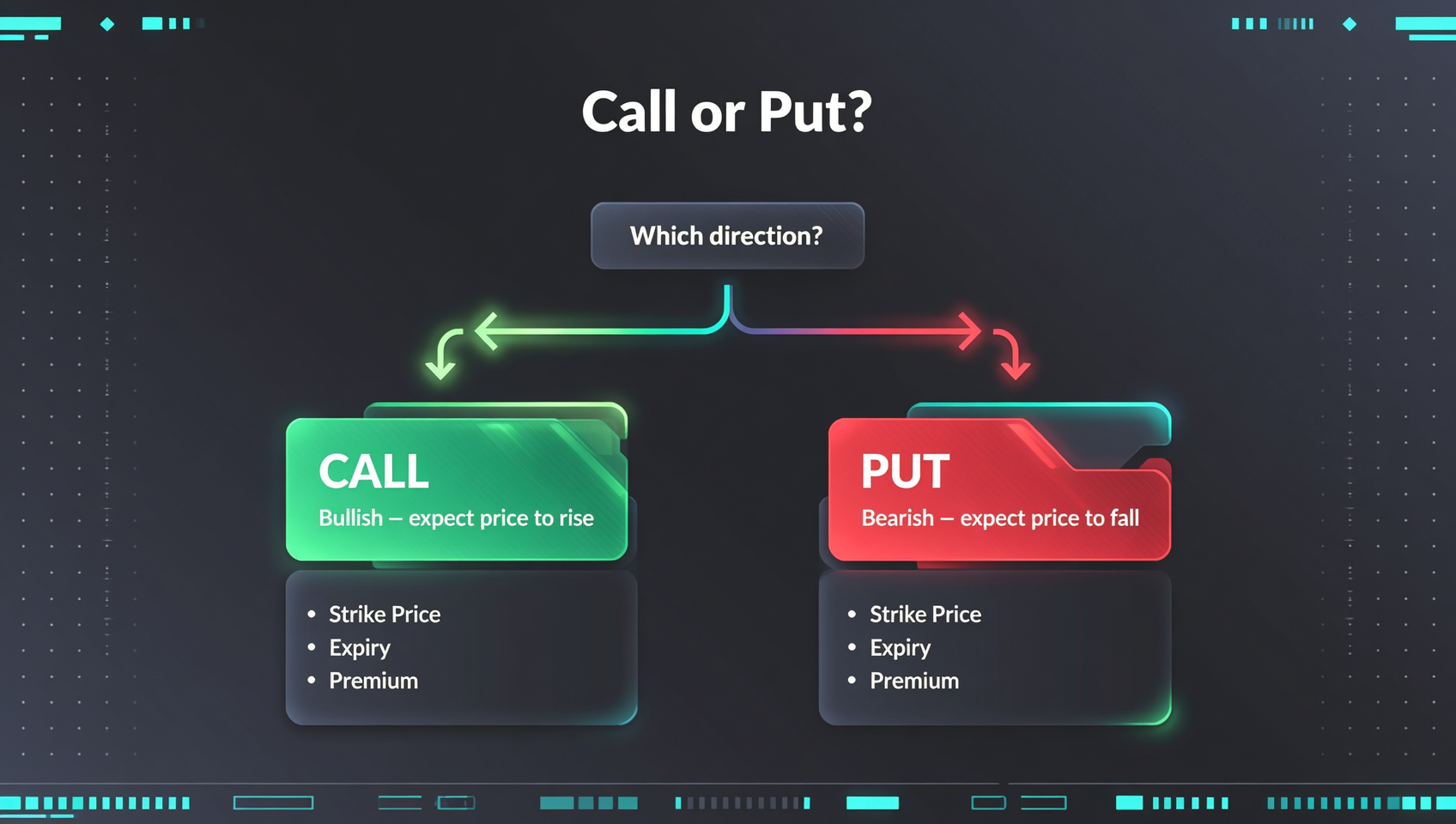 OKX options Simple mode — underlying, expiry and call/put direction selection
Step 4: Choose the underlying and expiry
Pick the underlying (BTC/ETH/SOL) → pick the expiry. Key principles:
- Nearer expiries are cheaper, but time value (Theta) decays faster — you can lose even when your direction is right
- Further expiries cost more, but give you more time to be right
- Beginners should start with a weekly or monthly expiry to avoid rapid intraday decay
Step 5: Pick call or put and set a budget
Decide your direction: bullish picks Call, bearish picks Put. After choosing the strike, the interface shows each option's premium. Set a "maximum I can afford to lose" budget first (e.g. 100–200 USDT worth of BTC), then work backward to how many contracts — never bet everything on one direction.
Step 6: Place the order and hold or close early
Confirm the premium and place your order. After buying:
- To take profit or cut loss: close anytime before expiry under "My Options"
- To hold to expiry: in-the-money options auto-settle at 16:00 HKT on the expiry day, out-of-the-money options expire worthless
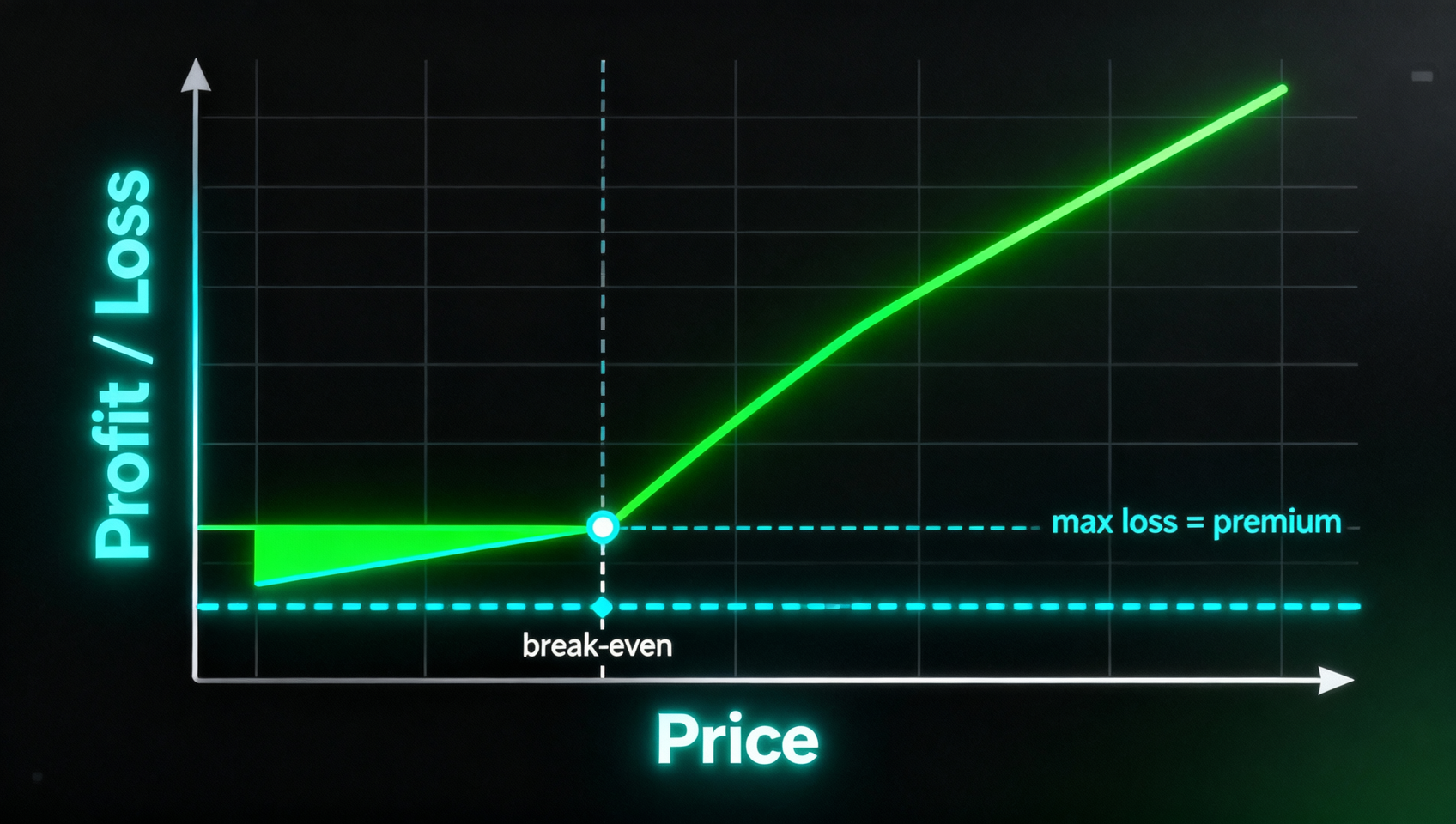 OKX options profit/loss diagram — buyer's maximum loss is the premium, upside is theoretically uncapped
5. How are OKX options fees calculated?
Options fees are simpler than futures fees, in two parts:
| Fee | When charged | Rate (approx.) |
|---|---|---|
| Transaction fee | On open and close | ~0.03% (maker/taker) |
| Exercise settlement fee | Only on in-the-money auto-exercise | ~0.015% |
Three key points:
- Capped: the transaction fee is capped at 7% of that option's premium, so deep out-of-the-money options with tiny premiums get proportionally tiny fees
- Daily options are exempt from the settlement fee — only auto-exercised in-the-money options pay it
- Calculated on the premium, not notional value: this usually makes options fees far lower in absolute terms than same-direction high-leverage futures
Quick estimate: if you pay a 0.05 BTC premium for one BTC option, at a 0.03% transaction fee the per-contract fee is roughly 0.05 × 0.03% = 0.000015 BTC (a few dollars), well below the 7% cap (0.0035 BTC). Exact rates are under "My trading fees" and vary with account tier and OKB holdings.
6. When to use options: three real scenarios
Options aren't a must-learn for everyone, but in these three scenarios they beat spot and futures:
Scenario 1: Bet on direction with small cost (directional speculation)
You expect BTC to rise from $120k to $150k in a month but don't want futures liquidation risk. Buy a one-month Call with, say, a 0.03 BTC premium — your maximum loss is that premium, yet you capture the full move if it happens. Loss is capped, upside follows the market — certainty futures can't give you.
Scenario 2: Buy "downside insurance" for your spot position (hedging)
You hold 2 BTC and worry about a short-term crash but don't want to sell. Buy a few Puts — it's like insuring your position: if BTC falls, the Puts offset some spot loss; if BTC rises, you only lose a small premium. This is the most classic and practical spot + options combination.
Scenario 3: A loss-limited directional bet instead of high-leverage shorts
To express a bearish view without the risk of a short squeeze, buying Puts is safer than shorting futures — a short has theoretically unlimited loss (price can rise infinitely), while a bought Put at most loses the premium.
Conversely, when not to use options: if you just want to accumulate long-term, buy spot and DCA. If you need high-frequency short-term trading and high leverage, options' time decay and premium cost work against you.
7. Risk warning: options aren't a sure-profit tool
Buying options "caps the loss", but that doesn't mean "easy to profit". Stay clear-eyed on these:
- Capped loss ≠ low probability of loss: buying options is a race against time. Even if your direction is right, if the market doesn't reach past the strike before expiry, the premium still goes to zero. Deep out-of-the-money options are "cheap" but also likely to expire worthless
- Time value keeps decaying: option value declines as expiry approaches (Theta) — even if the underlying stays flat, your premium slowly shrinks
- Coin-settlement FX risk: BTC options settle in BTC; if BTC itself is falling, your "BTC-denominated" P&L must be converted back to fiat to see the real picture
- Liquidity differences: some far-dated / deep out-of-the-money options have thin order books and wider spreads than spot or perpetuals
- Never sell options: stay in buy-only Simple mode until you fully understand seller mechanics
FAQ
Q: What's the difference between OKX options and futures?
The biggest difference is the P&L structure, not leverage. Futures have linear P&L — wrong direction can liquidate the whole position. Options are non-linear — the buyer's max loss is locked at the premium, with no liquidation. Futures are a "direction amplifier"; buying options is "paying a fixed cost for loss-limited insurance".
Q: How much do I need to buy OKX options?
Simple mode has no minimum — a few dozen dollars of BTC/ETH can buy a deep out-of-the-money option. But each contract has a multiplier (0.01 BTC, 0.1 ETH), so final premium = quote × multiplier. Start with under 5% of total funds, roughly 100–500 USDT equivalent, treating it as money you can afford to lose entirely.
Q: Are OKX options American or European? How do they settle?
OKX options are European-style — buyers exercise only at expiry, but can close on the market anytime before. At expiry, in-the-money options auto-settle and out-of-the-money options expire worthless. Settlement is at 16:00 HKT on the expiry day — unlike American options, which can be exercised anytime.
Q: Can buying OKX options liquidate me?
Simply buying options cannot liquidate you — the buyer's maximum loss is the premium. What can be liquidated is selling options, where the seller faces potentially large or unlimited loss. Beginners should stay in Simple mode and only buy.
Q: How are OKX options fees calculated?
Two parts: a transaction fee (open and close, ~0.03%, capped at 7% of premium) and an exercise settlement fee (only in-the-money auto-exercise, ~0.015%; daily options exempt). Fees are calculated on the premium, not notional value — see "My trading fees" for exact rates.
Q: Should a beginner buy or sell options?
Beginners should only buy, never sell. Buying has limited risk (the premium); selling is "limited income, potentially unlimited loss". OKX's Simple mode is buy-only for exactly this reason. Learn to buy calls/puts and understand the P&L curve first.
Summary: start your first option with an "insurance premium" mindset
OKX options are one of the few crypto tools with predictable downside. The whole idea in one sentence: treat it as buying insurance, not adding leverage.
- ✅ Sign up for OKX — verify with a referral code and unlock options
- ✅ Enter Simple mode, buy-only
- ✅ Pick your direction: bullish = Call, bearish = Put
- ✅ Set a budget you can afford to lose, under 5% of funds
- ✅ Hold to expiry or close early, accepting the premium may go to zero
💡 Want to understand futures vs spot first? Options are the "advanced piece" built on those two — start with the OKX spot & futures guide before coming back. If you already have a Binance account, you can also use the Binance referral link to diversify across platforms.
📚 Further Reading:
- OKX Spot & Futures Trading Guide — master spot and futures before options
- OKX Futures Leverage: How Much Is Right? — the full logic of leverage and liquidation
- OKX 2026 Complete Review — platform security and fees
- Trading Fees Explained: Maker vs Taker — the general fee framework
- On-Chain Guide — blockchain and on-chain data basics
Disclaimer: this article is for educational purposes only and is not investment advice. Options trading carries risk of total premium loss, time-value decay and thin liquidity, and selling options can lead to large or unlimited losses. Crypto markets are highly volatile — decide according to your own risk tolerance and follow your local laws.
Footnotes: