



TL;DR: The Bottom Line
A "Bitcoin treasury" means the same thing across the board: more companies, governments, and funds now buy Bitcoin as a reserve asset and hold it long-term instead of treating it as a speculation. By 2026, these institutions collectively hold millions of BTC and have become one of the largest buying forces outside retail and miners.
The five most important facts:
- One company holds roughly 4% of all Bitcoin. Strategy (formerly MicroStrategy) holds about 848,000 BTC — about 70% of all public-company holdings, and more than 19x the second-largest holder1.
- About 151 public companies collectively hold ~1.17 million BTC, with miners (MARA, Riot, CleanSpark) accumulating through a "mine and hold" strategy2.
- The US government holds ~200,000 BTC in its strategic reserve, almost all from law-enforcement seizures (Silk Road, Bitfinex), and it neither actively buys nor sells on a schedule3.
- Spot Bitcoin ETFs are the largest "compliant" on-ramp for institutions: about 1.57 million BTC (~7.5% of supply), with BlackRock's IBIT alone holding ~786,000 BTC4.
- Don't blindly copy the trade. In 2026, pure treasury companies actually fell (Strategy -40%, Metaplanet -49%) while miners outperformed — because capital structure, cost basis, and time horizon are completely different5.
Here's the full picture of who's buying Bitcoin, why, and what it means for you.
Table of Contents
- First, separate the three types of Bitcoin holders
- At a glance: who's buying Bitcoin in 2026
- Strategy (MicroStrategy): one company holds 4% of all Bitcoin
- Why miners "mine and hold": MARA, Riot, CleanSpark
- Asia's Strategy: Metaplanet targets 210,000 BTC
- The US strategic reserve: 200,000 seized Bitcoin
- Spot Bitcoin ETFs: the compliant on-ramp
- Why do these institutions buy Bitcoin?
- What it means for you: should you copy them?
- How to track Bitcoin treasuries yourself
- FAQ
- Further Reading
First, separate the three types of Bitcoin holders
News about "companies buying Bitcoin" often blurs three very different types of holders. Before analyzing anything, separate them:
- Governments (sovereign reserves) — the US holds ~200,000 BTC, sourced from seizures, treated as a strategic reserve with no short-term return target.
- Public companies (corporate treasuries) — Strategy, Metaplanet, and miners treat Bitcoin as a balance-sheet reserve asset, funding purchases through debt, share issuance, or mining.
- Funds (spot ETFs) — BlackRock's IBIT and Fidelity's FBTC hold Bitcoin on behalf of clients; the largest holders, but backed by countless investors.
The biggest difference is where the money comes from and why they hold: governments use seized coins, companies use shareholder and creditor capital, and ETFs use client subscriptions. Once you understand this, you'll stop confusing "the US government bought Bitcoin" with "Strategy bought Bitcoin."
At a glance: who's buying Bitcoin in 2026
Stack the three types together for a full view of who's buying (mid-2026 figures; trackers differ slightly in methodology):
| Holder | Type | Holdings | Notes |
|---|---|---|---|
| Strategy (MSTR) | Public company | ~848,000 BTC | Largest globally, ~70% of public-company holdings1 |
| US strategic reserve | Government | ~200,000 BTC | From seizures; holds without active buying3 |
| Spot ETFs total | Funds | ~1.57 million BTC | ~7.5% of supply; BlackRock IBIT is largest4 |
| Public companies total | Companies | ~1.17 million BTC | Across ~151 companies2 |
| Metaplanet (Japan) | Public company | ~43,000 BTC | Largest in Asia; 100,000 BTC target by end-20266 |
| MARA / Riot / CleanSpark | Miners | ~36,000 / 15,000 / 14,000 BTC | "Mine and hold," accumulating at cost2 |
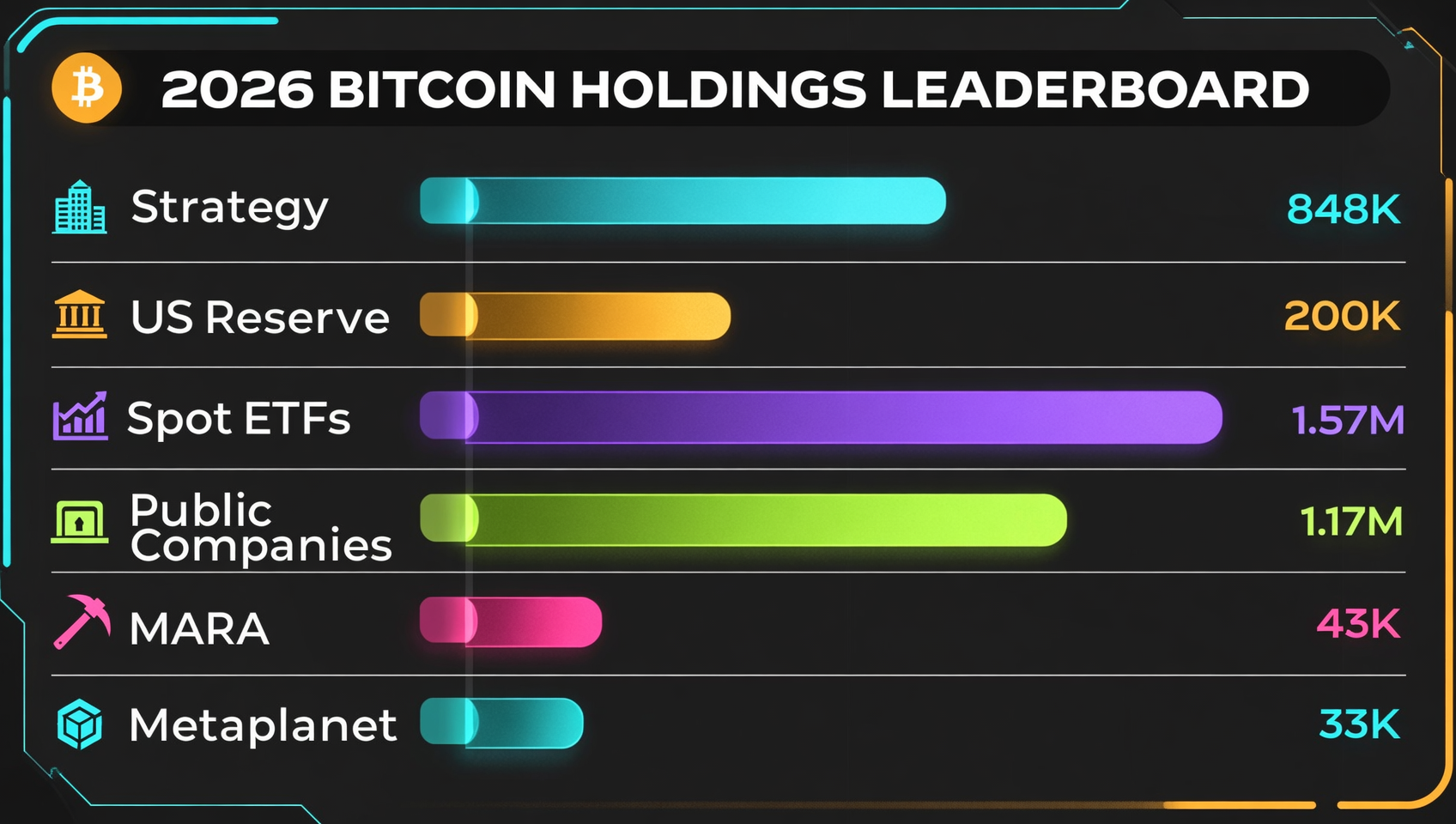
One-line summary of this table: ETFs hold the most (retail and institutional money), Strategy and miners are the most committed hodlers, and the government is the most misread — it simply keeps the coins it already seized.
Strategy (MicroStrategy): one company holds 4% of all Bitcoin
Strategy (formerly MicroStrategy, ticker MSTR) is the largest and most extreme "Bitcoin treasury" company. As of October 2026 it holds about 848,000 BTC — worth roughly $73 billion at a BTC price around $86,000 — with a cumulative investment of about $64 billion at an average cost of roughly $75,000 per coin1.
It does something almost no traditional public company does: it funnels money raised through debt and share issuance into Bitcoin, and holds it long-term. Founder Michael Saylor's thesis is that "the dollar will debase, and Bitcoin is a better reserve asset." The strategy turned the software company into a "Bitcoin proxy stock" — MSTR's price tracks BTC closely.
But in 2026 it also broke its "never sell" promise: it sold 32 BTC in May to fund preferred-stock dividends, then sold 3,588 BTC between late June and early July for about $216 million to meet stock-related obligations and shore up cash1. This shows that even the most committed hodler will sell under capital pressure — "holding" is never unconditional; the health of the capital structure and cash flow is what matters.
Why miners "mine and hold": MARA, Riot, CleanSpark
Bitcoin miners are another kind of "natural hodler." Their logic differs from Strategy's: mining produces Bitcoin at a cost usually below market price, so instead of selling to pay bills in fiat, they keep it and wait for appreciation.
The three large public miners (mid-2026): MARA ~36,000 BTC, Riot ~15,000 BTC, CleanSpark ~14,000 BTC2. Since 2024 they've broadly shifted to "mine and hold," keeping most mined coins in the company wallet rather than selling on exchanges.
A striking 2026 contrast: miners outperformed pure treasury companies. Through 2026, MARA rose about 31%, Riot about 73%, and CleanSpark about 39% year-to-date, while Strategy fell about 40%5. The reason: miners have real cash flow (mining revenue) and business flexibility (they can pivot to AI-compute hosting), while pure treasury companies depend on capital markets to fund purchases — so when share prices and coin prices fall together, their funding chain tightens.
Asia's Strategy: Metaplanet targets 210,000 BTC
Japan's Metaplanet is often called "Asia's MicroStrategy." It pivoted to a Bitcoin-treasury strategy in 2024 and holds about 43,000 BTC as of mid-2026, making it the largest public-company holder in Asia and third-largest globally6.
Its playbook is nearly identical to Strategy's: issue zero-interest bonds and shares, then convert the proceeds into Bitcoin. Metaplanet has also announced aggressive targets: 100,000 BTC by end-2026 and 210,000 BTC by end-2027 (about 1% of total Bitcoin supply)6.
Again, note the 2026 reality: Metaplanet's stock fell about 49% at one point during the year5. Announcing targets is easy; surviving volatility is hard — the damage a treasury strategy does to a company's stock in a bear market is far bigger than most retail investors expect.
The US strategic reserve: 200,000 seized Bitcoin
This is the most misread part. The US "Strategic Bitcoin Reserve" of about 200,000 BTC (roughly 207,000 BTC) comes almost entirely from law-enforcement seizures — including the Silk Road takedown and the Bitfinex hack recovery3.
In March 2025, a Trump executive order converted coins the government previously "seized and auctioned" into a strategic reserve, turning the government from a periodic seller into a structural holder. This removed the selling pressure created by auction policies and was read as a long-term bullish signal.
But remember the key conclusion: the US government currently does not actively buy Bitcoin on the open market — it simply keeps the coins it seized. So if you see headlines like "the US will buy 1 million Bitcoin," distinguish between "seized coins" and "congressionally-funded active purchases" — as of mid-2026, active purchases have not happened3.
Spot Bitcoin ETFs: the compliant on-ramp
If the question is "who holds the most Bitcoin," the answer is spot ETFs. As of 2026, global Bitcoin spot ETFs collectively hold about 1.57 million BTC, or roughly 7.5% of circulating supply4.
The largest is BlackRock's iShares Bitcoin Trust (IBIT) at ~786,000 BTC, followed by Fidelity's FBTC (~176,000 BTC) and Grayscale Mini (~63,000 BTC)4.
For ordinary institutions (pensions, family offices, corporate treasuries), ETFs are the lowest-friction "compliant" way to buy Bitcoin — no self-custody or cold wallet needed; you just buy IBIT shares like a stock. ETF net inflows are therefore often read as a real-time gauge of whether institutional money is still entering. To learn how regular investors can buy via ETF or an exchange, see Further Reading.
Why do these institutions buy Bitcoin?
Stack the motivations together and you'll see three distinct "buy theses":
- Hedge against fiat debasement — Strategy and Metaplanet's core narrative is "the dollar/yen will debase long-term, and Bitcoin's fixed 21-million supply makes it a better store of value." This is the most common hodling rationale.
- Cost arbitrage — miners' logic is "mining cost is below market price," so holding locks in that cost advantage while capturing upside.
- Compliant allocation demand — behind ETFs is "clients want Bitcoin exposure but can't or won't self-custody," so funds provide the compliant tool.
Note that none of these is "buying because it will go up." Institutional treasury decisions run on multi-year horizons and ask "will this money still hold value in ten years," not "will it be up tomorrow." That's why companies like Strategy often keep buying even during sharp short-term dips.
What it means for you: should you copy them?
This is what most readers actually want to know: "If companies are buying, should I buy too?" My judgment: treat it as a long-term signal, not as a trading instruction to copy.
Three reasons:
- Capital structure is completely different. Strategy can raise near-unlimited money through debt and share issuance and keep buying through a 50% drawdown; you only have your own money and may be forced to sell on the way down.
- Cost basis is completely different. Miners' cost basis is mining cost (usually far below market), while yours is buying at spot — they aren't the same thing.
- 2026 already gave the answer. Pure treasury companies sharply underperformed (Strategy -40%, Metaplanet -49%), showing that "holding Bitcoin" does not automatically equal "making money" in the stock market5.
A decision table:
| Your situation | How to read this signal | Why |
|---|---|---|
| Gauging Bitcoin's long-term value | Worth watching: persistent institutional accumulation signals strengthening long-term consensus | Institutional money is "long money"; actions speak louder than slogans |
| Wanting to day-trade on it | Don't: institutional holdings change on a monthly/quarterly scale, not intraday | Time-horizon mismatch |
| Wanting to diversify long-term | Consider it, but only with spare cash, dollar-cost averaging, and a loss you can afford | Institutions ride volatility; retail must size positions |
| Wanting to go all-in chasing the top | Not advised: even Strategy sold under pressure; retail won't hold up | Neither cash flow nor psychology supports it |
One-line summary: institutional accumulation proves the "Bitcoin as a reserve asset" narrative is materializing, but it does not tell you how much to buy right now.
How to track Bitcoin treasuries yourself
To follow "who's hoarding Bitcoin" yourself, these free tools are enough:
- bitcointreasuries.net — the most popular public-company holdings leaderboard, showing each company's BTC count, cost, and share of total2.
- Bitcoin Magazine's Bitcoin Treasuries page — a one-stop overview of company + ETF + government holdings.
- Company quarterly reports / 8-K filings — the most original and accurate primary source, if you can read filings.
- ETF official holdings pages (such as BlackRock's IBIT) — daily holdings and net inflows.
One reminder: different trackers use different methodologies and update times, so you may find different numbers for the same company (Strategy shows both 843,000 and 848,000 BTC across sources). Use official filings for decisions; treat trackers as snapshots.
FAQ
Which public companies hold Bitcoin?
As of mid-2026, roughly 151 public companies collectively hold about 1.17 million BTC. The largest is Strategy (~848,000 BTC, ~70% of the total), followed by Twenty One Capital and Metaplanet (~43,000 BTC each), MARA (~36,000 BTC), Bullish, Strive, SpaceX, Coinbase, Riot, and CleanSpark. Miners broadly "mine and hold."
What does a Bitcoin treasury mean?
It means a company or institution buys Bitcoin as a reserve asset and holds it on its balance sheet long-term, rather than trading it short-term. The classic example is Strategy, which since 2020 has raised money through debt and share issuance to buy Bitcoin as a hedge against fiat debasement. The trend has shifted from a speculative bet to a balance-sheet staple for some companies.
How much Bitcoin does the US government hold?
The US strategic reserve holds about 200,000 BTC (roughly 207,000 BTC), mostly from law-enforcement seizures (Silk Road, Bitfinex). A March 2025 executive order converted them into a strategic reserve. The government only holds seized coins — it neither actively buys on the open market nor sells on a schedule.
How much Bitcoin do spot ETFs hold?
As of 2026, global Bitcoin spot ETFs collectively hold about 1.57 million BTC (~$128.6 billion, ~7.5% of supply). The largest is BlackRock IBIT (~786,000 BTC), followed by Fidelity FBTC (~176,000 BTC) and Grayscale Mini (~63,000 BTC).
Is it a good idea to copy what public companies do and buy Bitcoin?
Copying them outright is not recommended. Companies raise capital through debt and share issuance and can ride out long drawdowns, while retail investors use their own money and may be forced to sell in a crash. In 2026, pure treasury companies fell (Strategy -40%, Metaplanet -49%) while miners outperformed. Treat it as a long-term signal, not a trading instruction.
Where can I check corporate Bitcoin holdings?
The most popular tracker is bitcointreasuries.net, along with Bitcoin Magazine's Bitcoin Treasuries page, company quarterly reports and 8-K filings, and ETF holdings pages such as BlackRock's IBIT. Holdings change with the market, so judge using official filings.
Further Reading
- Bitcoin Spot ETF Guide: Brokers, Channels, and How to Invest — how to hold Bitcoin compliantly through an ETF
- How to Buy Bitcoin: Binance/OKX Beginner Guide — the first step to buying spot directly on an exchange
- How to Make Money with Bitcoin: 6 Ways — hodling is just one way; see the other five
- Bitcoin Cold Storage: Safely Self-Custody Your Coins — must-read for long-term hodlers
- Best Bitcoin Wallets 2026 Comparison — which wallet to self-custody with
- On-Chain Guide — more blockchain fundamentals and on-chain tutorials
Recommended exchanges: To buy spot Bitcoin for long-term holding, use Register on Binance (code BINANBT — the deepest spot liquidity; registering doesn't increase your cost). For futures or diversification, Register on OKX (code 60895497).
Data verification note: Strategy's holdings (~848,000 BTC, ~$64 billion cost, ~$75,000 average), the public-company Top 10, the US strategic reserve (~200,000 BTC), spot ETF holdings (~1.57 million BTC, IBIT ~786,000 BTC), and the year-to-date stock moves of miners and treasury companies were all verified on 2026-10-18 from the sources in footnotes1–6. Different trackers use different methodologies and update times, so treat these figures as point-in-time snapshots and rely on company filings and official announcements for decisions.
This is not investment advice. Cryptocurrency prices are highly volatile, and the holdings data cited comes from third-party trackers and may differ by methodology or lag. It is provided for informational purposes only and is not an endorsement of any company, token, or platform, or a recommendation to buy or sell. Make your own independent judgment and comply with local laws and regulations.
Footnotes
-
Strategy (formerly MicroStrategy) holdings: ~848,000 BTC as of October 2026, worth ~$73 billion at ~$86,000/BTC, ~$64 billion cumulative investment at ~$75,000 average; first sales in 2026 (32 BTC in May + 3,588 BTC in June–July for ~$216 million). Sources: KuCoin "Top 10 Publicly Traded Companies by Bitcoin Holdings as of July 2026," Cryptoast, Incrypted (queried Oct 2026). ↩ ↩2 ↩3 ↩4 ↩5
-
Public-company holdings: ~151 companies holding ~1.17 million BTC; Top 10 (2026-07-25, bitcointreasuries.net): Strategy 843,775; Twenty One Capital 43,514; Metaplanet 43,000; MARA 36,303; Bullish 24,300; Strive 19,921; SpaceX 18,712; Coinbase 16,492; Riot 15,680; CleanSpark 13,924. Sources: bitcointreasuries.net, KuCoin/CoinMarketCap republications (queried Oct 2026). ↩ ↩2 ↩3 ↩4 ↩5
-
US strategic reserve: ~207,000 BTC from Silk Road, Bitfinex, and other seizures; March 2025 executive order converted them into a reserve, hold-only with no active buying. Sources: BYDFi, CalculatorIQ Bitcoin Strategic Reserve Tracker 2026 (queried Oct 2026). ↩ ↩2 ↩3 ↩4
-
Spot ETF holdings:
1.57 million BTC ($128.6 billion, ~7.5% of supply); BlackRock IBIT ~786,000 BTC, Fidelity FBTC ~176,000 BTC, Grayscale Mini ~63,000 BTC. Sources: TokenPost "BTC institutional tracker," Followin (14 consecutive days of net inflows), 2026 (queried Oct 2026). ↩ ↩2 ↩3 ↩4 -
2026 stock performance: miners MARA +31%, Riot +73%, CleanSpark +39% (YTD); treasury companies Strategy -40%, Metaplanet -49%, Twenty One Capital -48%, Bullish -37% (YTD). Sources: KuCoin/CoinMarketCap July 2026 roundup (queried Oct 2026). ↩ ↩2 ↩3 ↩4
-
Metaplanet:
43,000 BTC as of mid-2026, largest in Asia and third globally; targets 100,000 BTC by end-2026 and 210,000 BTC by end-2027; bought 5,075 BTC ($398 million) in Q1 2026. Sources: KuCoin, Cryptoast, 2026 (queried Oct 2026). ↩ ↩2 ↩3 ↩4