


Table of Contents
- TL;DR: The Verdict First
- The Decision Table: Match Yourself in 30 Seconds
- The 2026 Numbers Side by Side
- The Trap Most Comparisons Miss: They've Become Different Species
- Deposit Rates, Calculated: What $1,000 and $10,000 Earn
- The Design Divide: Pooled Liquidity vs Isolated Markets
- Safety: The 2026 Kelp Event Was a Real Stress Test
- Roadmaps: Aave V4 Cross-Chain vs Compound's Institutional Pivot
- Practical Paths: Three Playbooks
- FAQ
- Further Reading
TL;DR: The Verdict First
Retail users who want yield, deep liquidity and the fullest feature set → Aave. People or institutions who want isolated single-asset markets and more conservative risk controls → Compound. But that sentence hides the most important point: "Aave vs Compound" in 2026 is no longer a close contest — Aave's TVL is ~$17.7B versus Compound's ~$1.5B, a ~12x gap. They've diverged into two different product shapes, and most comparisons still use 2021 data to treat them as interchangeable.
Three judgments that carry the argument:
- The size gap is an order of magnitude. As of mid-2026, Aave holds ~$17.7B TVL (total deposits ~$30B) versus Compound's ~$1.5B1. Aave has over 60% of the DeFi lending market and crossed $1 trillion in cumulative lending volume in Q1 20262.
- The designs have split. Aave is "pooled liquidity + cross-chain V4," fully loaded (flash loans, eMode, rate switching); Compound V3 is an "isolated single-asset market" that trades features for more conservative risk control3.
- Safety isn't about who is stronger — it's about exposure surface. In April 2026 the Kelp DAO bridge was hacked; Aave absorbed ~$190M in bad debt (backstopped by Umbrella — no depositor losses), while Compound froze markets and recorded zero bad debt4. That real stress test shows: Aave is strong but exposed, Compound is stable but limited.
⚠️ This article compares tools, not investment advice. DeFi lending has no FDIC-style deposit insurance — your money is secured by smart contracts, and the risk is yours to manage. Never put more than you can afford to lose into DeFi.
Who this article is NOT for: complete beginners who've never used an on-chain wallet. If that's you, start with our What Is DeFi guide and come back.
The Decision Table: Match Yourself in 30 Seconds
| Your situation | Pick | Why |
|---|---|---|
| Just want to deposit USDC and earn yield | Aave | Slightly higher rate, deepest liquidity, most chains, stable-rate option |
| Want a minimal, conservative pool | Compound V3 | Isolated single-asset markets, wider liquidation buffer, more conservative |
| Institutional / compliance-first, RWA assets | Compound | $52M pivot to institutions in 2026, opened a USDC institutional market |
| Arbitrage, liquidations, flash-loan power user | Aave | Flash loans + eMode + multi-asset pools, the fullest toolkit |
| Borrow stablecoins against ETH (leverage) | Check LTV | Aave eMode hits 97% LTV on correlated assets; Compound has a wider buffer |
| Multi-chain player (Arbitrum/Base/Avalanche…) | Aave | 21 chains, V4 cross-chain liquidity |
| Need fiat on-ramp to buy USDC/ETH | CEX first | Buy on Binance/OKX, then withdraw to your wallet — see below |
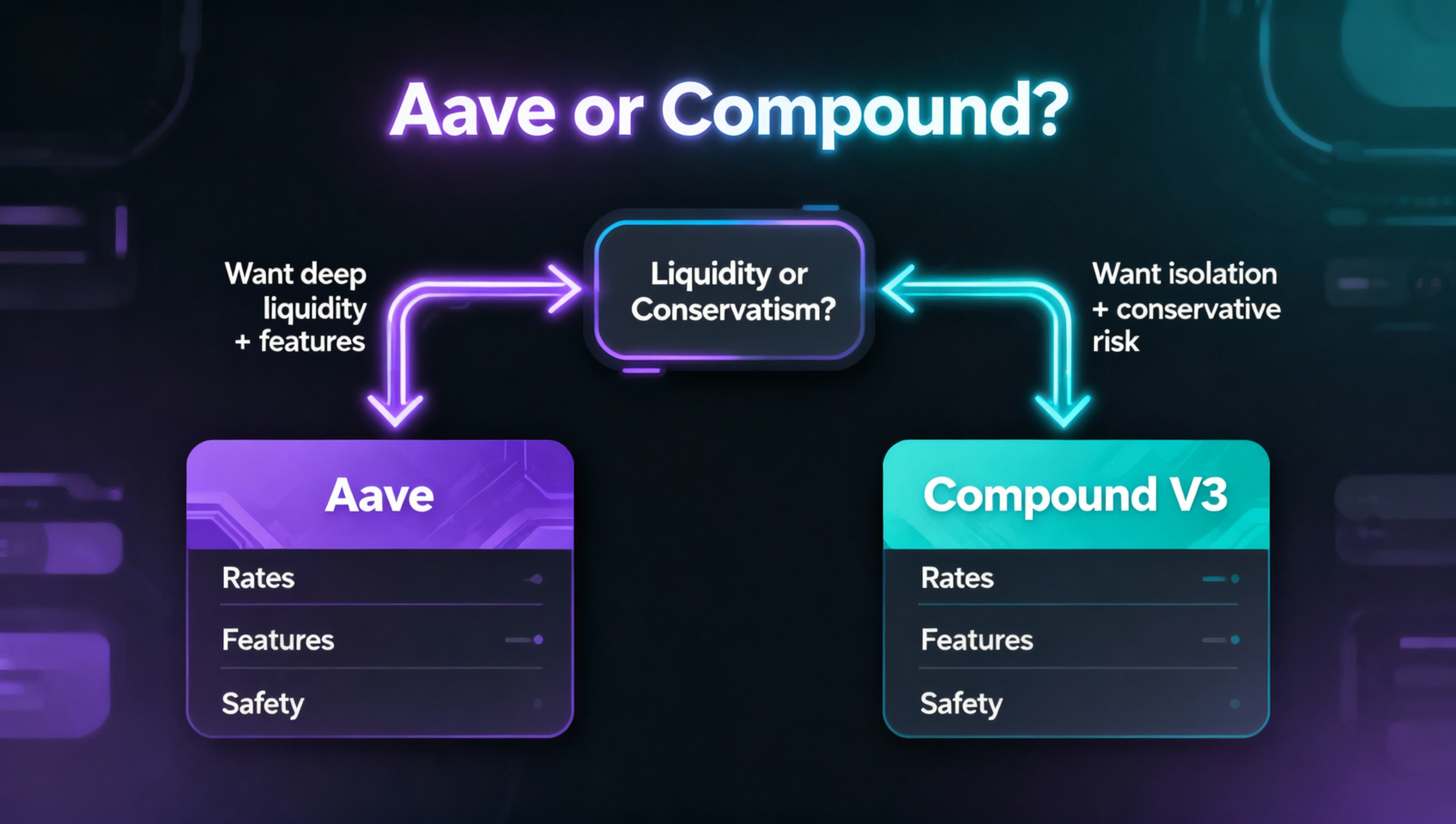
💡 The pattern underneath every row: first ask whether you want liquidity or conservatism, then trade features against safety. Everything below supports this one idea.
The 2026 Numbers Side by Side
Most "Aave vs Compound" posts still quote 2021–2022 figures. Here are 2026 numbers, verified 2026-09-225123:
| Metric | Aave | Compound |
|---|---|---|
| TVL | ~$17.7B (total deposits ~$30B) | ~$1.5B |
| Active borrows | ~$11.1B | ~$640M |
| Market design | Pooled liquidity (V3 + V4) | Isolated single-asset (V3 Comet) |
| USDC supply APY | ~3.8%–5.2% (variable, plus stable) | ~3%–5% (variable only) |
| Rate options | Stable + variable, switchable | Variable only |
| Flash loans | ✅ Yes (pioneered) | ❌ No |
| High-LTV mode | eMode, up to 97% on correlated | No eMode, ~10pp buffer |
| Chains | 21 chains | A few (Ethereum-centric) |
| Safety module | Umbrella (staked AAVE backstops bad debt) | None (isolation + freeze) |
| Major 2026 event | Kelp event, ~$190M bad debt absorbed | Kelp event, frozen markets, zero bad debt |
Three readings worth remembering:
- Aave's lead is crushing. ~$17.7B vs $1.5B is not "a bit ahead" — it's an order of magnitude. Compound's TVL has fallen ~90% from its ~$12B peak in 20212.
- Both still offer a deposit-vs-borrow spread, but the rates themselves barely differ. What really separates them isn't the APY fraction, it's liquidity depth, features and the safety model.
- The April 2026 Kelp event finally split their safety philosophies. Aave's openness (listing LRTs and other risky collateral) bought growth but also one real bad-debt event; Compound's conservatism bought a "zero bad debt" record.
The Trap Most Comparisons Miss: They've Become Different Species
Ask "Aave or Compound?" and most articles lay out a parameter table and let you "choose." But the 2026 reality is these two barely compete for the same user anymore. Aave is building "all of a decentralized bank" — cross-chain, flash loans, high LTV, every asset class. Compound is going down the "institutions + RWA" path — approving a $52M budget in 2026, replacing leadership, and shifting focus from retail to institutional clients, including a USDC institutional market at 87% LTV opened in September2.
This is why the framing matters:
- If you're a retail user earning yield, Aave is basically the default answer — deepest liquidity, most chains, more flexible rate options. The comparison you should actually be making isn't against Compound; it's Aave versus other pooled-liquidity protocols like Morpho or Spark.
- If you're institutional or extremely conservative, Compound V3's isolated single-asset model is what matters — each market centers on one base asset (e.g. USDC), bad debt stays isolated in that market, and the liquidation buffer is wider3.
The counterintuitive takeaway: "Aave vs Compound" is, for most retail users, a question already answered by scale. Compound is the "founding father" of DeFi lending, but its 2021 COMP distribution bug and subsequent institutional pivot pushed it in a different direction from Aave. Few people genuinely need to agonize between the two: either stability-focused users who prize isolation and conservatism, or money following the institutional/RWA narrative.
Deposit Rates, Calculated: What $1,000 and $10,000 Earn
Let's be clear up front: both use variable rates that float with market supply and demand, so APY changes daily. The figures below are mid-2026 ranges — always confirm on the app before acting5.
| Deposit | APY (at ~4.5%) | Daily | Monthly | Yearly |
|---|---|---|---|---|
| $1,000 | 4.5% | ~$0.12 | ~$3.75 | $45 |
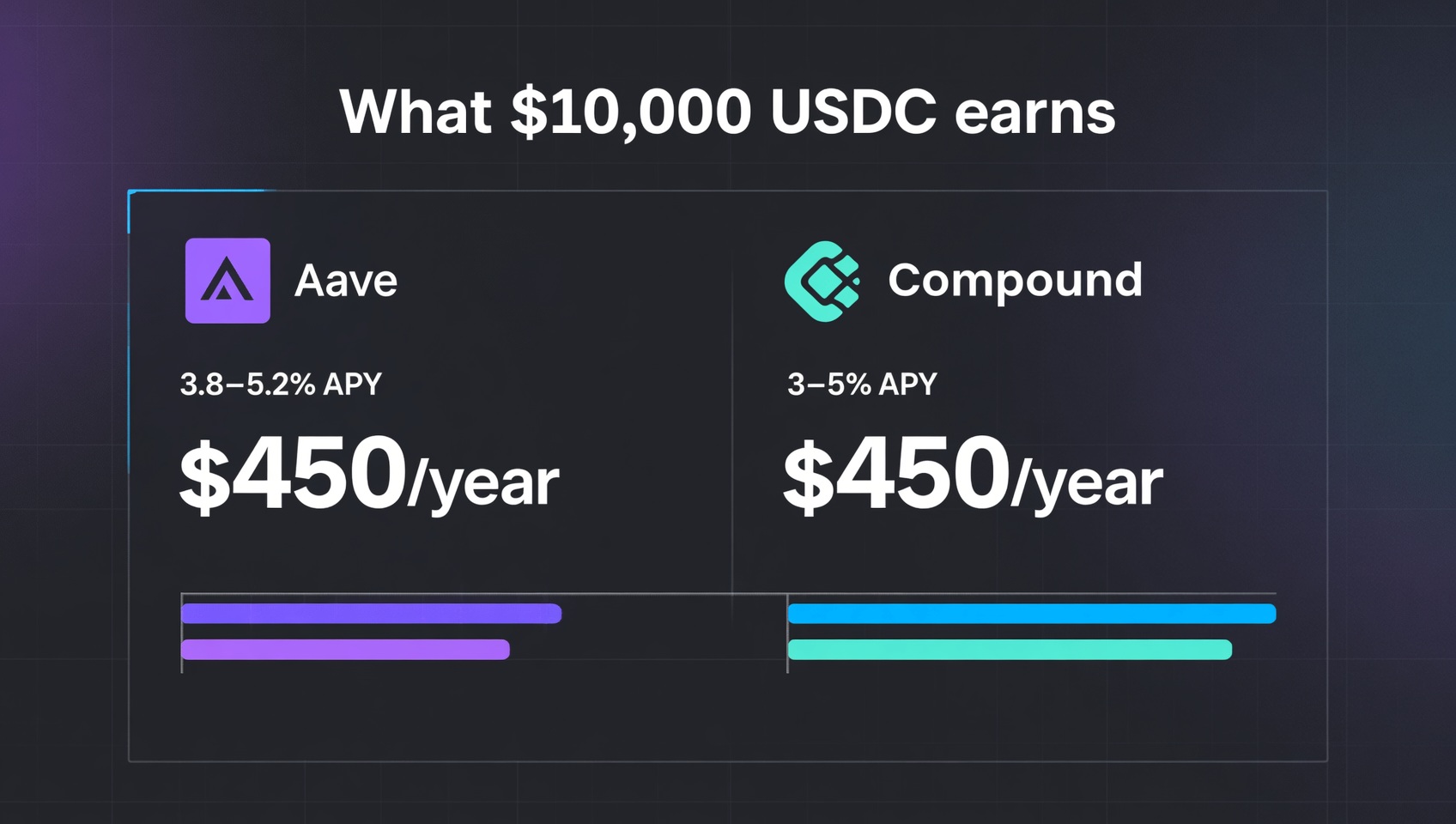
| $10,000 | 4.5% | ~$1.23 | ~$37.50 | $450 |
| $50,000 | 4.5% | ~$6.16 | ~$187.50 | $2,250 |
Three conclusions:
- For depositing USDC, Aave and Compound pay almost the same. The gap is under one percentage point; on $10,000 a year the difference is a few dozen dollars. Don't agonize over a 0.5% rate edge — the market will erase it within days.
- The real difference is Aave's stable-rate option. If you hate rate volatility, you can switch your USDC deposit to a stable rate on Aave and lock in a fixed APY; Compound only offers the variable rate5.
- Look past the rate to whether you plan to borrow. If you collateralize ETH to borrow stablecoins, Aave's eMode pushes LTV up to 97% on correlated assets (like wstETH borrowing ETH) — far more capital-efficient than Compound. But Compound's wider liquidation buffer means you're less likely to be suddenly liquidated. It's efficiency versus safety.
💡 You can buy USDC and ETH directly on Binance or OKX, then withdraw to your own wallet on the Arbitrum/Base network — low fees and cheap gas. The entry point for depositing into Aave or Compound is the same: connect a self-custody wallet.
The Design Divide: Pooled Liquidity vs Isolated Markets
This is the most fundamental difference between the two, more important than any parameter:
Aave is "pooled liquidity." A single market mixes dozens of assets; depositors put assets into a shared pool, borrowers draw from it, and rates are set by the pool's overall utilization3. The upside is extreme liquidity and capital efficiency, plus add-ons like flash loans and eMode. The cost is risk contagion — if any one collateral asset in the pool breaks, the whole market can be affected (the 2026 Kelp event was exactly this: one collateral type, rsETH, dragged the whole pool).
Compound V3 is "isolated single-asset markets." Each market centers on one base asset (like USDC); you collateralize multiple assets to borrow just that one base asset, and bad debt stays isolated in its own market, unable to spread3. The upside is clear risk control and a wide liquidation buffer. The cost is lower capital efficiency and fewer features — and note that your supplied collateral earns no interest in Compound V3 (only the base asset and borrow positions accrue).
Remember it in one line: Aave trades complexity for efficiency; Compound trades simplicity for isolation. Your risk tolerance decides which philosophy you buy.
Safety: The 2026 Kelp Event Was a Real Stress Test
Everyone asks "which is safer," but most articles just repeat "both are audited." A real attack in April 2026 is more persuasive than any audit report:
What happened: On April 18–19, 2026, Kelp DAO's rsETH cross-chain bridge (built on LayerZero) was exploited for roughly $292M of rsETH4. The attacker used the stolen rsETH as collateral to borrow more liquid WETH across multiple lending protocols — Aave took ~$196M of that debt, Compound ~$39.4M, and Euler ~$840K4.
The two reacted completely differently:
- Aave froze its rsETH markets and zeroed the LTV, but the already-borrowed funds became bad debt. Ultimately its Umbrella safety module (a pool of staked AAVE) backstopped ~$190M of it — no depositor lost funds, but Aave's TVL dropped ~$6.6B and the AAVE token fell double digits within hours4. Aave's own contracts were never breached; what failed was the "rsETH" collateral it had accepted.
- Compound froze its rsETH markets through a guardian multisig and recorded zero bad debt. Its isolated single-asset design and more conservative collateral whitelist left it unscathed in the same event4.
The uncomfortable truth: the biggest risk in DeFi lending isn't the protocol code getting hacked — it's the collateral you accept going bad. Aave's willingness to list high-risk collateral like LRTs (liquid restaking tokens) bought growth but also a larger exposure surface; Compound's conservative whitelist dodged the bullet but keeps its TVL low. Those two are two sides of the same coin.
Roadmaps: Aave V4 Cross-Chain vs Compound's Institutional Pivot
The two are betting on completely different futures in 2026:
Aave is betting on "cross-chain + bank-ification." Aave V4 went live on mainnet on March 30, 2026 with a Hub-and-Spoke architecture — consolidating previously fragmented liquidity into unified pools and enabling cross-chain liquidity; the new rate model charges riskier collateral a higher rate; V4 deployed to Avalanche on July 15, 20266. Founder Stani Kulechov's 2026 roadmap is V4 + Horizon (an RWA platform) + the Aave App, aimed at turning Aave from a "product" into "bank-grade infrastructure."
Compound is betting on "institutions + RWA." Compound approved a record $52M budget and replaced leadership, shifting focus to institutional clients and real-world assets, and opened an 87% LTV USDC institutional market in September 20262. For retail users, this means Compound's product iteration will stay slow and conservative.
For most retail users, Aave's roadmap is more immediately useful; for institutions and RWA-focused capital, Compound's pivot is worth watching.
Practical Paths: Three Playbooks
💡 Everything below assumes you first buy USDC and a little ETH on a centralized exchange, withdraw to your self-custody wallet (Arbitrum or Base), then connect the wallet to the protocol. You can register on Binance with referral code BINANBT, or OKX with code 60895497 — registering through either link enjoys a 20% fee rebate.
Path A — You just want to deposit USDC and earn yield:
- Buy USDC + a little ETH on Binance or OKX.
- Withdraw to Arbitrum or Base (not Ethereum mainnet — gas is expensive).
- Connect to app.aave.com, choose USDC, hit Supply. Full steps in our Aave lending guide.
Path B — You want to collateralize ETH and borrow stablecoins for leverage:
- Deposit ETH as collateral per Path A.
- Use Aave's eMode for capital efficiency (up to 97% LTV on correlated assets), or Compound for a wider buffer (less likely to be liquidated).
- Watch your health factor and keep it above 1.5 — understand liquidation via our liquidation mechanics guide.
Path C — You want extreme conservatism or institutional use:
- Use Compound V3's USDC market — isolated single-asset, bad debt can't spread.
- Accept the trade-offs (supplied collateral earns no interest, slightly lower rates) for a wider safety margin.
Stop conditions — pause if any of these are true:
- Someone asks for your seed phrase or private key in a DM → it's a scam, stop.
- You're about to put more than a few months' savings into DeFi → shrink it to "fine to lose."
- You're chasing a 0.5% rate edge by listing a risky asset you don't understand → not worth it, don't.
- You've collateralized volatile assets and borrowed near the limit → pull your health factor back above 1.5 first.
FAQ
Which is better, Aave or Compound?
For most retail users earning yield, Aave is the more direct choice — ~$17.7B TVL vs Compound's ~$1.5B, slightly higher USDC rates with a stable-rate option, and far more features. Compound suits those who want isolated single-asset markets and conservative risk control, or money following its institutional pivot. Ask whether you want liquidity or conservatism first.
Is Aave safer than Compound?
At the protocol layer neither's core contracts have been directly exploited, and Aave has more audits. At the collateral layer, the April 2026 Kelp event split them: Aave absorbed ~$190M bad debt (Umbrella backstopped it, no depositor losses), while Compound froze markets with zero bad debt. Aave is strong but exposed; Compound trades features for stability.
What's the difference in deposit rates?
Small — in mid-2026 Aave's USDC supply APY was ~3.8%–5.2% versus Compound's ~3%–5%. The key difference is Aave offers switchable stable + variable rates, while Compound is variable-only. The real gap is liquidity and features, not APY.
What is Aave's flash loan? Does Compound have one?
A flash loan is Aave's original single-block, no-collateral borrow that reverts if not repaid in the same block — used mainly by arbitrageurs and liquidation bots. Compound has no flash loans.
Why is Compound's TVL so much lower than Aave's?
Three reasons: (1) a 2021 COMP distribution bug over-paid ~$90M, shaking confidence; (2) Aave moved first on multi-chain and aggressive listings, draining liquidity; (3) Compound pivoted to institutions and RWA, slowing retail iteration. TVL fell from ~$12B in 2021 to ~$1.5B in 2026.
Should a beginner deposit USDC on Aave or Compound?
Buy USDC on a centralized exchange, withdraw to Arbitrum/Base, and connect a wallet. For the single action of earning interest on USDC, Aave is smoother; for a minimal, conservative pool, Compound V3's USDC market works. See our Aave tutorial for the full walkthrough.
Further Reading
- Aave Lending Guide: Deposit & Borrow — step-by-step tutorial
- DeFi Liquidation Mechanics Guide — health factor and liquidation explained
- What Is DeFi? A Beginner's Guide — DeFi fundamentals
- Stablecoin Yield Strategy Guide — where to put stablecoins for yield
- Revoking DeFi Contract Approvals — clean up approvals after use
- On-Chain Guide — more blockchain explainers and on-chain tutorials
Data verification note: TVL, rates, borrow volume and security events verified 2026-09-22 from the sources cited below512346. DeFi rates and TVL fluctuate constantly — always confirm on DefiLlama and each protocol's app before acting.
This article is not investment advice; DeFi carries smart-contract, liquidation and market risk. Follow your local laws.
Footnotes
-
TVL: Aave ~$17.7B (total deposits ~$30B, DefiLlama Aug 2026) vs Compound ~$1.5B (Sept 2026). Sources: DefiLlama, KuCoin/CoinMarketCap coverage. ↩ ↩2 ↩3
-
Aave's 60%+ DeFi lending share and $1T cumulative volume by Q1 2026; Compound's ~$12B 2021 peak, $52M institutional pivot and 87% LTV USDC institutional market. Sources: Gate Learn, The Defiant "What Happened to Compound's Crypto Lending Empire?", KuCoin. ↩ ↩2 ↩3 ↩4 ↩5 ↩6
-
Design differences: Aave V3 pooled liquidity (flash loans, eMode, rate switching); Compound V3 "Comet" isolated single-asset markets (collateral earns no interest, ~10pp liquidation buffer). Sources: Aave docs and Compound docs. ↩ ↩2 ↩3 ↩4 ↩5 ↩6
-
Kelp DAO rsETH bridge hack (~$292M) on 2026-04-18/19; Aave ~$196M bad debt (Umbrella backstopped ~$190M, TVL down ~$6.6B), Compound ~$39.4M exposure but frozen markets and zero bad debt, Euler ~$840K. Sources: CoinDesk, The Defiant, KuCoin. ↩ ↩2 ↩3 ↩4 ↩5 ↩6
-
Deposit rate ranges: Aave USDC ~3.8%–5.2% (variable, plus stable), Compound USDC ~3%–5% (variable only). Sources: DefiLlama protocol pages and live in-app rates (Sept 2026), see Aave and Compound V3. ↩ ↩2 ↩3 ↩4
-
Aave V4 mainnet launch 2026-03-30 (Hub-and-Spoke, cross-chain liquidity, new rate model), Avalanche deployment 2026-07-15. Sources: Aave blog, KuCoin. ↩ ↩2