


Table of Contents
- TL;DR: The answer first
- Decision table: find your situation
- The 2026 landscape in data: gaps of orders of magnitude
- Fixing the most common misconception: the chain sets your cost, not the DEX
- Real fee math: what a $1,000 and a $10,000 swap actually cost
- Versions explained: V2/V3/V4/Infinity in one minute
- Platform tokens in 2026: UNI turns the corner, CAKE deflates, SUSHI falls behind
- Safety: three veterans, one shared risk surface
- How to actually choose: three paths
- FAQ
- Further reading
TL;DR: The answer first
📺 Prefer to watch? This article has a companion video — the core conclusion in 3.5 minutes: Uniswap vs PancakeSwap vs SushiSwap: DEX Comparison & Real Fee Math
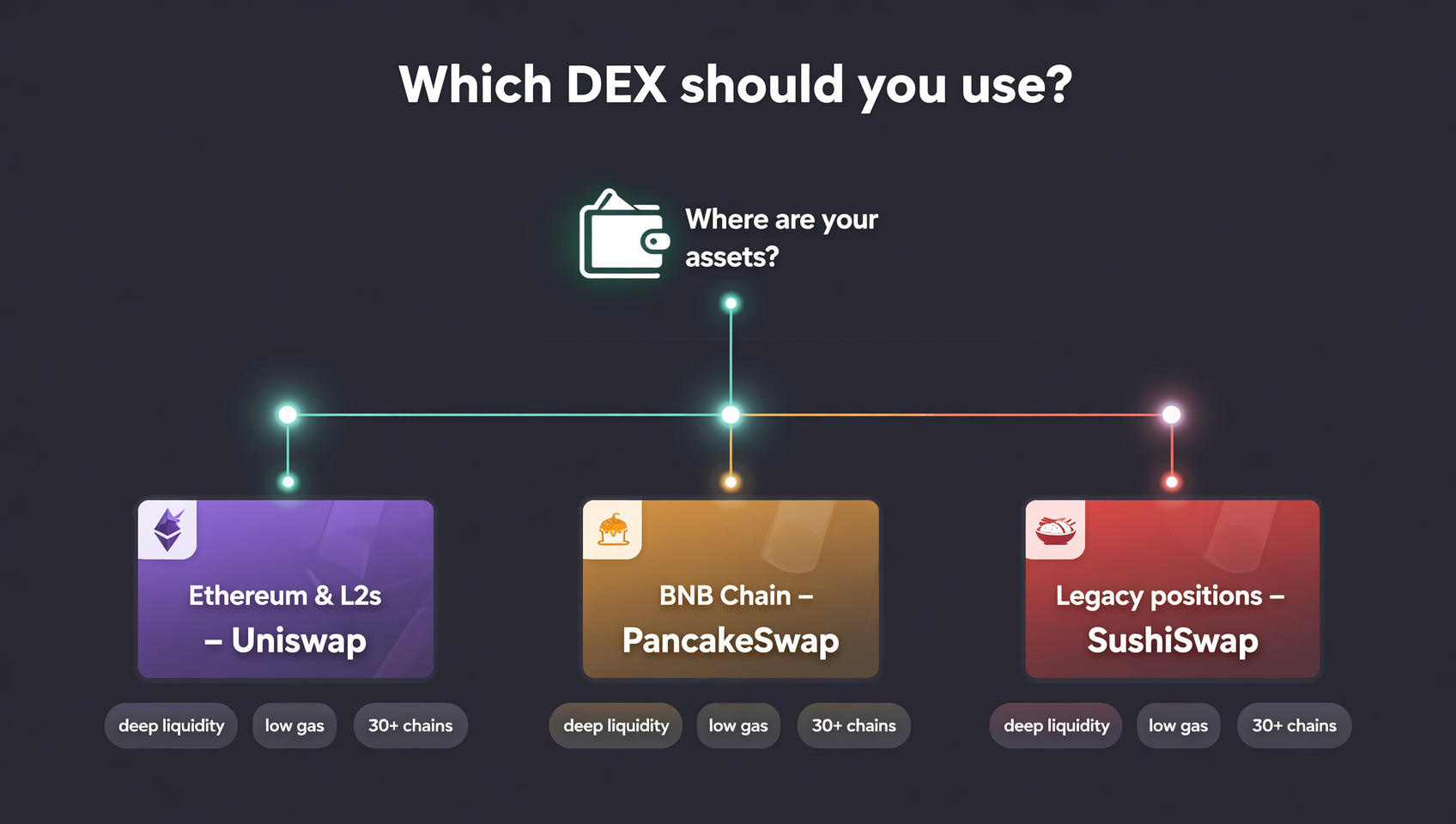
One-line answer: use the DEX with the deepest liquidity on the chain your assets are already on — Uniswap on Ethereum and its L2s (Arbitrum/Base/Unichain etc.), PancakeSwap on BNB Chain, and SushiSwap only if you hold legacy positions or are stuck on a niche chain where it's the only option.
Three supporting facts:
- The volume gap is orders of magnitude. In mid-September 2026, Uniswap's 30-day volume was ~$77B (V3+V4), PancakeSwap's ~$29.6B, SushiSwap's ~$270M1. Liquidity decides slippage, especially on large trades.
- Fees are no longer the differentiator. All three use 0.01%–1% tiered fees (lowest for stablecoin pairs); the spread between them is usually 0.05–0.25 points. Switching chains, however, changes gas by 10–100x. Choosing the wrong chain costs far more than choosing the wrong DEX.
- The new variable in 2026 is the tokens. Uniswap governance passed UNIfication in late 2025, routing protocol fees into UNI burns; PancakeSwap cut CAKE's max supply to 400M and keeps net-burning2. You don't need any of these tokens to use the DEXs — but if you care about tokens, this is the biggest shift in years.
⚠️ This article is about choosing a tool, not investment advice. DEX tokens are highly volatile, and LP positions add impermanent loss on top — risks covered below and in the further reading.
Who should read something else first: if you don't even have an exchange account yet, start with CEX vs DEX: Complete Comparison to figure out whether you need a DEX at all.
Decision table: find your situation
| Your situation | Pick | Why |
|---|---|---|
| Assets on Ethereum mainnet | Uniswap | ~76% of Ethereum DEX volume3, deepest liquidity, least slippage |
| Assets on Arbitrum / Base / Unichain (L2s) | Uniswap | Native deployments, rock-bottom gas, fullest V3/V4 pools |
| Assets on BNB Chain (BSC) | PancakeSwap | The undisputed BSC king — V3 alone does ~$20B/month1 |
| First time on a DEX, small trial | Uniswap on an L2, or PancakeSwap on BSC | Cents of gas, cheapest possible mistakes |
| Buying a newly launched meme/small cap | Whichever chain the token lives on | Most BSC launches are on PancakeSwap; Solana launches are outside this article |
| Holding legacy Sushi positions/LPs | Sushi (redeem first, then decide) | The protocol still works; migrate after you exit |
| On a niche small chain | Sushi may be the only option | Sushi survives by covering many chains1 |
| Thinking of LP-ing for fees | Read the impermanent loss guide first | Pick the wrong pool and fees won't cover IL |
💡 One logic repeats across the whole table: the chain is the first filter; the DEX is only the second. Everything below supports that conclusion.
The 2026 landscape in data: gaps of orders of magnitude
Most "top 3 DEX" articles online still run on 2021 data. Here are live numbers pulled from DefiLlama on 2026-09-161:
| Metric | Uniswap (V3+V4+V2) | PancakeSwap (V3+Infinity+V2) | SushiSwap (V2+V3) |
|---|---|---|---|
| 24h volume | ~$3.3B | ~$970M | ~$11M |
| 30-day volume | ~$77B | ~$29.6B | ~$270M |
| TVL | ~$3.5B | ~$1.9B | ~$40M |
| Chain deployments | 40+ (across versions) | ~11 | 30+ |
| Newest major version | V4 (Jan 2025) | Infinity (hooks engine) | V3 (partial) |
| Platform token | UNI | CAKE | SUSHI |
Three readings worth remembering:
- Uniswap is the highest-volume single DEX protocol in the world. A year and a half after launch, V4's 30-day volume (~$40B) has overtaken V3's — the migration is real1.
- PancakeSwap is no longer "BSC-only": it runs on 11 chains including Ethereum, Base, Arbitrum and Linea, but its home base is still BSC — on BSC it has no real rival.
- Sushi's true position: TVL fell from a 2021 peak of over $3B to roughly $40M, a
99% drawdown. Comparison pieces still list it as a "top-3 DEX" without telling you the scale — it's not dead, but it has gone from competitor to niche-scenario tool. It also patched a router vulnerability in 2023 ($3.3M exposed, mostly recovered via a whitehat bounty) and has been stable since.
Fixing the most common misconception: the chain sets your cost, not the DEX
The question you see most online — "Is PancakeSwap cheaper than Uniswap?" — is the wrong question in 2026, because a DEX trade's total cost has three parts:
- Pool fee: paid to the liquidity pool (i.e., LPs), 0.01%–1% tiers, nearly identical across all three
- Chain gas: paid to the network, varies by chain, gaps up to 100x
- Price impact/slippage: set by pool depth, matters more the larger your trade
Typical gas for one ordinary swap (checked September 2026; varies with congestion):
| Chain | Gas per swap | Usual DEX |
|---|---|---|
| Ethereum mainnet | $3–10, higher when congested | Uniswap |
| BNB Chain (BSC) | $0.05–0.3 | PancakeSwap |
| Base / Arbitrum (L2s) | $0.01–0.5 | Uniswap |
| Other small chains | varies; test small first | mostly local DEXs |
In plain words: on Ethereum mainnet, Uniswap and PancakeSwap are equally expensive in gas; on BSC, PancakeSwap's 0.25% is not more expensive than Uniswap — because Uniswap's BSC liquidity is thin and slippage will eat what you thought you saved.
The right order to save money: pick the chain first (L2 or BSC) → then the DEX with the deepest liquidity on it → compare fee tiers last. That's also why the withdrawal network you pick at the exchange matters so much (see Binance withdrawal network guide).
Real fee math: what a $1,000 and a $10,000 swap actually cost
Swapping 1,000 USDC into ETH (a mainstream pair), with typical fee tiers:
| Scenario | Pool fee | Fee | Gas | Total | % of trade |
|---|---|---|---|---|---|
| Uniswap V3 · Ethereum mainnet | 0.05%–0.30% | $0.5–3 | $3–10 | $3.5–13 | 0.35%–1.3% |
| Uniswap V3 · Base | 0.05% | $0.5 | ~$0.03 | ~$0.53 | 0.05% |
| PancakeSwap V3 · BSC | 0.25% | $2.5 | ~$0.1 | ~$2.6 | 0.26% |
| SushiSwap V2 · mainnet | 0.30% | $3 | $3–10 | $6–13 | 0.6%–1.3% |
Same trade at $10,000 (gas unchanged, fees scale):
| Scenario | Fee | Gas | Total |
|---|---|---|---|
| Uniswap · Base | $5 | ~$0.03 | ~$5 |
| Uniswap V3 · mainnet (0.05% tier) | $5 | $3–10 | $8–15 |
| PancakeSwap · BSC | $25 | ~$0.1 | ~$25 |
| SushiSwap · mainnet | $30 | $3–10 | $33–40 |
Three conclusions from the math:
- Large amounts: low tier + L2. $10,000 on Uniswap Base's 0.05% pool costs about $5 — a third to a half of mainnet options.
- Small amounts: stop optimizing fees, optimize gas. On a swap under $500, a 0.2-point fee difference is about a dollar; mainnet gas alone can be $5.
- Stablecoin pairs run on the 0.01% tier: USDT/USDC swaps are effectively free — great for rebalancing between venues and yield positions.
💡 Fees above are typical tiers for mainstream pools — the confirmation screen always shows the real number. Slippage comes on top and can exceed every fee on the table during violent moves.
Versions explained: V2/V3/V4/Infinity in one minute
Open any of the three and you'll find multiple versions — V2, V3, Infinity — sitting side by side. That's fork-era baggage and a practical blind spot most comparison articles never mention:
- Uniswap: V2 (full range, flat 0.30%) → V3 (2021, concentrated liquidity + tiers 0.01%/0.05%/0.30%/1.00%) → V4 (Jan 2025, hooks architecture, pluggable pool logic, dynamic fees)
- PancakeSwap: V2 (0.25%) → V3 (tiers 0.01%/0.05%/0.25%/1%) → Infinity (hooks engine, Uniswap V4's counterpart)
- SushiSwap: V2 (0.30%; traditionally 0.25% to LPs, 0.05% to xSUSHI stakers) → V3 (deployed on 29 chains) → Trident (slow progress)
What it means for you:
- Just swapping: use the default recommended version — the experience is nearly identical
- Providing liquidity: version = income model. Concentrated liquidity (V3/V4/Infinity) is capital-efficient but stops earning when price leaves your range; V2 is simpler but capital-inefficient. Start with the real math in the Uniswap tutorial
- Hooks/V4 advanced play: for developers and strategy players; a normal swap never touches it
Platform tokens in 2026: UNI turns the corner, CAKE deflates, SUSHI falls behind
Facts and mechanisms only — not a recommendation to buy anything. Platform tokens are far riskier than using the DEXs themselves.
UNI — the "fee switch" finally switched on. In late 2025, Uniswap governance passed UNIfication: protocol fee revenue is no longer idle but swapped for UNI and permanently burned (mainnet fees go to a "Firepit" contract; L2 fees are bridged back via "TokenJar" contracts for burning)4. In February 2026, governance voted to extend protocol fees to every remaining V3 pool on Ethereum mainnet and to eight more chains — Arbitrum, Base, Celo, OP Mainnet, Soneium, X Layer, Worldchain and Zora4. V4 protocol fees are not yet live; extending them is the key thing to watch. UNI has gone from pure governance token to an asset with real cash-flow backing — the most fundamental change in its fundamentals in three years.
CAKE — deflation written into the rules. Tokenomics 3.0 (April 2025) retired veCAKE, cut daily emissions from ~40,000 to ~22,250 CAKE, and targets ~4% annual deflation; the max-supply cap went from 750M to 450M (2023) and then to 400M via a January 2026 vote2. Official data shows CAKE net-burned about 8.19% of supply in 20252. Part of the staking revenue share has also been redirected into burns. Among the three platform tokens, CAKE has the most aggressive supply story.
SUSHI — left behind, not gone. It started as 2020's "vampire attack" fork of Uniswap and was once a true top-3 DEX. Since then: core-team turmoil, a 2023 SEC Wells notice, a token down more than 90% from its high, and an on-chain share below 1% on Ethereum3. xSUSHI staking still exists, but for new users the only reasons to pick Sushi are legacy positions or a small chain where it's the only DEX.
Safety: three veterans, one shared risk surface
Protocol level first: all three are mature, battle-tested protocols descended from the same open-source code (Sushi and PancakeSwap both forked Uniswap early on) with years of audits. Uniswap's and PancakeSwap's core contracts have never suffered a catastrophic exploit; Sushi patched a router vulnerability in 2023 (~$3.3M, mostly recovered via whitehat bounty) and has been stable since.
What actually loses people money is none of the above — it's these three:
- Phishing front-ends: the "Uniswap" at the top of search results may be fake. Only enter through app.uniswap.org / pancakeswap.finance / sushi.com — bookmark them
- Unlimited approvals: approve exact amounts, revoke with Revoke.cash when done — see revoking DeFi approvals
- Counterfeit and honeypot tokens: anyone can deploy a token; look-alikes and unsellable honeypots are everywhere — check the honeypot detection guide before buying small caps
These three defenses are identical on every DEX — so "which DEX is safer" is really "which habits are safer".
How to actually choose: three paths
Path A: your assets are in the Ethereum ecosystem (ETH/USDC etc.)
- When withdrawing from the exchange, pick Arbitrum One or Base as the network (not mainnet — gas is 10x+ lower)
- Open app.uniswap.org, connect your wallet, confirm the network in the top-right matches your withdrawal network
- Do one small swap first, confirm arrival, then scale up
Path B: you want to trade on BNB Chain
- Withdraw on BEP20 (BSC)
- Open pancakeswap.finance and connect your wallet
- BSC has many new tokens — and many fakes. Always verify contract addresses
Path C: you trade on a CEX and only touch a DEX when needed
Completely fine. CEXs remain the main venue for most people's liquidity, tooling and fiat rails; DEXs cover what CEXs can't — airdrops, on-chain yield, newly launched tokens. They divide labor; they don't replace each other.
💡 No on-chain assets yet? Buy USDC/USDT plus a little ETH/BNB with fiat on Binance (referral link) or OKX (referral link), then withdraw to your own wallet using the network tips above.
Stop conditions — pause if any of these is true:
- You can't explain where the token's contract address came from → don't buy
- Slippage on the confirmation screen exceeds 3%–5% → shrink the size or change pools
- Mainnet gas is above 2% of the trade size → wait for congestion to ease or use an L2
- Anyone tells you it's "limited time", "now or never" → that's a 100% scam signal
FAQ
Q: Which is cheaper, Uniswap or PancakeSwap?
It depends on the chain, not the DEX. The gas gap between chains (up to 100x) dwarfs the 0.05–0.25 point fee gap. Pick the chain first, then the DEX with the deepest liquidity on it.
Q: Is SushiSwap dead?
Not dead, but marginalized: 30-day volume is ~1/280 of Uniswap's and under 1% of Ethereum DEX volume. It still runs on 30+ chains — fine for legacy positions, pointless for new funds.
Q: Do I need UNI, CAKE or SUSHI to use the DEXs?
No. Core functions carry no usage fee; tokens are about governance and incentives. Buying tokens just to use a DEX adds volatility for nothing.
Q: Are DEX trades traceable?
Yes — addresses, amounts and routes are permanently public on-chain. No KYC doesn't mean no obligations; for taxes, get professional advice.
Q: What's the minimum amount to make it worthwhile?
Gas decides: $20–50 works on Base/Arbitrum/BSC; on mainnet, gas of $3–10 ruins trades under $200. Practice on an L2 or BSC first.
Q: Can a DEX run away with my funds?
No — DEXs never custody your assets; swaps execute on-chain. The real risks are malicious approvals, fake/honeypot tokens and phishing front-ends, none of which depend on the DEX you pick.
Further reading
- Uniswap Tutorial 2026: Swap, Add Liquidity, Earn Fees — hands-on walkthrough with real LP math
- DeFi Liquidity Pools & Impermanent Loss Guide — read before providing liquidity
- CEX vs DEX: Complete Comparison — decide whether you need a DEX at all
- Binance Withdrawal Networks: BEP20 vs ERC20 — and how to recover a wrong network
- Revoking DeFi Token Approvals — the cleanup step after every on-chain action
- More on-chain guides at our sister site CoinVado.net (external link)
Data note: volume, TVL and chain counts checked 2026-09-16 via DefiLlama1; fee tiers per official docs; gas ranges are typical-congestion estimates. Protocol fees and tokenomics change often — always confirm with official announcements before acting.
This article is not investment advice — on-chain actions are your own responsibility and must comply with local laws.
Footnotes
-
DefiLlama DEX volume and TVL data, checked 2026-09-16: defillama.com/dexs ↩ ↩2 ↩3 ↩4 ↩5 ↩6
-
PancakeSwap official blog "Implementation of CAKE Tokenomics 3.0" (April 2025) and "Proposal to Reduce CAKE Token Max Supply" (January 2026 — cap lowered to 400M; ~8.19% net burn in 2025) ↩ ↩2 ↩3
-
CoinMarketCap research: Uniswap holds ~76% of Ethereum DEX volume vs ~0.45% for SushiSwap (2026) ↩ ↩2
-
The Block: Uniswap governance considers activating protocol fees on all V3 pools and eight more chains (2026-02-19); UNIfication passed in late 2025 with the first fee-driven burns starting in December ↩ ↩2