


TL;DR: The Bottom Line First
The most compliant, lowest-friction way to buy US stocks from mainland China is not opening a broker account — it's a QDII mutual fund, which you buy directly in RMB without touching personal forex controls or needing an offshore account. The brokers most beginners search for first — Futu and Tiger — are now essentially closed to ordinary mainland residents.
Five facts that matter most:
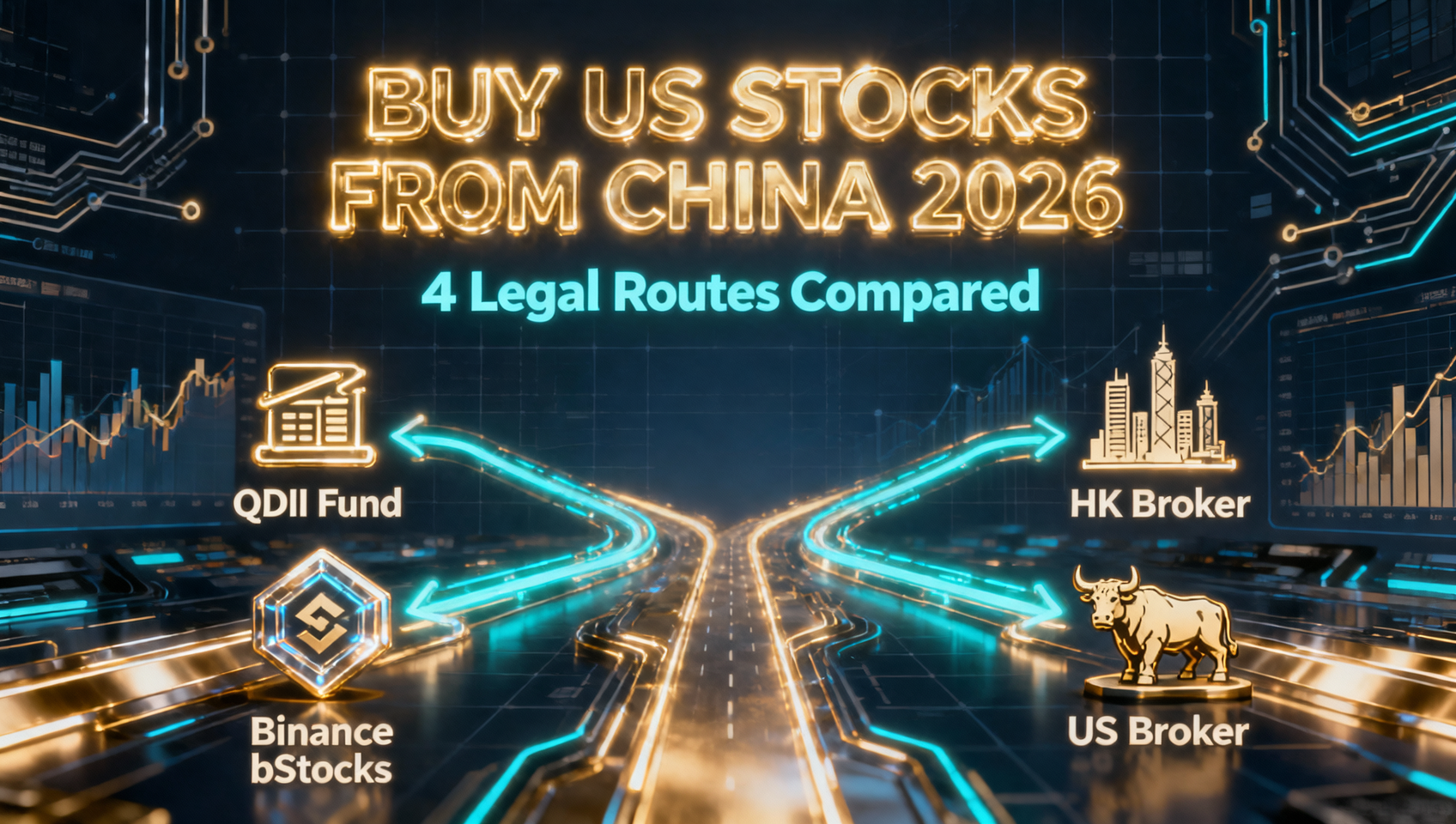
- Four routes. QDII funds (most compliant), Hong Kong brokers (Futu/Tiger, largely closed), US brokers (Schwab/Firstrade/IBKR, hurdle is moving money out), and crypto tokenized stocks (Binance bStocks, likely unavailable to mainland users)1.
- Futu and Tiger are effectively closed to new mainland accounts. In December 2022 the CSRC classified their cross-border business as illegal, and they tightened further through 2025-2026, now requiring overseas identity or work/living proof1.
- The real hurdle isn't opening an account — it's legally moving money out. Individuals have a $50,000 annual FX quota that explicitly excludes overseas securities investment, and banks scrutinize "securities investment" remittances hard2.
- QDII funds are restricted too. Since November 2025, Nasdaq and S&P 500 QDII funds have seen mass subscription limits, with roughly 60% of equity QDII funds restricted and some capped at 10 RMB per day3.
- Binance bStocks are tokenized certificates, not actual shares. No shareholder rights or voting power, dividends reinvested after a 30% withholding tax, and mainland China is likely outside the eligible region4.
Here's the status, cost and risk of each route, ending with a decision table so you can match your situation.
Table of Contents
- Two hard constraints on buying US stocks from mainland China
- Route 1: QDII mutual funds (most compliant, top pick)
- Route 2: Hong Kong brokers (Futu/Tiger/Longbridge)
- Route 3: US brokers (Schwab/Firstrade/IBKR)
- Route 4: Crypto tokenized stocks (Binance bStocks)
- Four routes compared
- Decision table: which route fits you
- 4 risks and pitfalls to know
- FAQ
- Further reading
Two hard constraints on buying US stocks from mainland China
Before you act, understand two constraints that decide which of the four routes is actually open to you.
First, personal forex controls. Mainland residents have a $50,000 annual "convenience" FX quota, but the purchase declaration explicitly states the money may not be used for overseas securities investment or other capital-account spending. Trying to remit it to an offshore broker for stocks sits in a gray zone, and banks heavily scrutinize (and often reject) remittances where the payee is a broker and the purpose is securities investment2.
Second, how regulators classify cross-border brokers. In December 2022 the CSRC classified Futu and Tiger's cross-border securities business toward mainland investors as illegal operations and required "curbing the increment, resolving the stock." In May 2026 eight regulators issued a plan for a 2-year crackdown1.
Together these constraints produce a counterintuitive conclusion: for ordinary mainland residents, the most compliant route into US stocks is a QDII fund, not any offshore broker. Let's break each route down.
Route 1: QDII mutual funds (most compliant, top pick)
A QDII fund is the most compliant, lowest-threshold way for mainland residents to get US equity exposure — you subscribe in RMB and the fund legally converts money under a state-approved quota to buy overseas stocks or indices.
Here's how it works: fund companies (China Asset Management, Bosera, JPMorgan, E Fund, etc.) apply for QDII quotas from the State Administration of Foreign Exchange, then legally convert that quota to buy constituents of the Nasdaq 100 or S&P 500. You simply subscribe in RMB through a domestic bank, broker, or app like Ant Fortune — the fund handles everything, so you never touch personal forex controls3.
Who is it for? Anyone who wants broad "US market" exposure (not a single stock), prioritizes compliance and simplicity, and has no offshore bank account. This should be the first route most people consider.
But it has three real drawbacks:
Tight quotas, frequent subscription limits. QDII forex quota is scarce — by June 2025 SAFE had approved a cumulative $170.869 billion, while total QDII fund assets neared RMB 970 billion, a severe imbalance3. Since November 2025 Nasdaq and S&P QDII funds have faced mass limits; by July 2026 roughly 60% of equity QDII funds were restricted and over 70% of US broad-index products were limited. China Asset Management's Nasdaq 100 and S&P 500 feeder funds paused subscriptions on November 24, 2025, and JPMorgan's Nasdaq 100 / S&P 500 RMB shares were capped at just 10 RMB per day3.
High on-exchange premiums. When off-exchange subscriptions dry up, money floods into on-exchange ETFs, driving premiums to 15% or more in late 2025 and over 20% on some cross-border ETFs. Buying at a premium means you overpay the moment you enter — and you lose real money if the premium collapses3.
It's an index, not a single stock. QDII funds track broad indices, so you can't buy Apple, Nvidia or Tesla individually, nor short or use leverage.
In short: for a compliant, hands-off way to own the US market, QDII is the top pick — but accept three costs: you can't always get in, on-exchange premiums run high, and you can only buy the index. Want individual stocks or leverage? Read on.
Route 2: Hong Kong brokers (Futu/Tiger/Longbridge)
Futu, Tiger and Longbridge are essentially closed to ordinary mainland residents — stop following account-opening tutorials from 2021.
The timeline is clear:
- December 2022: the CSRC classified Futu and Tiger's cross-border business as illegal operations.
- May 2023: both pulled their mainland apps.
- June–September 2025: further tightening. Futu fully stopped "existing-account proof" onboarding and now only supports residents actually working or living overseas; by September it required overseas permanent residency. Tiger required mainland clients to provide overseas work/living proof (work visa, residence permit, tax records)1.
- May 2026: eight regulators issued the crackdown plan with a 2-year window; Futu, Tiger and Longbridge all received advance notice of administrative penalties1.
- June 2026 onward: existing mainland accounts were restricted to one-way selling and fund withdrawal, with buying and deposits paused1.
The numbers show the scale: by Q1 2026 Futu's mainland clients with assets had fallen to 13% of the group, and Tiger's mainland assets to about 10% of its total1.
What this means for you: without overseas permanent residency or proof you actually work/live abroad, Futu and Tiger are effectively closed. Even if you opened an account years ago, it may be dormant — and mainland accounts are now "sell-only."
In short: for the vast majority of mainland residents, Hong Kong brokers are in the rear-view mirror. If you hold overseas identity or work proof, it's a different story; otherwise don't waste time here.
Route 3: US brokers (Schwab/Firstrade/IBKR)
Among US brokers, Charles Schwab and Firstrade are relatively open to mainland residents (a passport often suffices to apply), while Interactive Brokers has tightened. The real hurdle isn't opening the account — it's legally moving money out.
Current status after the 2025-2026 tightening5:
| Broker | Mainland-resident hurdle | Notes |
|---|---|---|
| Charles Schwab | Passport is often enough (most lenient) | Commission-free stocks, a common Futu/Tiger "substitute" |
| Firstrade | Passport is often enough | Long-standing zero-commission broker with Chinese support |
| Interactive Brokers | Passport + overseas address/residency (stricter) | Strong tools, but basically closed to pure mainland residents |
| BBAE | National ID card | Chinese-backed, lowest threshold |
Opening the account is the easy part — funding it is not. Even after you open a Schwab account, two more hurdles remain25:
- Moving money out. The $50,000 annual FX quota explicitly excludes overseas securities investment, and banks scrutinize remittances to offshore brokers. Declaring "securities investment" gets rejected; mis-declaring risks anti-money-laundering flags.
- An offshore bank card. Most US brokerage accounts need a linked offshore bank account (Hong Kong card, US card, or Wise) for smooth deposits and withdrawals — and getting one is itself a hurdle.
Compliance risk must be stated plainly: through these offshore brokers, if the money-out step isn't compliant you risk a banned account or frozen funds, and account information may be shared with Chinese tax authorities via CRS5.
In short: Schwab/Firstrade are "openable but hard to use" — the account threshold isn't high, but funding is bottlenecked by forex compliance and the offshore bank card. Suited to people who already hold overseas assets or income, not someone starting from zero with only domestic RMB.
Route 4: Crypto tokenized stocks (Binance bStocks)
Binance bStocks are tokenized US-stock certificates, not actual shares — they trade 24/7 from about $5, but holders get no shareholder rights, and mainland China is likely outside the eligible region.
What they are: bStocks are issued by BTech Holdings Limited (a Binance group company) under Abu Dhabi Global Market (ADGM) regulation, backed 1:1 by real shares, and issued on BNB Chain (BEP-20)4. Common tickers include Tesla TSLAB, Nvidia NVDAB, Apple AAPLB and Microsoft MSFTB4.
Three fundamental differences from buying real US stocks4:
- No shareholder rights. You hold a tokenized certificate pegged to the share price, not shares in the company — no voting power, and no direct cash dividends.
- Dividends auto-reinvest. Dividends are reinvested automatically via a "Multiplier" mechanism after a 30% US withholding tax, so your token balance quietly grows but you never see cash.
- 24/7 trading + fractional shares. No US market-hours limit, minimum of about $5, and you can withdraw to a BNB Chain wallet for on-chain use.
The key point: mainland China users are likely outside bStocks' eligible region. Binance's earlier "stock tokens" in 2021 explicitly excluded mainland China; after the 2026 bStocks launch, third-party region tables mark the mainland as "not served," with actual eligibility depending on whether the feature appears in your Binance app4. For the full walkthrough, see our [Binance bStocks tutorial] and [tokenized-stock comparison (bStocks vs OKX/Bitget/Gate)].
In short: bStocks is a new way for crypto natives to get US stock exposure, suited to those who already hold stablecoins and accept the region limits and "token ≠ share" reality. Beginners shouldn't treat it as their first route.
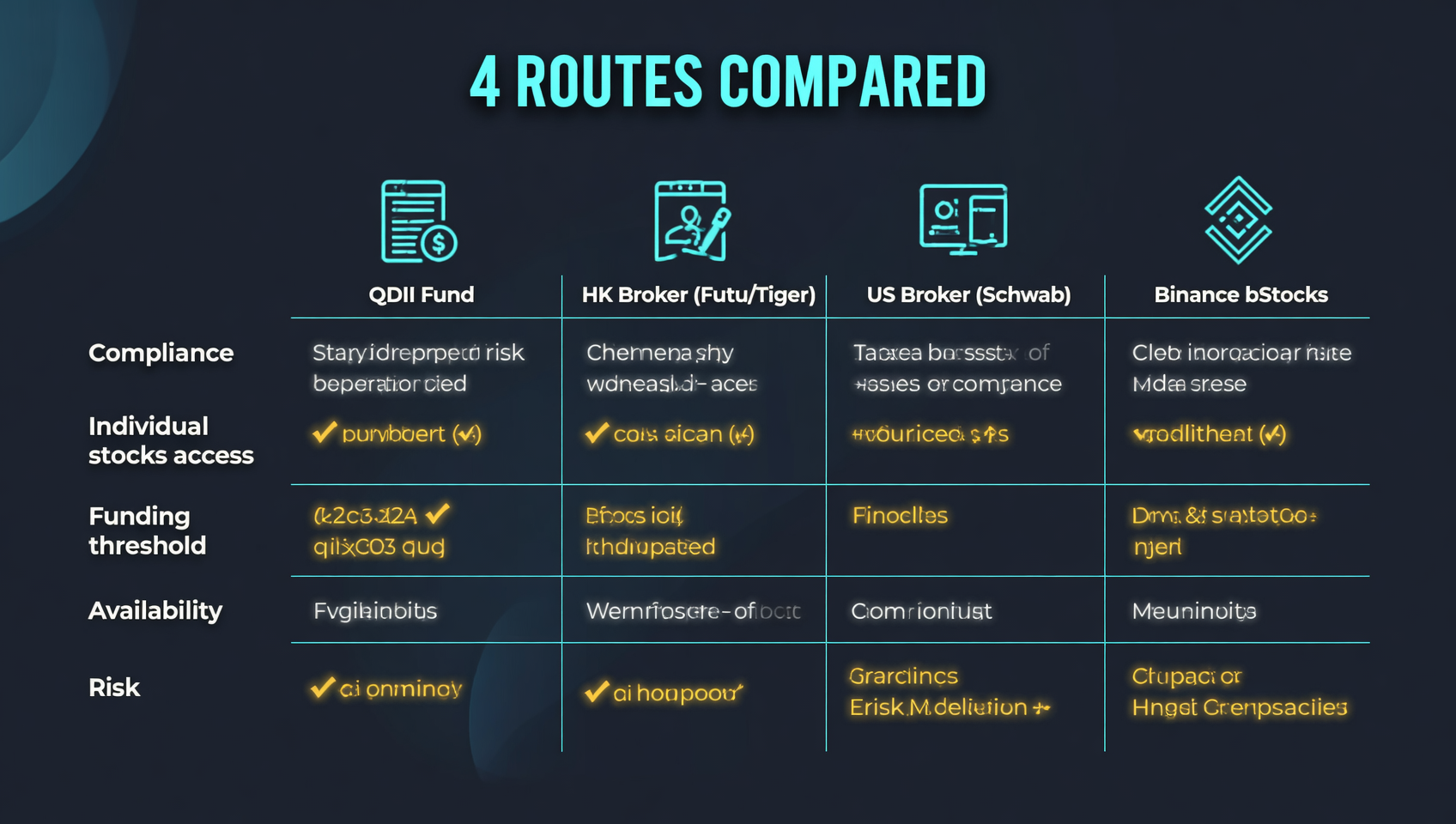
Four routes compared
| Dimension | QDII fund | HK broker (Futu/Tiger) | US broker (Schwab/Firstrade) | Binance bStocks |
|---|---|---|---|---|
| Compliance | ✅ Most compliant | ⚠️ Classified illegal | ⚠️ You bear the forex risk | ⚠️ Likely unavailable in China |
| Buy individual stocks | ❌ Index/fund only | ✅ (but can't open) | ✅ | ✅ (tokenized single stocks) |
| Funding threshold | ✅ RMB, low | ❌ Offshore funds needed | ❌ Offshore bank card needed | ✅ Stablecoins, ~$5 min |
| Offshore account needed | ❌ No | ✅ Yes | ✅ Yes | ⚠️ Binance account + region |
| Current availability | ⚠️ Limited, high premium | ❌ Closed to ordinary mainland | ⚠️ Bottlenecked at funding | ⚠️ Likely unavailable in China |
| 24/7 trading | ❌ Fund rules | ✅ | ❌ (market hours) | ✅ |
| Shareholder rights / dividends | Indirect, in NAV | ✅ Yes | ✅ Yes | ❌ No voting, dividends reinvested |
| Main risk | Premium collapse, quota limits | Can't open, stock wound down | Forex compliance, CRS | Token ≠ share, region limits |
Decision table: which route fits you
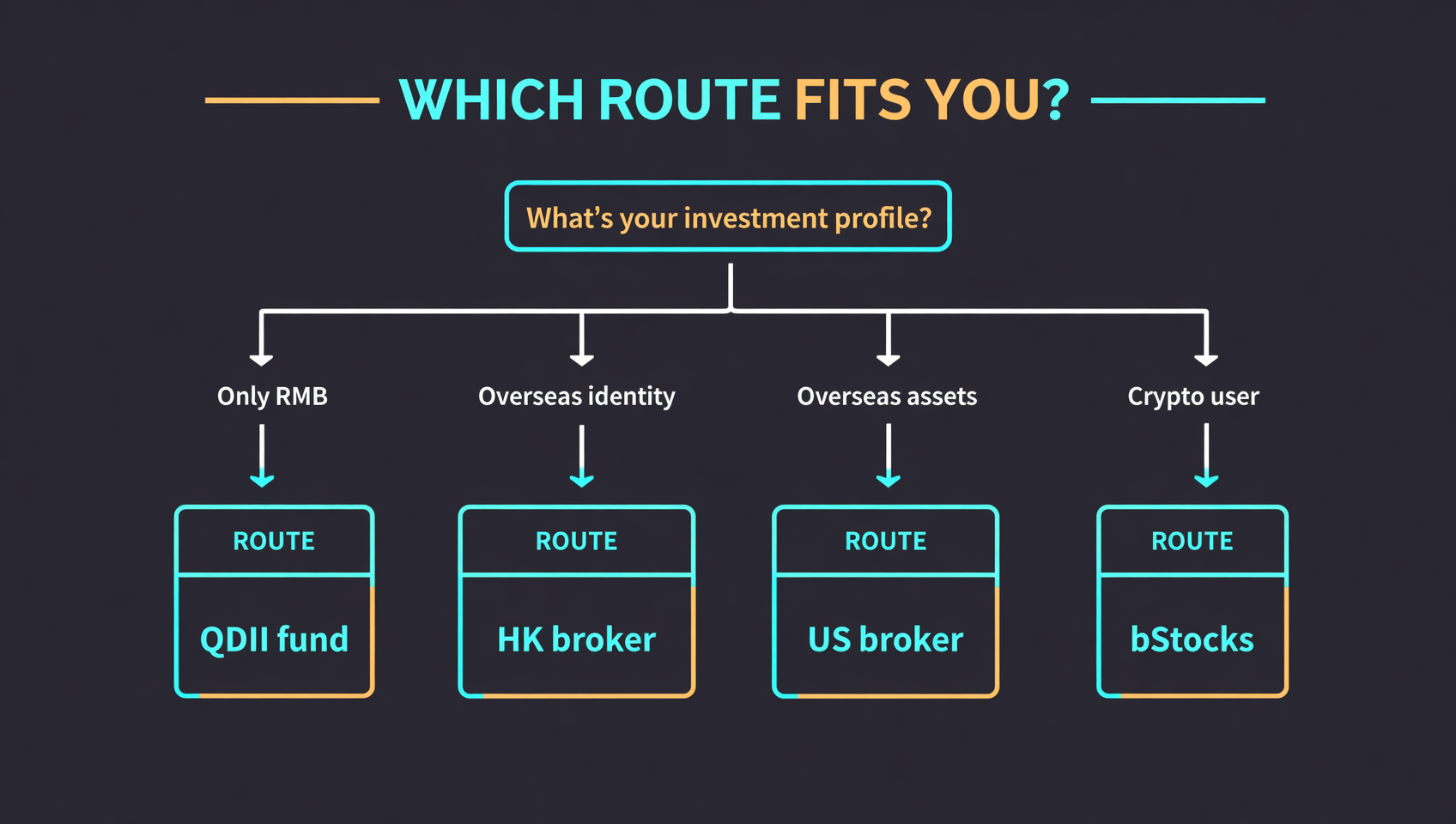
| Your situation | Top pick | Runner-up |
|---|---|---|
| Only domestic RMB, no offshore account, want the broad US market | ✅ QDII fund (Nasdaq/S&P feeder) | Mutual-recognition fund |
| Already have overseas identity / work-life proof | ✅ HK broker (Futu/Tiger) | US broker |
| Already have offshore assets / bank card, want individual stocks | ✅ US broker (Schwab/Firstrade) | IBKR (advanced) |
| Crypto user holding USDT/USDC, can accept region limits | ✅ Binance bStocks | Stock perpetuals |
| Mainly want Hong Kong stocks, asking about US as an afterthought | ✅ Stock Connect (HK only) | QDII fund |
The decision rule: first check whether you have overseas identity or funds, then whether you want an index or individual stocks, then whether you can accept limits or region restrictions. Most people land on the first row — QDII funds.
4 risks and pitfalls to know
Don't follow old tutorials to open Futu/Tiger. Most 2021-2023 account-opening guides are outdated and will just waste your time. These brokers are now basically closed to ordinary mainland residents, and don't trust "agent account-opening" middlemen — fabricating proof is a violation that risks a banned account and frozen funds15.
Don't buy QDII on-exchange ETFs at high premiums. Buying at a 15%+ premium means you're down 15% the moment you enter. A premium is a sign of overheating — it's safer to dollar-cost-average in after the premium retreats3.
Don't mistake tokenized stocks for real shares. bStocks carry no shareholder rights, no voting power, and a 30% dividend withholding tax — they are "price exposure," not equity. For real shareholder rights, buy actual shares through a broker4.
Moving money out is the biggest trap — avoid underground channels. The $50,000 FX quota explicitly excludes overseas securities investment, and using underground banks or middlemen to move money illegally risks frozen funds or worse. Bring funds back through legal channels too25.
Risk disclaimer: this article is for information only and is not investment, legal or tax advice. Cross-border securities investing involves forex, regulatory and tax constraints — confirm the latest rules in your jurisdiction and consult a professional before acting.
FAQ
The FAQ section below matches the FAQ schema at the top of this page.
Further reading
- [How to buy US stocks with Binance bStocks (2026 tutorial)]: the advanced crypto route to US stock exposure.
- [Tokenized stocks compared: Binance bStocks vs OKX/Bitget/Gate]: fees, regions and risks across four tokenized-stock routes.
- [Binance stock trading: buying US stocks and HK ADRs with USDC]: Binance's stock-trading feature (distinct from bStocks).
- [Perpetual futures for stocks, commodities and forex compared]: the leveraged crypto route to long/short stocks, gold and forex.
Footnotes
-
Source: CSRC's December 2022 classification and rectification of Futu and Tiger's cross-border securities business; Futu Q1 2026 results (mainland clients with assets at 13%); Tiger International Q1 2026 (mainland client assets ~10%); the May 2026 eight-agency plan to crack down on illegal cross-border securities, futures and fund activities. Verified October 2026. ↩ ↩2 ↩3 ↩4 ↩5 ↩6 ↩7 ↩8
-
Source: State Administration of Foreign Exchange personal FX regulations and the purchase declaration — $50,000/year convenience quota, explicitly excluding overseas securities investment. Verified October 2026. ↩ ↩2 ↩3 ↩4
-
Source: SAFE QDII quota ($170.869 billion cumulative by June 2025); Eastmoney/Tiantian Fund subscription-limit announcements Nov 2025–Jul 2026 (~60% of equity QDII funds restricted, China AMC Nasdaq 100 feeder paused, JPMorgan Nasdaq capped at 10 RMB, on-exchange premiums 15%+). Verified October 2026. ↩ ↩2 ↩3 ↩4 ↩5 ↩6
-
Source: Binance official bStocks announcements (issued by BTech Holdings, ADGM-regulated, 1:1 real-share backed, BNB Chain BEP-20); Binance June 2026 bStocks launch and region restrictions. Verified October 2026. ↩ ↩2 ↩3 ↩4 ↩5 ↩6
-
Source: Charles Schwab, Firstrade and Interactive Brokers account-opening requirements (public terms after the 2025-2026 tightening); broker websites and user reports. Verified October 2026. ↩ ↩2 ↩3 ↩4 ↩5