


📋 Table of Contents
- TL;DR Summary
- The Bottom Line: Who BSC Fits and Who It Doesn't
- First, Get the Names Straight: Binance, BNB Chain, BSC, BEP20, BNB
- Scenario 1: Is Withdrawing from Binance to BSC Worth It?
- Scenario 2: Is BSC DeFi (PancakeSwap etc.) Enough?
- Scenario 3: Are BSC NFTs and GameFi Worth Touching?
- A Safe 5-Step Onboarding Flow for Beginners
- The 5 Mistakes New Users Make Most
- The Main Security Risks of BSC
- Conclusion: One-Line Takeaway and Who It's For
- FAQ
- About the Author
TL;DR Summary
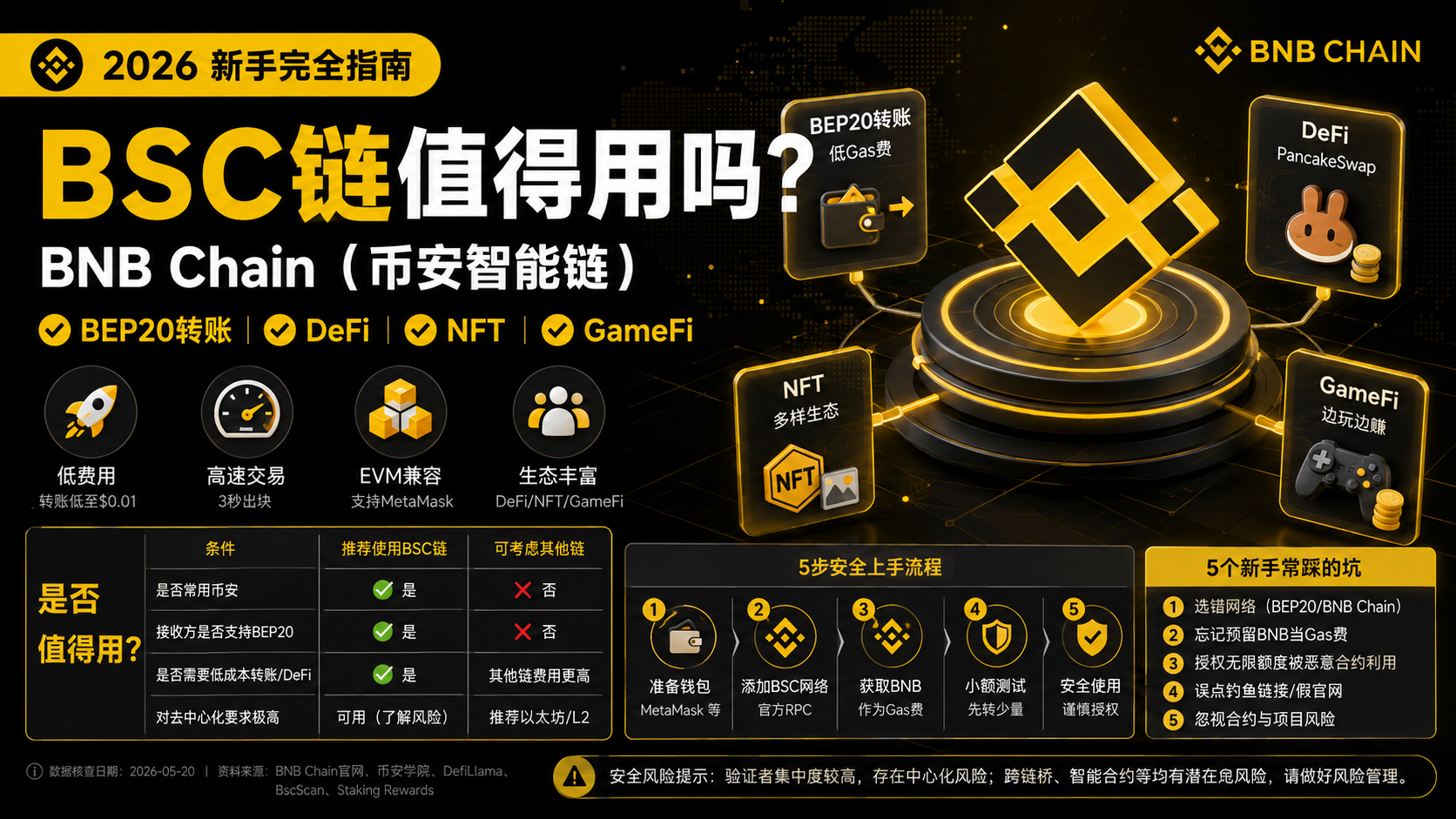
Is BNB Chain (BSC, the former Binance Smart Chain) worth using? It comes down to three conditions: whether you use Binance regularly, whether your recipient supports BEP20, and whether you need low-cost on-chain transfers or basic DeFi. If all three fit, BSC is one of the cheapest ways for a beginner to learn wallets and swaps — it's EVM-compatible (MetaMask works), produces blocks in ~0.5 seconds, and gas is typically a few cents. But think of it as an operating network, not a first choice for storing large amounts long-term: validators are relatively concentrated, the ecosystem is shallower than Ethereum L2s, and every on-chain operation is your own responsibility.12
The Bottom Line: Who BSC Fits and Who It Doesn't
Match your needs to the table below — don't follow "BSC is cheap" blindly, because cheap comes with trade-offs that don't suit everyone. This is the core decision table:
| Your need | Is BSC a fit? | Why |
|---|---|---|
| Withdraw USDT/BNB from Binance to your own wallet | Consider it | Usually lower withdrawal fees; just confirm the recipient supports BEP20 |
| First time learning wallet, transfer, swap | Great for small amounts | Low gas keeps the cost of mistakes low |
| Only buying and holding on an exchange | Not needed yet | No on-chain operation, no need for the chain |
| Want to use BNB to cut Binance trading fees | Related but not required | The BNB discount happens inside your Binance account, not on-chain |
| Researching complex DeFi, deep data | Compare Ethereum L2s too | Fewer protocols and deep-dive tools than ETH L2 |
| Care deeply about decentralization/censorship resistance | Be cautious | BSC validators and block production are relatively concentrated |
| Recipient doesn't support BEP20 | Don't use it | Network mismatch can mean funds never arrive correctly |
| Storing large amounts long-term | Be cautious | Consider self-custody, network, and token-contract risk |
One-line takeaway: BSC is one of the most convenient low-cost chains for Binance users, but it's not a universal best answer for the whole crypto market. Every section below ends with a clear judgment, so you don't have to guess.
First, Get the Names Straight: Binance, BNB Chain, BSC, BEP20, BNB
The biggest reason beginners get stuck on BSC is that these names look similar but are not the same thing. Sort them out first, and you'll be far less likely to send to the wrong network:
- Binance: the centralized exchange — your account, funds, and support live here;
- BNB Chain: the umbrella brand for Binance's blockchain ecosystem, spanning several chains;
- BSC (BNB Smart Chain): the main chain of BNB Chain, where daily transfers and DeFi happen — when people say "use BNB Chain," most of the time they mean BSC;
- BEP20: the token standard on BSC (like Ethereum's ERC20) — you must pick the right network for USDT, BNB, etc.;
- BNB: the token of the Binance ecosystem — used to pay gas on BSC and to get fee discounts inside Binance: same coin, two uses;
- opBNB / BNB Greenfield: BNB Chain's L2 scaling network and decentralized storage network — beginners can ignore them for now, but don't confuse opBNB with BSC.3
Also remember: "using BSC" is not the same as "investing in BNB." On-chain operations only need a small BNB reserve for gas; whether to buy BNB is a separate decision.
Scenario 1: Is Withdrawing from Binance to BSC Worth It?
Most people first meet BSC when withdrawing USDT from Binance to their own wallet. BSC is usually cheap and smooth — but only if both sender and recipient support BEP20. First, separate two costs, or you'll do the math wrong:
- Exchange withdrawal fee: the fixed fee shown on Binance's withdrawal page, set by the platform and subject to change;
- On-chain wallet gas: the fee charged by the BSC network when you send from your wallet to another address, paid in BNB — keep some BNB in the wallet.
| Network | Exchange withdrawal fee | On-chain wallet transfer | Key caution |
|---|---|---|---|
| BEP20 (BSC) | See the withdrawal page | Paid in BNB gas | Recipient must support BSC/BEP20 |
| TRC20 (Tron) | See the withdrawal page | Paid in TRX | Recipient must support Tron |
| ERC20 (Ethereum) | See the withdrawal page | Paid in ETH gas | Fees can rise sharply when congested |
My judgment: as long as both sender and recipient support BEP20, BSC is usually one of the cheaper, smoother options — but that doesn't mean it's always cheapest at all times and on all platforms. What you should actually compare is the "net amount received after fees," not some memorized fixed fee.14
If you pick the wrong network, how bad it is depends on the recipient: if you control the address and it's EVM-compatible, the assets may just be on another network and still visible after switching; but if funds go to a platform or custodial address that doesn't support the network, you may need manual recovery, pay a retrieval fee, or never get them back. For the first transfer to any new address, do a small test within the platform's limits first.
Scenario 2: Is BSC DeFi (PancakeSwap etc.) Enough?
BSC's DeFi is "enough" for a beginner: gas is low, and you can cheaply learn the whole wallet / swap / approval flow. For complex strategies and deep research, though, it's not the richest environment. The most common apps on BSC:56
| App | Main function | What to watch for |
|---|---|---|
| PancakeSwap | Decentralized swaps, liquidity pools | Slippage, token contract, approval scope |
| Venus | Lending protocol | Liquidation, oracles, smart-contract risk |
| BNB Staking | Staking BNB | Unlock rules, validators, yield changes |
| opBNB apps | L2 applications | Don't confuse opBNB with BSC |
My decision logic: I wouldn't simply say "BSC's DeFi is worse than Ethereum's." More accurately — BSC is for completing basic operations at low cost; Ethereum and its L2s are for researching more complex strategies, richer lending markets, and more mature on-chain tools. For a beginner, the cheapest way to learn transfer, swap, approval, and approval-revoking is on this chain; when your needs get complex, consider whether to move to an ETH L2.
To understand DeFi fundamentals, see What Is DeFi? A Beginner's Guide; before operating on-chain, read up on wallet security and revoking unused approvals.
Scenario 3: Are BSC NFTs and GameFi Worth Touching?
BSC's NFTs and GameFi are mostly low-cost experiments where risk far outweighs opportunity: fast to zero, heavy pyramid-style churn, and plenty of scams. Treat them as practice and entertainment, not investment.
- NFTs: many BSC collections are cheap to mint, illiquid, and quick to zero; fakes of major collections and honeypot contracts are common;
- GameFi: game tokens depend heavily on user growth — when the hype fades, prices collapse, and many projects are "extract value from entrants" from day one.
If you still want to try, only use money you can afford to lose entirely, and run the 5-step honeypot check before buying any new BSC token — contract scan, buy/sell tax, liquidity, holder concentration, small test-sell; stop if any step raises a red flag. For the logic behind NFTs themselves, see What Are NFTs? Are They Still Worth It in 2026.
A Safe 5-Step Onboarding Flow for Beginners
For your first time on BSC, follow these 5 steps and you'll avoid the vast majority of beginner mistakes. Safety is built into each step:
- Confirm the network: make sure both sender and recipient support BEP20 before withdrawing or sending; test with a small amount first on a new address;
- Set up the wallet: use a BSC-compatible wallet like MetaMask or Trust Wallet, downloaded from official sources only, and add the BNB Smart Chain network (RPC details from official docs);
- Keep gas reserve: send a small amount of BNB (a few dollars) into the wallet first, or your USDT transfers will fail; don't convert all your BNB into other coins;
- Small swap: do your first swap on PancakeSwap with the minimum amount, watching slippage and what actually arrives;
- Clean up after: revoke approvals you no longer need (with a revoke tool), and consider moving larger amounts to a cold wallet.
For wallet setup details, see the MetaMask wallet guide and the deposit & withdrawal guide.
The 5 Mistakes New Users Make Most
Say what not to do first — mistakes on BSC are highly concentrated, and these 5 cover the vast majority. Each one explains how the risk actually happens, not just "stay safe":
- Assuming the same coin means any network works: USDT can be withdrawn on BEP20, TRC20, or ERC20, but if the recipient doesn't support the network you chose, funds may never arrive — or cost a retrieval fee. Always verify the network before withdrawing;
- Converting all BNB away, leaving no gas: without BNB, every transfer and swap fails, and you're stuck scrambling to top up gas;
- Connecting to random projects just because gas is cheap: cheap is about fees, not risk — connecting to unknown DApps signs approvals, and malicious approvals can drain your coins;
- Treating BSC like a Binance account: BSC is decentralized — no support desk, no recovery. Lose your private key or seed phrase and it's gone forever;
- Treating "using BSC" as "investing in BNB": on-chain use needs only a small BNB reserve; buying lots of BNB for fee discounts is a separate investment decision.
Of these, #3 and #4 decide the safety of most of your funds. Read the anti-phishing guide and the common crypto scams guide for the full picture.
The Main Security Risks of BSC
BSC's advantages are cheap and convenient; its costs are centralization and self-responsibility. See the risks clearly before you start — that matters more than learning the mechanics:
- Relatively concentrated validators and block production: BSC uses Proof of Staked Authority (PoSA), with around 45 validators (21 cabinet + 24 candidate) elected by BNB stakers, closely tied to the Binance ecosystem — less decentralized than Ethereum mainnet;1
- No on-chain support, no recovery: lost private keys or wrong-network transfers have no human channel to restore;
- Smart-contract and approval risks: honeypots, rug pulls, approval phishing, and fake contracts are all common on BSC — the easiest place for a beginner to lose money;
- Self-custody responsibility: everything on BSC is on you — wallet, network, contracts, approvals — each one you must manage yourself.
Remember: BSC made "going on-chain" cheaper, but it didn't make "being safe" simpler. That part costs you just as much.
Conclusion: One-Line Takeaway and Who It's For
BSC (BNB Smart Chain) fits users who regularly use Binance, need low-cost on-chain operations, and whose recipients support BEP20 — as a money-saving network for practice and everyday transfers; but it's not the place to store all your assets, nor is it a model of decentralization.
- Good for: Binance users, beginners who want a low barrier to learning wallets and DeFi, and small transfers plus basic DeFi needs;
- Not for: users who only trade on exchanges and never go on-chain (no need); users who care deeply about decentralization and censorship resistance (be cautious); and users storing large amounts long-term (evaluate self-custody and network risk yourself).
One line to close: BSC is genuinely cheap — but only for people who know how to use it safely.
⚠️ Risk warning: This article is educational blockchain content, not investment advice. On-chain operations on BSC and crypto investment carry extreme risk; gas, withdrawal fees, and platform rates can all change — follow Binance's official fee page and the wallet/block explorer's live figures, and only use money you can afford to lose.
FAQ
Organized by real search queries, so you can find your case quickly.
I only have USDT in my wallet, no BNB — can I send a transaction on BSC?
No. Every transfer, swap, and contract call on BSC (BNB Smart Chain) requires a small amount of BNB to pay gas. Without BNB, your USDT transfer will keep failing. Fix: send a small amount of BNB (a few dollars) to that wallet first — enough to cover a few operations.
Withdrawing USDT from Binance — BEP20, TRC20, or ERC20? How do I decide?
First check which network the recipient supports, then compare the "actual amount received after fees." If the recipient supports BEP20 and the net amount is competitive, BSC is usually the low-cost, smooth choice; if they only support TRC20 use Tron, and ERC20 use Ethereum. Don't just trust network names — the withdrawal page shows the live fee and estimated arrival amount.
How much does a BSC transfer actually cost?
BSC gas is priced in BNB and varies dynamically, typically a few cents per transaction (far below Ethereum mainnet). Check the wallet or block explorer for the live gas estimate. Note: the dollar value of gas moves with BNB's price — the more expensive BNB is, the higher the dollar cost of the same gas.
Do I need to buy a lot of BNB to use BSC?
No. On-chain operations only need a small BNB reserve for gas (a few dollars lasts a long time). Holding BNB to get fee discounts on Binance is a separate matter that happens inside your Binance account — don't confuse the two.
Can I move assets from BSC to Ethereum or other chains?
Yes, but you need a cross-chain bridge. Bridges are prime hacker targets, with hundreds of millions stolen in the past. If you must bridge, use only well-known, audited bridges, test with small amounts, and double-check the target chain and address. See the cross-chain bridge security guide.
Is it safe to buy new tokens on BSC?
High risk. BSC hosts many newly launched low-cap and meme coins, and a large share are honeypots (buy but can't sell), rug pulls, or fake contracts impersonating major coins. Before buying any new BSC token, run the 5-step honeypot check — contract scan, buy/sell tax, liquidity, holder concentration, small test-sell — and stop if any step raises a red flag.
About the Author
CoinVado Research is the content research team behind CoinVado, focused on blockchain education, on-chain data, and crypto risk awareness. We keep every data point verifiable and never fabricate facts, so newcomers can build a sound understanding of crypto.
⚠️ Risk warning: This article is educational content and does not constitute investment advice. BSC on-chain interaction and crypto investment carry extreme risk; gas, fees, and rules can change at any time — follow Binance's official fee page and live on-chain data, and act according to your own risk tolerance.
📖 Related reading:
- Crypto Wallet Complete Guide: Hot vs Cold Wallets — master self-custody basics before going on-chain
- MetaMask Complete Wallet Guide — setting up a common BSC-compatible wallet
- What Is DeFi? A Beginner's Complete Guide — DeFi fundamentals and risks
- How to Detect Honeypot Tokens 2026 — run this check before buying any new BSC token
- DeFi Approval Security: Revoking Unused Approvals — clean up approvals after you finish
- Crypto Phishing Guide 2026 — fake sites and approval phishing protection
- On-chain Guide (CoinVado) — more on-chain data and crypto education
Footnotes
-
BNB Chain official docs (https://docs.bnbchain.org/bnb-smart-chain/introduction/): BSC uses PoSA consensus with 45 validators (21 cabinet + 24 candidate), ~0.45s block time, gas typically $0.01–0.10. History and network parameters verified 2026-08-14. ↩ ↩2 ↩3
-
Binance official FAQ (https://www.binance.com/en/support/faq/detail/115000583311): paying fees with BNB gives up to 25% off spot/margin and 10% off futures; spot example 0.10% → 0.075%. Fees verified 2026-08-14, subject to change. ↩
-
BNB Chain official docs (https://docs.bnbchain.org/): the ecosystem includes BNB Smart Chain (BSC), opBNB (L2), and BNB Greenfield (decentralized storage). Verified 2026-08-14. ↩
-
BscScan (https://bscscan.com/) — BNB Smart Chain block explorer for validators, gas, and on-chain data. Verified accessible 2026-08-14. ↩
-
PancakeSwap official docs (https://docs.pancakeswap.finance/) — the decentralized exchange on BSC. Verified accessible 2026-08-14. ↩
-
DeFiLlama (https://defillama.com/) — on-chain TVL and protocol data. Verified accessible 2026-08-14. ↩