


Table of Contents
- TL;DR: The Verdict First
- The Decision Table: Match Yourself in 30 Seconds
- 2026 Data: The Three Side by Side
- What Most Comparisons Miss: The Three-Layer Structure
- Real Yield Math: What $1,000 and $10,000 Earn
- Token Mechanics: Three Different Receipts
- Decentralization & Safety: Lido's Centralization vs Rocket Pool vs Frax
- DeFi Integration: Collateral Depth and Liquidity
- New 2026 Risk: Restaking and Slashing Going Live
- How to Do It: Liquid Staking in Three Steps
- FAQ
- Further Reading
TL;DR: The Verdict First
Want liquidity, deep DeFi integration and easy large exits → pick Lido stETH; want decentralization, cleaner taxes and long-term holds → pick Rocket Pool rETH; understand the two-token design and only want maximum yield on a small position → pick Frax sfrxETH. But one point matters more: all three net yields are squeezed into a narrow 2%–3% band — the real differences are liquidity, decentralization and mechanism complexity, not the last decimal of APY. Most comparisons still use stale 2022 data and treat the three as interchangeable.
Three supporting judgments:
- The size gap is orders of magnitude. As of September 2026, Lido holds ~$17.5B TVL (~9.2M ETH), Rocket Pool ~$1.0B, and Frax Ether ~$100M1. Lido alone takes ~62% of the liquid staking token (LST) market.
- The mechanics have diverged. stETH is a rebasing token (balance grows daily), rETH is a value-accruing token (price rises against ETH), and sfrxETH is a two-token design (frxETH pegged 1:1 plus a yield-bearing sfrxETH wrapper)2.
- Safety isn't stronger-or-weaker — it's a trade-off between centralization and exposure. Lido controls ~24% of all staked ETH and is the largest single entity; Rocket Pool runs ~3,900 permissionless operators whose RPL bonds backstop slashing; Frax has the smallest validator set and no dedicated insurance fund3.
⚠️ This article is about choosing a tool, not investment advice. Liquid staking adds smart-contract and depeg risk on top of regular staking — there's no bank-style deposit insurance, so you manage the risk yourself. Never put more into DeFi than you can afford to lose.
Not the right article for you yet? If you've never used an on-chain wallet or don't know what staking means, start with What is DeFi? A Beginner's Guide and Crypto Staking Complete Guide first.
The Decision Table: Match Yourself in 30 Seconds
| Your situation | Pick | Why |
|---|---|---|
| Stake ETH but keep using it in DeFi | Lido stETH | 100+ protocol integrations, deepest liquidity, easy large exits |
| Long-term hold, don't want daily tax bookkeeping | Rocket Pool rETH | Value-accruing token, single capital event on sale |
| Prioritize decentralization | Rocket Pool rETH | ~3,900 permissionless operators, not a few institutions |
| Chase maximum yield on a small position only | Frax sfrxETH | Concentrates all rewards into sfrxETH, ~3% APY |
| Use the LST as collateral to borrow stablecoins | Lido or Rocket Pool | stETH has the deepest collateral depth; rETH the cleaner liquidation buffer |
| Under $1,000 | CEX or L2 | Mainnet gas eats most of the yield |
| Over $100,000 | Split across two | Diversify single-point risk, see amount-based picks below |
💡 One logic repeats through the whole table: first ask whether you want liquidity, decentralization or yield, then choose among the three. All the data below supports this line.
2026 Data: The Three Side by Side
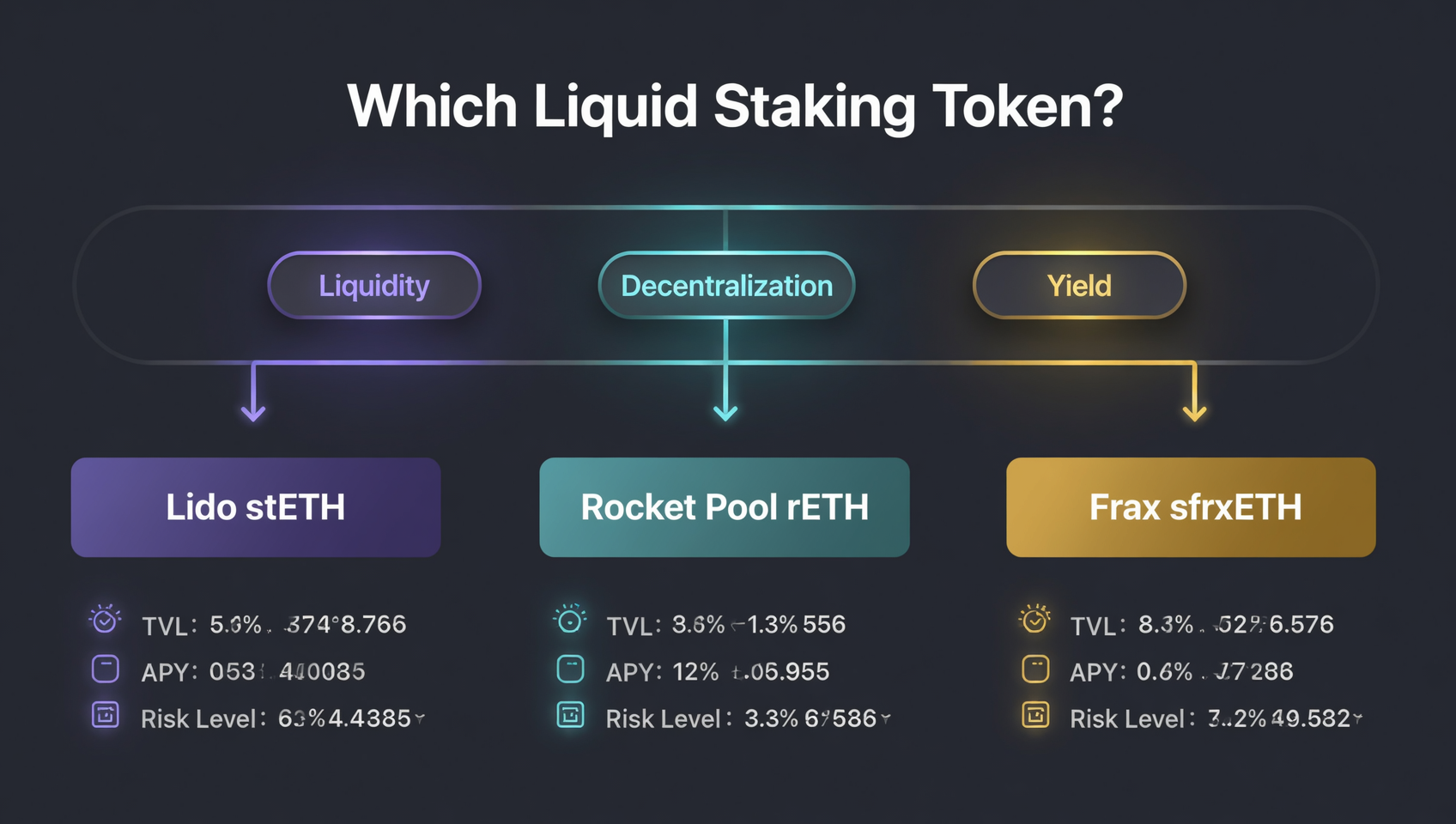
Plenty of "Lido vs Rocket Pool" articles still cite 2022-2023 numbers. Here's 2026 data, verified 2026-09-30123:
| Metric | Lido (stETH) | Rocket Pool (rETH) | Frax Ether (sfrxETH) |
|---|---|---|---|
| TVL | ~$17.5B (~9.2M ETH) | ~$1.0B (~500K ETH) | ~$100M (~54K ETH) |
| LST market share | ~62% | ~3.5% | ~0.3% |
| Share of all staked ETH | ~24% | ~1% | ~0.1% |
| Net APY (after fees) | ~2.2% | ~2.2% | ~3.0% |
| Protocol fee | 10% | 14% | 10% |
| Token mechanism | Rebase (balance grows daily) | Value accrual (price rises vs ETH) | Two-token (frxETH 1:1 + sfrxETH yields) |
| Node operators | ~36 curated + CSM permissionless module | ~3,900 fully permissionless | Smaller curated set |
| Dedicated insurance/backstop | Yes (insurance fund) | Yes (RPL bonds absorb slashing) | No |
| Depeg history | 2022-06 fell to 0.93 ETH | Redemption mechanism caps depeg | Indirect via Curve pool |
Three readings worth remembering:
- Lido's lead is crushing. ~$17.5B versus $1.0B and $100M — that's orders of magnitude, not a slight edge. Lido takes ~62% of the LST market, which is exactly why every DeFi protocol treats stETH as the default ETH collateral1.
- The three net yields are nearly identical. 2.2%, 2.2%, 3.0% — less than a point apart. In 2026 network staking APR has fallen from over 5% to ~2.6%, so after 10%–14% protocol fees everyone nets roughly 2%, except Frax, which pushes headline APY to ~3% by funneling all rewards into sfrxETH2.
- Frax's share is almost negligible. ~0.3% of LST, ~54K ETH — its value isn't scale but differentiation: it's one of the few LSTs whose yield reliably beats the market, at the cost of the most complex mechanics and no insurance fund.
What Most Comparisons Miss: The Three-Layer Structure
Liquid staking's essence is splitting "staking yield" from "capital liquidity" and selling them separately. Grasp this and you'll understand why there are different receipt tokens like stETH, rETH and sfrxETH at all.
Three layers in one sentence each:
- Bottom layer: validators are actually staking. The ETH you hand over ends up in Ethereum validator nodes earning network rewards. By September 2026 about 43 million ETH (~35% of supply) is staked, with ~900,000 active validators and network APR around 2.6%2.
- Middle layer: the protocol issues a receipt token. That receipt represents your claim on the underlying staked ETH. stETH, rETH and sfrxETH are all receipts — they just "grow" differently (see token mechanics below).
- Top layer: the receipt earns again in DeFi. You can use it as collateral to borrow on Aave, market-make on a DEX, or restake into EigenLayer for points — one pile of ETH earning two yields at once.
This structure explains the biggest counterintuition: staking yield itself is fixed and transparent — what actually separates the leaders is the breadth and depth of the top-layer DeFi integration. Lido is the leader not because its staking yield is highest, but because stETH can go to the most places and holds the hardest collateral value.
Real Yield Math: What $1,000 and $10,000 Earn
Using September 2026 net APYs, with ETH around $2,500:
| Amount | Lido stETH (~2.2%) | Rocket Pool rETH (~2.2%) | Frax sfrxETH (~3.0%) |
|---|---|---|---|
| $1,000 (~0.4 ETH) | ~$22/year | ~$22/year | ~$30/year |
| $10,000 (~4 ETH) | ~$220/year | ~$220/year | ~$300/year |
Three truths that are easy to miss:
- At small amounts, gas is the biggest cost. One mainnet stake can cost $5–$20 in gas, and every step — depositing stETH on Aave, swapping on a DEX — adds more. On $1,000 principal, a few operations eat half the yield. Below ~$1,000, use an L2 (gas costs cents on Arbitrum/Base) or a centralized exchange.
- There's a protocol fee between headline APY and what you get. Lido takes 10%, Rocket Pool 14%, Frax 10%. A "~3%" headline can net out to ~2.6%2.
- Frax's high yield has strings attached. sfrxETH's ~3% comes from two parts: network staking rewards plus Curve frxETH/ETH pool gauge incentives (FRAX token subsidies). When subsidies taper, the yield drops noticeably — it's not free 3%, it's volatile 3%3.
Token Mechanics: Three Different Receipts
This is the most fundamental — and most overlooked — difference between the three. It simultaneously determines how your yield accrues, your tax treatment, and how each behaves in a depeg.
| Mechanism | Lido stETH | Rocket Pool rETH | Frax frxETH/sfrxETH |
|---|---|---|---|
| Type | Rebase | Value accrual | Two-token |
| How yield shows up | Your stETH balance auto-grows daily | The rETH/ETH rate slowly rises | frxETH stays 1:1 to ETH; yield flows into sfrxETH |
| Typical tax | Daily rebases may count as income (US/UK) | Single capital event on sale/redeem | Wrapping treated differently by jurisdiction |
| During a depeg | Deepest liquidity re-pegs fastest | Redemption mechanism caps sustained depeg | Indirect depeg via the Curve frxETH/ETH pool |
Three points worth keeping:
- stETH's rebase is passive but fiddly. You do nothing and the balance grows; but in jurisdictions like the US and UK each rebase may count as a taxable income event — 365 events a year4.
- rETH's value accrual is quiet. It doesn't rebase; the rETH/ETH rate simply rises and you realize the gain once on sale or redemption. Cleanest bookkeeping for long-term holders.
- sfrxETH is split in two. You stake ETH to get frxETH (pegged 1:1, no yield), then wrap frxETH into sfrxETH to earn. That wrapping is what concentrates the yield — and what makes it more complex to understand and to tax5.
Decentralization & Safety: Lido's Centralization vs Rocket Pool vs Frax
The short version: none of the three core contracts has ever been directly exploited for user funds — the real divide is who controls the validator set and who backstops failures.
- Lido: centralization is a structural risk, not a rug-pull risk. Its validators were once run mostly by ~36 curated operators; by 2026 it has opened a permissionless Community Staking Module (CSM) to dilute concentration. But as of September 2026 Lido still controls ~24% of all staked ETH, the single largest entity3. What's threatened isn't "your money being stolen" but Ethereum's consensus-level censorship resistance — if a single entity approaches 33% of staked ETH it could theoretically influence block confirmation. That's why the community keeps pushing Lido to self-limit.
- Rocket Pool: backstop written into the economics. ~3,900 node operators are fully permissionless; anyone can stake 4–8 ETH plus RPL to run a node. The RPL bond's job: when a node misbehaves, the operator's RPL and ETH bond absorb the slashing before rETH holders take a hit — this is the backbone of its "most decentralized" claim6.
- Frax: the price of yield is no backstop. It has the smallest validator set and no dedicated insurance fund, relying entirely on curated-operator quality. That's why multiple sources advise against using sfrxETH as collateral or with leverage3.
Depeg risk is shared, and it's real. In June 2022, Three Arrows and Celsius dumped stETH for liquidity on Curve, pushing it to 0.93 ETH (about 7% below peg)7. Note: that was not slashing (validator misbehavior) but a liquidity crisis — which is exactly why "deepest liquidity re-pegs fastest" is Lido's moat and rETH/sfrxETH's soft spot.
DeFi Integration: Collateral Depth and Liquidity
In DeFi, an LST's value = where it can go + how much you can borrow against it + how little slippage on a large exit.
| Integration dimension | Lido stETH | Rocket Pool rETH | Frax sfrxETH |
|---|---|---|---|
| Integrated DeFi protocols | 100+ | Medium | Fewest |
| Aave collateral depth | Dedicated Lido market ($2B+ supplied) | Yes, smaller | None/minimal |
| Large-exit slippage on DEX | Smallest | Small | Largest |
- stETH is a universal collateral. Aave has a dedicated Lido market with $2B+ supplied, and DEX liquidity is deepest, so large exits have the least slippage6. That's the compounding effect of its 62% share — the more people use it as collateral, the more valuable it is, and the more valuable it is, the more people use it.
- rETH works but isn't as smooth as stETH. Integrations are growing, but large-exit liquidity is thinner.
- sfrxETH is yield-first, integration-second. It has the smallest DeFi footprint; in most cases it's not recommended as collateral, only as a "park it and earn" tool3.
New 2026 Risk: Restaking and Slashing Going Live
2026 is a watershed for the liquid staking risk map: restaking slashing actually went live.
- From April 2026, EigenLayer enabled slashing at the AVS layer — restake stETH/rETH into an AVS and you can lose principal at the AVS layer even if your underlying validator behaves perfectly8.
- The April 19, 2026 Kelp DAO incident was the first material restaking-layer security event since slashing went live, reminding the market that restaking chain-links risk8.
What this means for ordinary users: if you just want staking yield, stay at the base layer (plain stETH/rETH) and skip the points and extra rewards of restaking until the sector matures. Restaking's extra yield comes from you taking on extra slashing risk — it's not free money.
One more 2026 certainty: on August 5, 2025 the SEC's guidance concluded that LSTs "in most current implementations" are not securities, giving liquid staking a measure of regulatory comfort9.
How to Do It: Liquid Staking in Three Steps
Using Lido as the example, the whole flow takes about 10 minutes.
Step 1: Prepare ETH and a wallet
- Buy ETH on Binance/OKX and withdraw to a self-custody wallet (e.g. MetaMask).
- Use mainnet ETH for mainnet staking; to save gas, bridge ETH to Arbitrum or Base first.
Step 2: Connect and stake
- Open the Lido app and connect your wallet.
- Enter the amount of ETH to stake and confirm — you'll receive stETH at the current rate.
- Note the expected APR and protocol fee (Lido 10%).
Step 3: Manage your LST
- stETH rebases automatically, growing your balance daily; use wstETH (the non-rebasing wrapper) if you want a stable balance.
- To exit: swap stETH back to ETH on a DEX, or request a withdrawal from Lido (typically 1–5 days, worst case ~8 days)4.
- After using DeFi, revoke any unused contract approvals — see our DeFi approval security guide.
Stop conditions — if any of these appear, stop first:
- Someone DMs you for your seed phrase or private key → 100% a scam, stop.
- You're choosing the most complex, no-backstop protocol for an extra 0.5% APY on money you need locked → not worth it.
- You're exposing principal to AVS-layer risk you don't understand just for "restaking points" → learn what slashing means first.
FAQ
What's the difference between liquid staking and regular staking?
Regular staking locks your ETH — either with a centralized exchange or your own 32 ETH validator — so you can't use it elsewhere. Liquid staking hands ETH to a protocol for a receipt token (stETH/rETH/sfrxETH), letting you earn staking yield while using the receipt to borrow, market-make or restake. The trade-off is extra smart-contract and depeg risk.
Should I choose Lido, Rocket Pool or Frax?
Match it to your needs: want liquidity, DeFi integration and easy large exits → Lido stETH; want decentralization and cleaner taxes for long-term holds or collateral → Rocket Pool rETH; understand the two-token design and only want max yield on a small position → Frax sfrxETH. Net yields are all 2%–3%; the real differences are liquidity, decentralization and mechanism complexity.
Is stETH or rETH safer?
Protocol-layer: none of the three core contracts has been directly exploited. Exposure surface differs: Lido uses ~36 curated operators plus CSM and disclosed a ~20 ETH slashing in 2023; Rocket Pool's ~3,900 permissionless operators have RPL bonds that absorb small slashing first; Frax has the smallest set and no insurance fund. The shared real risk is depeg — stETH fell to 0.93 ETH in June 2022.
Why is Lido's centralization discussed so much?
Staking secures the network with economic penalties — if one entity controls over a third of staked ETH, it theoretically threatens consensus. Lido holds ~24% of all staked ETH (below 33% but the largest single entity), so the community pushes it to cap share and open the permissionless Community Staking Module. It's a structural risk, not a rug-pull risk.
Why have liquid staking yields dropped in 2026?
Staking APR moves inversely with total staked supply: more staked ETH means thinner per-validator rewards. By September 2026 ~43 million ETH (~35% of supply) was staked, pushing network APR from over 5% to ~2.6%, and LST net yields to ~2.2%–3% after fees. It's the whole market filling up, not a protocol getting stingy.
How much should I stake to make it worthwhile?
Below ~$1,000, mainnet gas eats most of the yield — use an L2 or a CEX. $1,000–$10,000 suits Lido or Coinbase's cbETH; $10,000–$100,000 favors Rocket Pool rETH; above $100,000 split across two protocols; above $200,000 consider running your own 32 ETH validator to skip protocol fees.
Further Reading
- Crypto Staking Complete Guide 2026 — PoS staking, liquid staking and yields
- What is DeFi? A Beginner's Guide — DeFi fundamentals
- Aave Lending & Borrowing Guide — the most common place stETH earns as collateral
- DeFi Liquidity Pools & Impermanent Loss Guide — the risk of market-making with LSTs
- DeFi Approval Security: Revoking Unused Contract Approvals — the cleanup you must do after
- On-Chain Guide — more blockchain explainers and on-chain tutorials
Data verification note: TVL, APY, market share and security events verified 2026-09-30; sources in the footnotes below123456789. Staking yield and TVL fluctuate in real time — check DefiLlama and each protocol's live app before acting.
This article is not investment advice. Liquid staking involves smart-contract, depeg, slashing and restaking risks — decide based on your own situation and comply with local laws.
Footnotes
-
TVL and LST share: Lido stETH ~$17.5B (~9.2M ETH), Rocket Pool rETH ~$1.0B (~500K ETH), Frax sfrxETH ~$100M (~54K ETH); LST shares ~62%, ~3.5%, ~0.3%. Source: DefiLlama Liquid Staking rankings (queried 2026-09). ↩ ↩2 ↩3 ↩4
-
APY and network data: network staking APR ~2.6%, ~43M ETH staked (~35% of supply), ~900K active validators; net APY stETH ~2.2%, rETH ~2.2%, sfrxETH ~3.0%. Source: DefiLlama, Bitget "Ethereum Staking Weekly Report" 2026-09-07, Ebunker staking data. ↩ ↩2 ↩3 ↩4 ↩5 ↩6
-
Validator models and safety: Lido ~36 curated operators + CSM, ~24% of all staked ETH; Rocket Pool ~3,900 permissionless operators (4–8 ETH + RPL bond); Frax curated set, no dedicated insurance fund. Source: ChainGain "Liquid Staking 2026: Lido vs Rocket Pool vs Frax Compared", Panaprium slashing-risk analysis. ↩ ↩2 ↩3 ↩4 ↩5 ↩6 ↩7
-
stETH rebase and wstETH wrapper, withdrawal 1–5 days (worst case ~8 days), and tax treatment. Source: Lido official docs, ChainGain tax section. ↩ ↩2 ↩3
-
Frax two-token design (frxETH 1:1 peg + yield-bearing sfrxETH, yield from network rewards + Curve frxETH/ETH pool gauge incentives). Source: Frax official docs, ChainGain. ↩ ↩2
-
Aave dedicated Lido market with $2B+ supplied, stETH integrated with 100+ protocols; Rocket Pool RPL bond slashing backstop. Source: Aave, Rocket Pool docs, Jumper Learn. ↩ ↩2 ↩3
-
June 2022 stETH depeg to ~0.93 ETH (~7% discount), driven by Three Arrows/Celsius selling on Curve. Source: ChainGain, CoinDesk historical coverage. ↩ ↩2
-
EigenLayer AVS-layer slashing went live April 2026; the 2026-04-19 Kelp DAO incident was the first material restaking-layer event since. Source: ChainGain, The Defiant 2026 coverage. ↩ ↩2 ↩3
-
August 5, 2025 SEC guidance that LSTs "in most current implementations" are not securities. Source: SEC statement, cited by ChainGain. ↩ ↩2