


Table of contents
- TL;DR: the bottom line
- Decision table: match yourself in 30 seconds
- Fix one misconception first: these chains have become three different species
- Core data comparison: one table to see it all
- Speed and fees: Solana is fast and cheap, but fast isn't everything
- Ecosystem and capital: TVL is what actually matters
- Consensus and decentralization: three different tradeoffs
- Developer view: Solidity or Rust
- Three questions that decide which chain you use
- FAQ
- Further reading
TL;DR: the bottom line
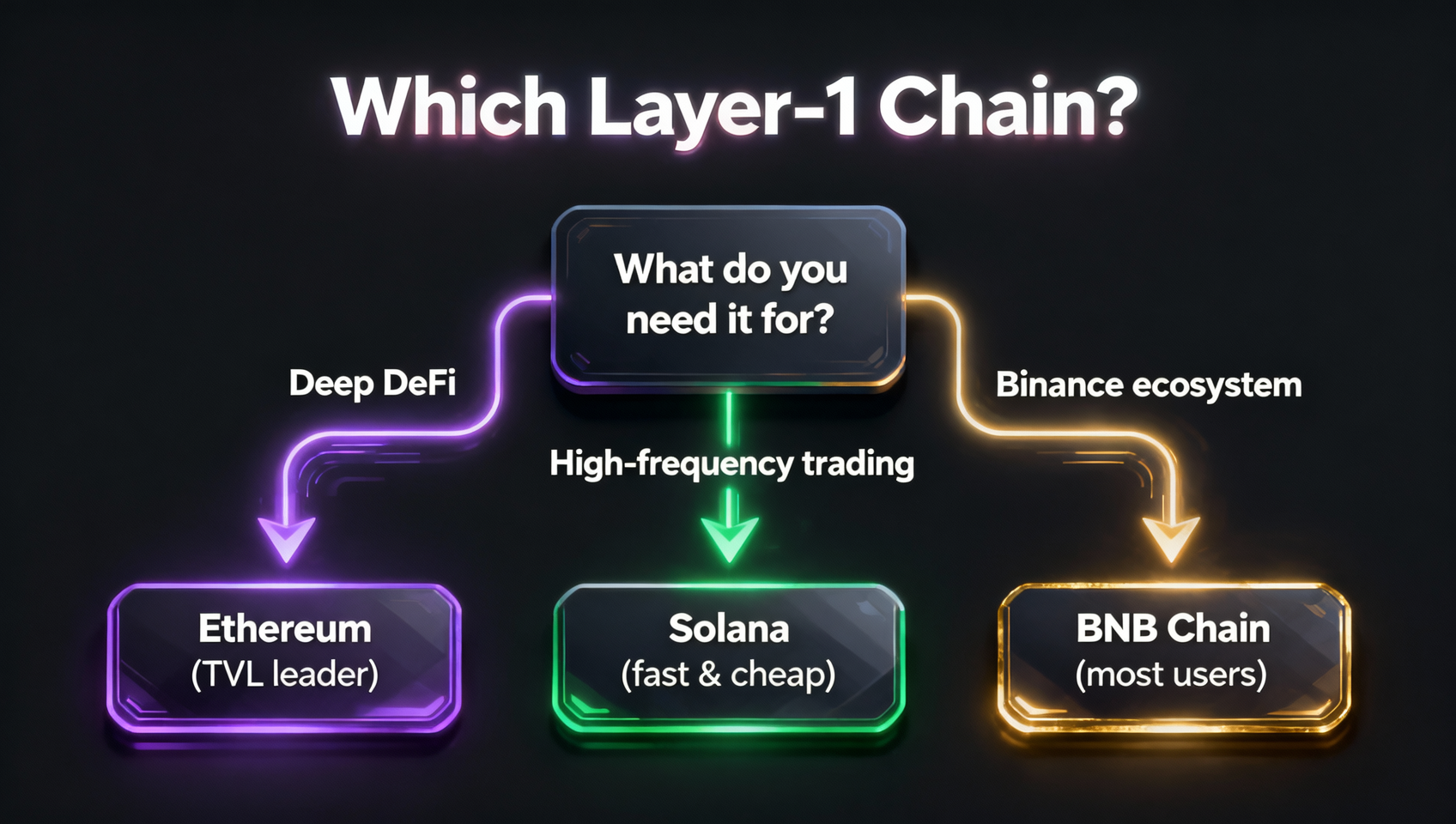
This isn't a "which chain is better" question — it's a "what do you need it for" question, because the three chains have already split into three species. Deepest capital and institutional-grade security → Ethereum; fastest and cheapest, for high-frequency trading or new-narrative coins → Solana; a cheap, high-user EVM chain inside the Binance ecosystem → BNB Chain.
Three supporting judgments:
- Speed and capital are two different things. Solana is fastest (roughly 1,100–2,500 real TPS, ~$0.003 fees), but its DeFi TVL is only about $5.9B — roughly one-eighth of the "slow and expensive" Ethereum's $49.9B12. Speed fixes the transaction experience; capital settles on secure consensus and institutional trust.
- Market cap ≠ usage. BNB has a ~$100B market cap but only ~$5.9B in TVL; Solana has a ~$61B market cap yet carries the industry's highest daily transaction count (about 79–95 million) and 18 straight months as #1 in DEX share34. Don't judge a chain's value by market cap alone.
- The three chains' "decentralization" is not the same order of magnitude. Ethereum has millions of validators, Solana thousands, and BNB Chain about 45 (21 producing per round)5. Security and decentralization are the hidden password to understanding their differences.
⚠️ This article is about how to choose and understand these chains, not investment advice. SOL, ETH, and BNB are all highly volatile crypto assets, and a technical advantage never guarantees a higher price. Don't read "this chain is faster" as "this token will gain more."
If you're not yet sure what these chains are, start with the Solana beginner guide and the Ethereum 2026 complete guide before coming back to the comparison.
Decision table: match yourself in 30 seconds
| Your situation | Pick | Why |
|---|---|---|
| Deep DeFi, large stablecoin positions, working with institutions | Ethereum | $49.9B TVL leader; deepest stablecoins and RWA |
| High-frequency trading, chasing new coins, gaming, cheap + fast | Solana | ~$0.003 fees, #1 DEX volume, highest daily transactions |
| A cheap EVM chain inside Binance, borrowing Binance's user traffic | BNB Chain | ~$0.03 fees, 50M+ monthly users, opBNB for further scaling |
| Developer who knows Solidity / the EVM | Ethereum or BNB Chain | Code is nearly portable, tooling is most mature |
| Developer willing to learn Rust, with hard performance needs | Solana | Higher performance ceiling, but steeper learning curve |
| Institutions / RWA / tokenizing real-world assets | Ethereum | ~45.8% of RWA, deepest institutional trust |
| Just want to buy mainstream coins to hold | Any of the three | Judge the token's narrative and liquidity, not a single chain |
💡 The one line that keeps repeating: first ask "what am I using it for," then "which chain does that best." Speed, cost, and decentralization can't all be maxed — what you actually want is a tradeoff, not a "winner." Every data point below supports this.
Fix one misconception first: these chains have become three different species
Many comparison pieces line Solana, Ethereum, and BNB Chain up on the same track and compare "who has higher TPS, who's cheaper," then declare "Solana wins." That's wrong.
By 2026, these three chains are no longer competitors in the same species — they're three products with three different positions:
- Ethereum = the secure settlement layer. It deliberately outsources transaction execution to L2s (Arbitrum, Base, Optimism, etc.) and keeps only the two most expensive jobs on the mainnet — secure consensus and final settlement. It's not selling cheap gas; it's selling "trust that anyone can safely park money on." The 2026 Glamsterdam upgrade will push the gas limit from ~60M toward a 200M target and cut fees by roughly 60–70%6 — the more it cuts, the clearer it is that it doesn't care about earning from gas.
- Solana = the high-performance monolithic chain. No L2s, no splitting — one chain with parallel execution, maxed for speed. It sells "fast and cheap user experience," which is why it has led DEX volume for 18 straight months4.
- BNB Chain = Binance's EVM-compatible ecosystem layer. One BSC (EVM-compatible) + one opBNB (L2) + one Greenfield (storage), running a more centralized PoSA consensus. It sells "backed by Binance, most users, still cheap"57.
So when you ask "which chain is better," you're really asking "do I want secure settlement, extreme speed, or the largest user base" — three different questions with three different answers.
Core data comparison: one table to see it all
The table below is the skeleton of the whole article. All figures are a September 2026 snapshot; check live values123845:
| Dimension | Ethereum | Solana | BNB Chain |
|---|---|---|---|
| Native token market cap | ~$306B (~47% of chain share) | ~$61B | ~$100B |
| Token price | ~$2,500 | ~$104 | ~$750 |
| DeFi TVL | ~$49.9B (#1) | ~$5.9B (#3) | ~$5.9B (#2, just flipped Solana) |
| Avg transaction fee | ~$0.10+ (higher when congested) | ~$0.003 (lowest) | ~$0.03 |
| Real throughput TPS | ~15–30 (L1) | ~1,100–2,500 | ~2,545 (fastest EVM chain) |
| Block time | ~12 s | ~0.4 s | ~0.45 s |
| Monthly active addresses | ~9.6M | ~32.7M | ~50M+ (most) |
| Daily transactions | ~1.6–2M | ~79–95M (most) | high |
| Consensus | PoS (millions of validators) | PoH + PoS | PoSA (~45 validators) |
| Dev language | Solidity (EVM) | Rust | Solidity (EVM-compatible) |
| DEX share (Mar 2026) | ~26% | ~33% (#1) | ~15% |
| RWA share (Aug 2026) | ~45.8% (#1) | ~9.8% | ~15.4% |
A few takeaways you can read at a glance:
- Market cap and capital are heavily concentrated in Ethereum. Its TVL is over 6x the combined second and third places.
- The "speed leaderboard" and the "capital leaderboard" are two different crowds. Solana and BNB Chain sweep speed, cost, and user count, but can't hold the most capital; Ethereum is the reverse.
- BNB Chain only just flipped Solana for #2 TVL in September 2026 — by about $48M (under 1%), a razor-thin lead2.
Speed and fees: Solana is fast and cheap, but fast isn't everything
On speed and fees alone, the verdict is unambiguous: Solana wins outright, BNB Chain second, Ethereum mainnet last.
- Solana: theoretical TPS up to ~65,000, real-world ~1,100–2,500 TPS, per-transaction fees around $0.003 — so low it's practically invisible1.
- BNB Chain: ~2,545 TPS, the "fastest EVM chain," fees around $0.03; the January 2026 Fermi hard fork cut block times from ~750ms to 250ms, stabilizing at ~450ms by mid-year7. opBNB (the L2) reaches 4,000+ TPS at fees as low as ~$0.001.
- Ethereum mainnet: ~15–30 TPS, with per-transaction fees that can reach several dollars when congested. But note — the mainnet's slowness is by design; transactions go to L2s (Base does ~94 TPS) while the mainnet only settles6.
The key counterintuitive point: fast and cheap does not mean "more valuable." The simplest evidence: Solana does about 79–95 million daily transactions — tens of times Ethereum's mainnet — yet holds only about one-eighth of Ethereum's TVL12. Why?
Because "transaction count" measures how many operations happen in a day, while "TVL" measures how much money is willing to sit on a chain for years. The former can be driven up by speed and low fees (chasing memecoins, farming); the latter requires trust that "this chain won't break and my money won't vanish." They're two completely different metrics.
This isn't to say Solana is unsafe. It survived the 2022 FTX collapse and went on to become the DEX-volume leader — that's proof in itself. But there's still distance between "it can survive stress" and "institutions will park hundreds of billions in RWA here" — and right now, institutional capital and RWA overwhelmingly choose Ethereum (~45.8%)4.
Ecosystem and capital: TVL is what actually matters
If speed is the "face," TVL (the total assets locked in a chain's DeFi protocols) is the "foundation." It directly reflects how much money the market is willing to commit to a chain long-term.
As of September 14, 20262:
| Rank | Chain | DeFi TVL |
|---|---|---|
| 1 | Ethereum | ~$49.9B |
| 2 | BNB Chain | ~$5.9B |
| 3 | Solana | ~$5.9B |
| 4 | Base (Ethereum L2) | ~$5.6B |
| 5 | Tron | ~$5.5B |
Three points:
- Ethereum is a cliff-edge #1. Its $49.9B is over 8x second place; ranks 2 through 5 combined don't reach half of it. Stablecoin issuance, lending protocols, and institutional products are all Ethereum-centric.
- The second tier is a photo finish. BNB Chain and Solana are separated by only about $48M (<1%), and with Base and Tron, ranks 2–5 all sit in a narrow $5.5–5.9B band. BNB Chain's September flip of Solana is real, but it's a lead that hasn't yet pulled away.
- Notice Base's presence. It's an Ethereum L2 with $5.6B in TVL — further proof that "Ethereum's ecosystem depth" has to include its L2s.
What this means for ordinary users: need the deepest lending pools, lowest slippage, and fullest stablecoins → Ethereum (or its top L2s); want to play DeFi or chase new narratives fast and cheap → Solana; want to save fees inside the Binance ecosystem → BNB Chain. All three work, but the "depth" experience difference is real.
Consensus and decentralization: three different tradeoffs
This is the hidden password to understanding the three chains — and the part most comparison pieces skip.
- Ethereum: PoS, millions of validators. It moved to proof-of-stake in the 2022 Merge; roughly 33 million ETH is staked and validator count is in the millions. Attacking it would effectively mean buying an astronomical amount of ETH — which is why its "security trust" ceiling is the highest, and why it's slowest5.
- Solana: PoH + PoS, thousands of validators. Proof of History timestamps transactions, combined with proof-of-stake and parallel execution on hardware-demanding nodes to maximize speed. Decentralization is decent, but the high node hardware bar has always been a point of contention5.
- BNB Chain: PoSA, about 45 validators. Proof of Staked Authority combines staking economics with a small set of authoritative block producers — about 45 validators, 21 producing per round. It's the least decentralized of the three — in exchange for speed, low fees, and Binance's direct user flow5.
The three chains made three distinct picks on the "impossible triangle":
- Ethereum chose security + decentralization, sacrificing speed;
- Solana chose speed, with medium decentralization;
- BNB Chain chose speed + ecosystem, with the least decentralization.
There's no right answer, only tradeoffs. If your use case demands extreme censorship resistance and trustlessness (say, assets you won't touch for a decade), decentralization is a hard requirement; if you're high-frequency trading or playing chain games, speed and cost matter more, and slightly lower decentralization is an acceptable cost.
Developer view: Solidity or Rust
If you're building on-chain, the answer basically comes down to which language you know:
- Solidity (EVM ecosystem) → Ethereum or BNB Chain. Solidity is crypto's most mainstream smart-contract language, with the most mature tooling (Hardhat/Foundry), auditing, and talent. Ethereum and BNB Chain are both EVM-compatible, so code is nearly portable — build on one, and the cost of porting to the other is low.
- Rust → Solana. Solana programs are primarily written in Rust, with a higher performance ceiling but a steeper learning curve and more mental overhead (the account model, rent, etc. are harder than the EVM). Only choose it if your team can absorb that cost.
A practical rule of thumb: new teams chasing "fastest time-to-ship + fullest tooling" → Ethereum or BNB Chain; teams with hard performance requirements (on-chain order books, game state, high-frequency AI agents) who know Rust → Solana. This judgment beats "which chain is technically more advanced," because to a developer, technical advancement usually loses to "how fast and reliably can I actually ship."
Three questions that decide which chain you use
Before asking "which is better — Solana, Ethereum, or BNB Chain," answer these three:
- Are you a developer, a user, or a holder? Developers care about language and tooling (previous section); users care about what you're doing (trading/DeFi/gaming); holders care about the token's narrative, not technical details. "Good" means something different to each.
- Do you want "depth" or "speed"? Depth (large lending, stablecoins, institutions) → Ethereum; speed (high-frequency, new coins, gaming) → Solana or BNB Chain. In 2026, you still can't have both.
- How much do you care about "decentralization" as a hard metric? Extreme censorship resistance and trustlessness → Ethereum; willing to accept lower decentralization for speed and cost → BNB Chain or Solana.
The counterintuitive conclusion: for most people, "which chain" is a question that collapses fast once you know your use case. The real information edge isn't "which of the three is strongest" — it's "seeing that they're no longer the same species." Once you get that, titles like "this chain is #1 in TPS so it's the best" stop working on you.
💡 Whichever chain you want to use, the first step is an exchange account to buy ETH, SOL, or BNB. If you don't have one, you can sign up on Binance (code BINANBT) or register on OKX (code 60895497) and get a 20% fee rebate.
FAQ
Which is better, Solana, Ethereum, or BNB Chain?
There's no single "best" — only "best for you": deep DeFi and institutional security → Ethereum (the $49.9B TVL leader); fastest and cheapest, for high-frequency trading or new coins → Solana (~$0.003 fees, #1 DEX volume); a cheap, high-user EVM chain inside Binance → BNB Chain (50M+ monthly users). It's fundamentally a "security/depth vs speed/cost vs users/ecosystem" tradeoff.
Is Solana faster and better than Ethereum?
Faster and cheaper is true (~1,100–2,500 real TPS at ~$0.003), but "better" depends on the dimension. Solana's DeFi TVL is about $5.9B, roughly one-eighth of Ethereum's $49.9B. Speed fixes the transaction experience; capital settles on secure consensus, stablecoins, and institutional trust. So "fast" is not the same as "valuable."
Why is Ethereum slow and expensive, yet its TVL is 8x everyone else?
Because Ethereum repositioned as a secure settlement layer: transactions execute on L2s while the mainnet does security and settlement. TVL is determined by secure consensus, stablecoin issuance, and institutional/RWA trust (Ethereum holds ~45.8% of RWA) — not TPS.
Is BNB Chain the same as Binance? Is it centralized?
BNB Chain is community-governed and not owned by Binance, but it's Binance-incubated and deeply tied to its ecosystem. It uses PoSA with ~45 validators (21 per round), less decentralized than Ethereum and Solana — in exchange for speed (450ms blocks), low fees ($0.03), and Binance's 50M+ monthly users.
Which chain should developers build on?
Know Solidity → Ethereum or BNB Chain (EVM-compatible, most mature tooling); willing to learn Rust → Solana (higher ceiling, steeper curve). New teams wanting fastest time-to-ship → EVM ecosystem; teams with hard performance needs who know Rust → Solana.
Should I buy SOL, ETH, or BNB?
That's an asset question, not a technology question. ETH ($306B) is "top chain + secure settlement layer"; SOL ($61B) bets the high-performance narrative holds; BNB (~$100B) bets on Binance's ecosystem expansion. All three are mainstream, liquid, and volatile; this article gives a framework, not price predictions.
Further reading
- Solana complete beginner guide — understand Solana first, then the comparison
- Ethereum 2026 complete guide: smart contracts to L2s — the full Ethereum framework
- Ethereum L2 ecosystem comparison — how Ethereum's L2s divide the work
- BSC/BNB Chain beginner guide — intro to the BNB Chain ecosystem
- What is DeFi? A beginner guide — prerequisite for understanding TVL and on-chain capital
- On-chain guide — more blockchain explainers and on-chain tutorials
Data verification note: market cap, price, TVL, fees, TPS, user counts, and DEX/RWA shares were checked on 2026-09-27; sources are in the footnotes below12384567. On-chain metrics (especially TVL, market cap, and fees) move constantly — before acting, check live values on DeFiLlama, CoinMarketCap, and each chain's official explorer.
This article is not investment advice. Cryptocurrency involves price volatility, on-chain, platform, and regulatory risk. Make decisions based on your own situation and comply with local laws.
Footnotes
-
Fees and throughput: Solana avg fee ~$0.003, theoretical TPS ~65,000 / real ~1,100–2,500; BNB Chain ~2,545 TPS, fee ~$0.03; Ethereum mainnet ~15–30 TPS, fee ~$0.10+ (higher when congested). Sources: Syndica "Layer 1 & 2 Chains" report (Mar 2026), official chain docs and public reviews (checked Sep 2026). ↩ ↩2 ↩3 ↩4 ↩5
-
DeFi TVL, 2026-09-14: Ethereum ~$49.9B, BNB Chain ~$5.94B, Solana ~$5.89B, Base ~$5.63B, Tron ~$5.47B. Source: DeFiLlama (2026-09-14; BNB Chain flipped Solana that week by ~$48M, a <1% gap). ↩ ↩2 ↩3 ↩4 ↩5 ↩6
-
Market cap and price, Sep 2026: ETH
$302–307B ($2,500), BNB$96–100B ($750), SOL$61–62B ($104). Sources: CoinMarketCap, CoinLore Sep 2026 snapshots. ↩ ↩2 ↩3 -
DEX and RWA shares: DEX volume Mar 2026 — Solana ~33% ($66B) #1, Ethereum ~26% ($53B), BSC ~15% ($31B); Solana led DEX share for 18 straight months. RWA Aug 2026 — Ethereum ~45.8% ($17.1B), BNB Chain ~15.4% ($5.75B), Solana ~9.8% ($3.68B). Sources: DeFiLlama, RWA industry reports (Mar/Aug 2026). ↩ ↩2 ↩3 ↩4 ↩5
-
Consensus and decentralization: Ethereum PoS (2022 Merge, ~33M ETH staked, millions of validators); Solana PoH + PoS (thousands of validators, high hardware bar); BNB Chain PoSA (~45 validators, 21 producing per round). Sources: official chain docs and public reports (checked Sep 2026). ↩ ↩2 ↩3 ↩4 ↩5 ↩6 ↩7
-
Ethereum Glamsterdam upgrade (2026): execution-layer "Amsterdam" + consensus-layer "Gloas", targeting a gas limit increase from ~60M toward 200M and a ~60–70% fee reduction, including ePBS (EIP-7732), block-level access lists (EIP-7928, parallel execution), and gas repricing (EIP-8037). Mainnet expected in 2026 (timing depends on testing). Sources: HTX/MEXC and other public reports (2026). ↩ ↩2 ↩3
-
BNB Chain architecture and upgrades: composed of BSC (EVM-compatible main chain) + opBNB (Optimism OP Stack L2, 4,000+ TPS, fees as low as ~$0.001) + Greenfield (storage chain); the 2026-01-14 Fermi hard fork cut block time from ~750ms to 250ms, stabilizing at ~450ms with ~650ms finality by mid-year. Sources: BNB Chain official and public reports (2026). ↩ ↩2 ↩3
-
Users and transactions: BNB Chain ~50M+ monthly active addresses, Solana ~32.7M, Ethereum ~9.6M; Solana ~79–95M daily transactions, Ethereum ~1.6–2M. Sources: chain explorers and industry stats (early–mid 2026; counts vary slightly by source). ↩ ↩2