


Table of Contents
- TL;DR: The Bottom Line First
- What an AI Crypto Token Actually Is
- The Counterintuitive Data: Narrative Heat vs Value Capture
- What Real Problem Does AI x Crypto Solve? Four Sub-Sectors
- Top Projects: TAO / RENDER / FET / VIRTUAL / NEAR / ICP
- Why AI Coins Are Not "the Future of AI"
- Should You Buy AI Tokens? Four Profiles
- If You Must Buy: 5 Red Lines
- FAQ
- Further Reading
TL;DR: The Bottom Line First
Can you buy AI crypto tokens? Yes, but first fix a fundamental misconception: an AI token is not "AI company stock" — most are "usage vouchers" that settle AI services on a blockchain. You're buying an option on whether the decentralized-AI experiment works, not the certainty of AI's growth.
Three judgments to remember:
- Narrative heat runs far ahead of value capture. In Q1 2026, AI held 35.7% of crypto's narrative interest (ahead of memecoins at 27.1%)1, yet most AI coins still trade 70–90% below their highs — even as Nvidia's quarterly revenue hit about $96.2 billion2.
- AI coins split into four sub-sectors with completely different revenue models. Compute (Render/Akash) earns by renting GPUs, models (Bittensor) by serving AI inference, agents (Virtuals/ai16z) by autonomous execution, and data (The Graph/Ocean) by indexing and licensing. Only compute and models have verifiable real revenue34.
- AI coins are a high-risk option, not a certainty. The entire AI token sector is worth only about $15–25 billion5 — a rounding error next to Nvidia alone — and 70–90% drawdowns are normal.
⚠️ This article explains what AI tokens are and their risks; it is not investment advice. AI tokens are highly speculative and most may go to zero — only participate with money you can afford to lose in full.
Who this article is not for: complete beginners who don't yet know what spot trading, gas fees or token market cap are and want to get rich fast — start with what on-chain assets are and what DeFi is first.
What an AI Crypto Token Actually Is
An AI crypto token is a cryptocurrency that records and settles AI-related services on a blockchain — renting GPU compute, calling AI models, or letting AI agents pay each other autonomously. The problem it tries to solve: AI is becoming infrastructure monopolized by a few giants, and blockchains want to decentralize it, so that compute, models and data are jointly provided and jointly priced by nodes around the world.
The most fundamental difference from Nvidia stock is what you actually own:
| Dimension | Nvidia stock (company equity) | AI token (usage voucher) |
|---|---|---|
| What you hold | Equity in a profitable company | A voucher to record/settle an AI service |
| Cash flow | Yes, ~$96.2B quarterly revenue | Mostly none, driven by narrative |
| What drives price | Earnings + growth expectations | Narrative heat + speculation |
| Supply | ~24 billion shares | Varies; many inflate continuously |
| Zero risk | Very low (needs bankruptcy) | Very high (narrative collapse) |
This table is a mechanical fact, not a value judgment: an AI token gives you no equity in any AI company — it only gives you a "usage stake" in a decentralized AI network. If the network is genuinely used, the token may have value; if not, it's air. Understand that, and everything else falls into place.
The Counterintuitive Data: Narrative Heat vs Value Capture
Most people see "AI + crypto" and think of Nvidia's rise and how powerful ChatGPT is, assuming AI coins ride AI's tailwind. The data tells a different story:
| Metric | Figure |
|---|---|
| AI's share of crypto narrative interest (Q1 2026) | 35.7% (ahead of memecoins at 27.1%)1 |
| Most AI coins vs their all-time highs | still 70–90% below2 |
| Nvidia quarterly revenue | ~$96.2 billion2 |
| Entire AI token sector market cap | ~$15–25B (Oct 2026)5 |
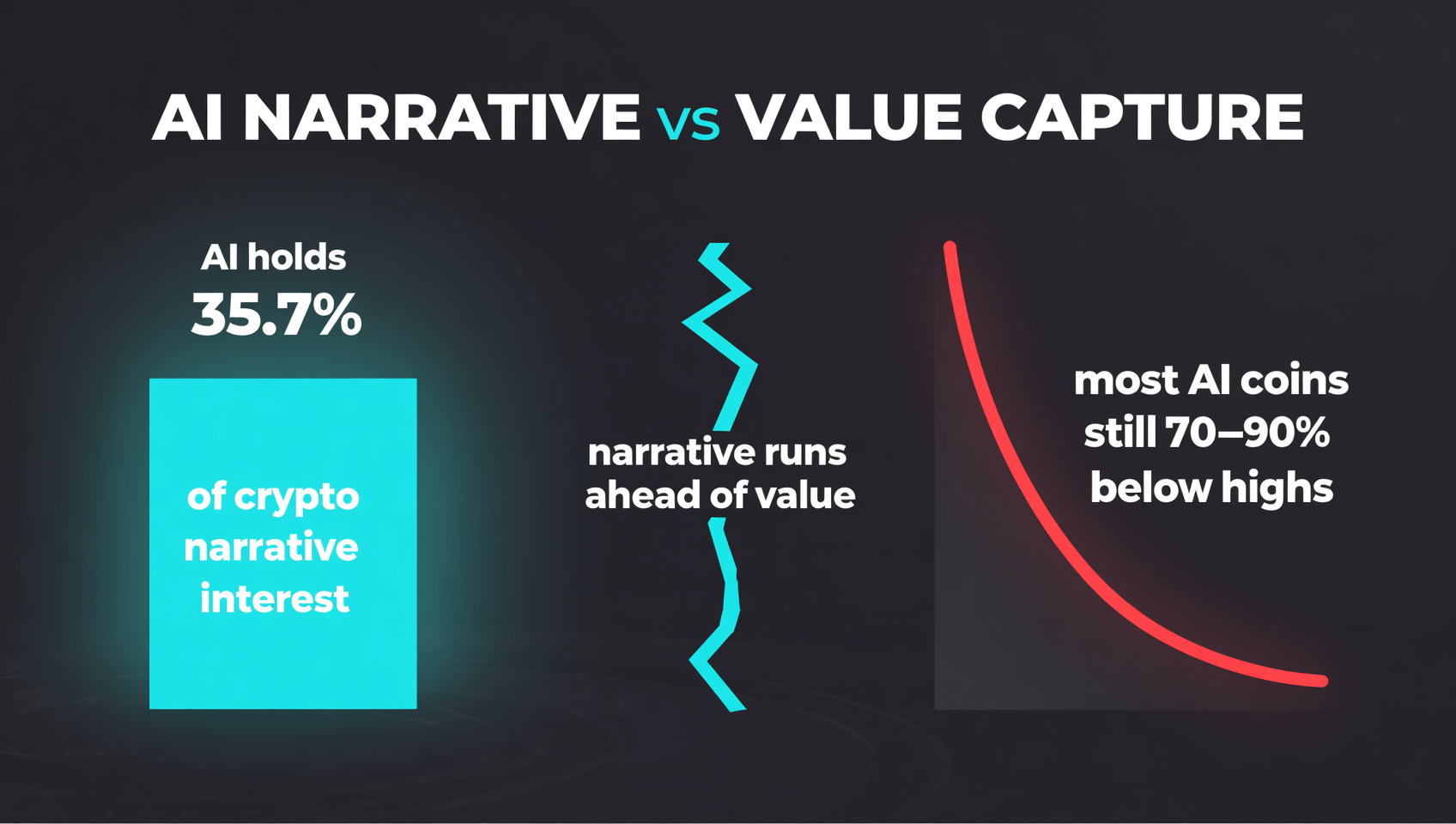
In other words, AI is crypto's hottest narrative, but also one of its most disconnected from fundamentals. The phrase analysts keep repeating is "value-capture gap": narrative interest of 35.7% ranks first, yet real revenue, users and cash flow trail far behind. That's why Nvidia rises while AI coins fall — the money in AI is captured by centralized giants, not by these tokens.
What Real Problem Does AI x Crypto Solve? Four Sub-Sectors
AI coins are not monolithic — they split into four sub-sectors with completely different revenue engines. Understand them, and you'll know what you're actually buying:
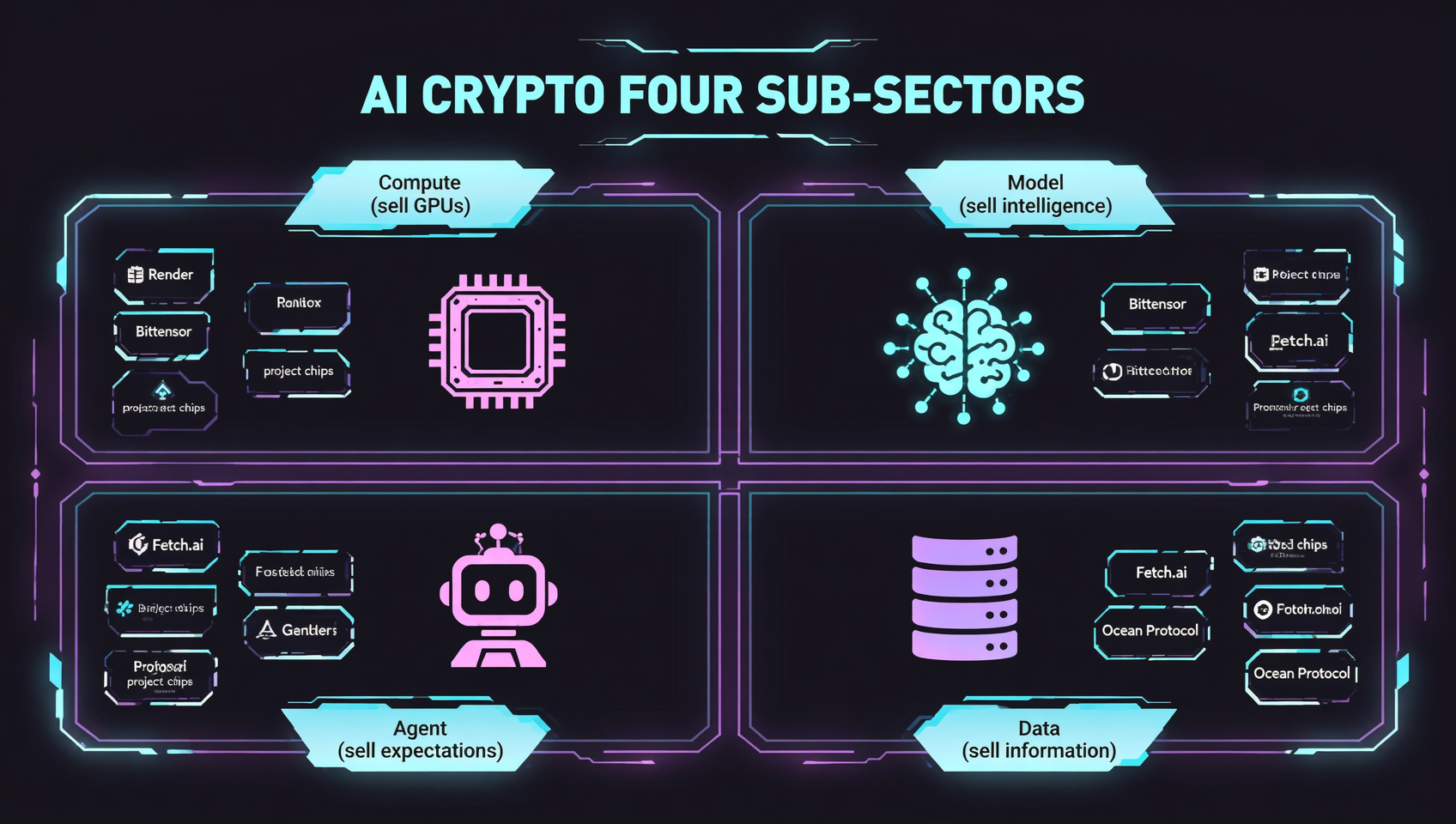
① Compute — the most mature and measurable
Representative projects: Render (RENDER), Akash (AKT), io.net, Aethir. Their essence is a decentralized GPU rental market: you list your idle GPU on the network to rent out for AI training or rendering, and earn tokens.
This is the sub-sector with the most real revenue. Render had roughly $38 million in monthly network revenue in January 2026, about 5,600 active GPU nodes and ~$450M annualized; Akash's usage grew 428% year-over-year with over 80% GPU utilization4. The pitch of these networks is being "60–90% cheaper than cloud providers."
But note: the compute sub-sector is essentially "selling GPUs," not "doing AI." It earns the margin on cloud-computing pricing, and its moat depends on how many real users actually come to rent.
② Models / Inference — the hardest, most defensible
Representative project: Bittensor (TAO). Bittensor is a decentralized machine-intelligence market: miners run AI models to answer tasks on each subnet, validators score the results, and good work earns TAO rewards.
It's one of the few AI coins with actual workloads: roughly 129 specialized subnets (planned to expand to 256) each handle a type of AI task, and it generated about $43 million in real revenue in Q1 20263. TAO has a 21-million supply cap, is staking-driven, and underwent a halving in December 2025. Its biggest risk: it must outperform centralized rivals like OpenAI, Anthropic and Google, or no one will use its models.
③ AI Agents — the newest and least anchored
Representative projects: Virtuals (VIRTUAL), ai16z, AIXBT. AI agents are the biggest 2026 narrative: autonomous AI that can order, pay and execute tasks. The underlying x402 protocol enables agent micropayments as small as $0.000001 settling in under 800 milliseconds, and Citigroup projects agentic commerce will reach $1.7 trillion by 20306.
But agent tokens fell hardest in the Q1 2026 correction, typically 80–90%, with Virtuals, ai16z and AIXBT trading 55–85% below highs6. The root cause is revenue: most agent tokens only offer "chat" capability with no recurring cash flow — they are priced on expectation, not usage.
④ Data — real but small
Representative projects: The Graph (GRT), Ocean Protocol, Filecoin (FIL), Grass. These tokens power AI's data infrastructure: indexing on-chain data, dataset licensing and decentralized storage. Revenue is metered-API based — real, but often too modest to justify the valuation.
One-line summary: compute is "selling GPUs," models is "selling intelligence," agents is "selling expectations," and data is "selling information" — only the first two have stable revenue, and the last two are still at the story-telling stage.
Top Projects: TAO / RENDER / FET / VIRTUAL / NEAR / ICP
These are the largest and most-discussed projects in the AI sector — not a "buy" list. Look at each one and what it does, and how it earns:
- Bittensor (TAO) — the largest pure AI token. A decentralized machine-intelligence market with 129 subnets, $43M quarterly revenue and a 21-million supply cap. Market cap around $3 billion, one of the few projects with real workloads3.
- Render (RENDER) — decentralized GPU. Pivoting from 3D rendering to AI inference, with $38M monthly revenue and 5,600 GPU nodes. Market cap around $1 billion4.
- Fetch.ai / ASI (FET) — the three-way alliance. Fetch.ai merged with Ocean and SingularityNET into the Artificial Superintelligence Alliance (ASI), focused on the AI-agent economy. Market cap around $500 million.
- Virtuals (VIRTUAL) — an AI-agent launchpad. Lets anyone launch an AI-agent token; it's the flag-bearer of the agent narrative with a market cap around $500 million but thin revenue.
- NEAR / ICP — general layer-1s lumped into AI. NEAR is building agentic-commerce infrastructure, and ICP touts "running AI on-chain." They are essentially layer-1s that happen to be "AI-friendly," and their valuations (NEAR ~$6B, ICP ~$1.8B) are mostly chain valuations, not AI valuations.
All market caps above are October 2026 approximations and fluctuate — check CoinMarketCap for live data5.
Why AI Coins Are Not "the Future of AI"
This is the article's core counterintuitive point: the money in AI is mostly captured by centralized giants, not by these tokens.
Look at this one comparison: Nvidia's quarterly revenue is about $96.2 billion, while the entire AI token sector (hundreds of projects) has a combined market cap of only $15–25 billion — not even a rounding error next to Nvidia. AI coins want to "decentralize AI," but they're up against the richest, most talented tech giants in the world, and the competition is fundamentally unequal.
There's an even subtler trend: even crypto's most "traditional" players are pivoting to AI. A CoinShares report projects that by December 2026, publicly listed Bitcoin miners could earn up to 70% of their revenue from AI (renting data centers and compute), not just mining7. This shows that the value in "AI + crypto" is concentrating in those with real compute and data centers — not in those who launched an AI token.
So the sober conclusion: AI tokens are a high-risk option on the decentralized-AI experiment, not a substitute for investing in AI itself. To invest in AI directly, Nvidia-style equities are the direct exposure; only if you want to bet on "decentralized AI working out" do AI coins come in.
Should You Buy AI Tokens? Four Profiles
The conclusion is simple: most people can hold a tiny position in the top projects, but only if they treat it as a sector option, not value investing. Match your situation:
| Your situation | Should you buy? | Why |
|---|---|---|
| Complete beginner wanting to get rich fast | ❌ No | Can't tell the four sub-sectors apart, easily swept up by "AI hype," likely to buy the top |
| Wanting to invest in AI's growth itself | ❌ Don't buy AI coins | Nvidia/US AI equities are the direct exposure; 70–90% drawdowns are the norm in AI coins |
| Bullish on decentralized AI long-term | ⚠️ Tiny position | Buy only revenue-generating leaders (TAO/RENDER) on a real exchange |
| Chasing agent-narrative upside | ❌ No | Agent coins fell 80–90%, have the thinnest revenue, pure narrative speculation |
My reasoning: I won't say "AI coins are all vapor" — Bittensor has real subnet revenue and Render has real GPU demand; those are real. A more accurate statement is: AI coins are high-volatility sector options; only someone who truly understands the four sub-sectors and can stomach a 70–90% drawdown should hold a tiny position in the leaders. If you have to pause to think about "the difference between compute and agents," the answer is: don't, for now.
Stop conditions — stop immediately if any apply: the money you're about to put in is living expenses, rent or borrowed; you're buying a coin only because "AI is hot right now"; you can't say which of the four sub-sectors it belongs to; or you can't explain "how it actually generates revenue."
If You Must Buy: 5 Red Lines
If, after all that, you still want a small position, hold these five lines to keep the drawdown tolerable:
- Only use money you can afford to lose completely. A 70–90% drawdown is normal in AI coins — treat this as the premium on a sector option.
- Only buy leaders with real revenue. Prefer compute (Render) and models (Bittensor) with actual workloads, and avoid agent coins with narrative but no cash flow. TAO, RENDER, FET, ICP and NEAR can be bought by registering on Binance or OKX.
- Figure out how it earns before you enter. If you can't answer "where does this token's revenue come from," you're betting on narrative, not allocating to a sector.
- Never chase a rally because "AI is hot," and never use leverage. AI coin volatility can wipe out your position instantly, and leverage multiplies that speed several times over.
- Only buy coins listed on major exchanges — never on-chain AI shitcoins. Many new tokens that borrow the "AI concept" have no product and are pure harvesting tools — see how to identify rug pulls and the honeypot token detection guide for the checklist.
FAQ
What are AI crypto tokens, and how are they different from Nvidia stock?
AI crypto tokens are cryptocurrencies that record and settle AI services on a blockchain — renting GPU compute, calling AI models, or letting AI agents pay each other. The difference from Nvidia stock: buying Nvidia means owning equity in a profitable company; buying an AI token means holding a usage voucher, and most AI coins have no cash flow, so their price is narrative-driven. Nvidia's quarterly revenue is ~$96.2 billion, while the whole AI token sector is only ~$15–25 billion.
Does buying AI tokens equal investing in the future of AI?
No. Most of AI's value is captured by centralized companies like Nvidia, OpenAI and Google, while AI tokens lag far behind. In Q1 2026 AI held 35.7% of crypto's narrative interest, yet most AI coins still trade 70–90% below highs. Buying an AI coin is a bet on whether the decentralized-AI experiment works, not a way to capture AI's growth.
What are the top AI crypto tokens?
Roughly by market cap: Bittensor (TAO, ~$3B), Render (RENDER, $1B), ASI (FET, $200M). NEAR and ICP are general layer-1s often lumped into the AI category but are really "AI-friendly" chains. Figures fluctuate — check CoinMarketCap.$500M), Virtuals ($500M) and Akash (
What is Bittensor (TAO), and why is it the largest pure AI token?
Bittensor is a decentralized machine-intelligence market: miners run AI models to answer subnet tasks, validators score them, and good work earns TAO. It runs ~129 specialized subnets and generated ~$43M in real revenue in Q1 2026 — one of the few AI coins with actual workloads. TAO has a 21-million supply cap and is staking-driven.
Why have AI agent tokens fallen so much?
AI agents are the biggest 2026 narrative, but agent tokens fell hardest in the Q1 2026 correction — typically 80–90%. The root cause is revenue: most agent tokens only offer chat capability with no recurring cash flow, so they're priced on expectation, not usage. Capital is now flowing to agents that actually execute actions.
How do I buy AI crypto tokens, and on which exchange?
The top AI coins (TAO, RENDER, FET, ICP, NEAR, etc.) are listed on Binance and OKX — buy them on the spot market with USDT. Before buying, ask which sub-sector (compute / models / agents / data) it belongs to, how it earns, and whether the valuation is already inflated by narrative.
Are AI tokens riskier than memecoins?
Top AI tokens are less risky than memecoins (real projects, real revenue, listed on major exchanges), but they share a common trap: narrative-driven valuation. AI coins at least have verifiable usage (Render's GPU revenue, Bittensor's subnet revenue), while memecoins have no fundamentals. Still, 70–90% drawdowns are common — don't treat them as a safe AI investment.
Further Reading
- What Are On-Chain Assets? A Beginner's Guide — the broader asset class AI tokens belong to
- What Are Memecoins? DOGE/PEPE/TRUMP Risks and Realities — contrast "narrative-driven" assets and the shared trap with AI coins
- Solana vs Ethereum vs BNB Chain 2026 Comparison — the layer-1s (like Solana) that settle AI agents
- Crypto Airdrops: How to Find, Claim Safely & Spot Fakes — spotting fake airdrops from AI-themed projects
- What Is a Rug Pull? How to Identify Scam Coins — identifying AI-concept harvesting projects
- On-Chain Guide — more blockchain education and on-chain tutorials
Data verification note: AI token sector and project market caps, narrative heat, drawdowns, and Bittensor/Render revenue figures were verified on 2026-10-10; sources in the footnotes below5123467. Market caps and prices move constantly — always check CoinMarketCap, CoinGecko and exchange prices in real time before acting.
This article is not investment advice. AI tokens are highly speculative and most may go to zero, carrying risks of price crashes, liquidity drains, narrative collapse and project rug pulls. Only participate with money you can afford to lose in full, and comply with your local laws.
Footnotes
-
AI held 35.7% of crypto narrative interest in Q1 2026, ahead of memecoins at 27.1%. Source: Grayscale report (via BYDFi, HTX). ↩ ↩2 ↩3
-
Most AI coins remain 70–90% below their all-time highs, even as Nvidia's quarterly revenue reached ~$96.2 billion. Source: HTX community ("AI Tokens Lag 70%-90% Despite Nvidia Revenue Boom"), Nvidia earnings. ↩ ↩2 ↩3 ↩4
-
Bittensor (TAO): ~129 active subnets (planned 256), ~$43M real revenue in Q1 2026, 21M supply cap, Dec 2025 halving (7,200→3,600 TAO/day). Source: Bittensor official docs, Token Terminal, Grayscale. ↩ ↩2 ↩3 ↩4
-
Render: ~$38M monthly network revenue (Jan 2026), ~5,600 active GPU nodes, ~$450M annualized; Akash usage +428% YoY with >80% GPU utilization; such networks are 60–90% cheaper than cloud providers. Source: Render official, CoinShares/Grayscale reports. ↩ ↩2 ↩3 ↩4
-
AI token sector market cap ~$15–25B (Grayscale Oct 2026 ~$15B; CoinMarketCap AI & Big Data category Jul 2026 ~$18B, ~919 projects ~$22.6B). Representative project market caps (TAO ~$3B, RENDER ~$1B, FET ~$500M, ICP ~$1.8B, etc.) are Oct 2026 approximations and fluctuate. Source: CoinMarketCap, CoinGecko, Grayscale. ↩ ↩2 ↩3 ↩4
-
AI agent narrative: x402 protocol supports $0.000001 micropayments settling in <800ms; Citigroup projects $1.7T agentic commerce by 2030; agent tokens fell 80–90% in the Q1 2026 correction (Virtuals/ai16z/AIXBT 55–85% below highs). Source: Citigroup, Motley Fool, Grayscale, CoinMarketCap. ↩ ↩2 ↩3
-
Publicly listed Bitcoin miners could earn up to 70% of revenue from AI (data centers / compute rental) by Dec 2026. Source: CoinShares Q1 2026 report. ↩ ↩2