
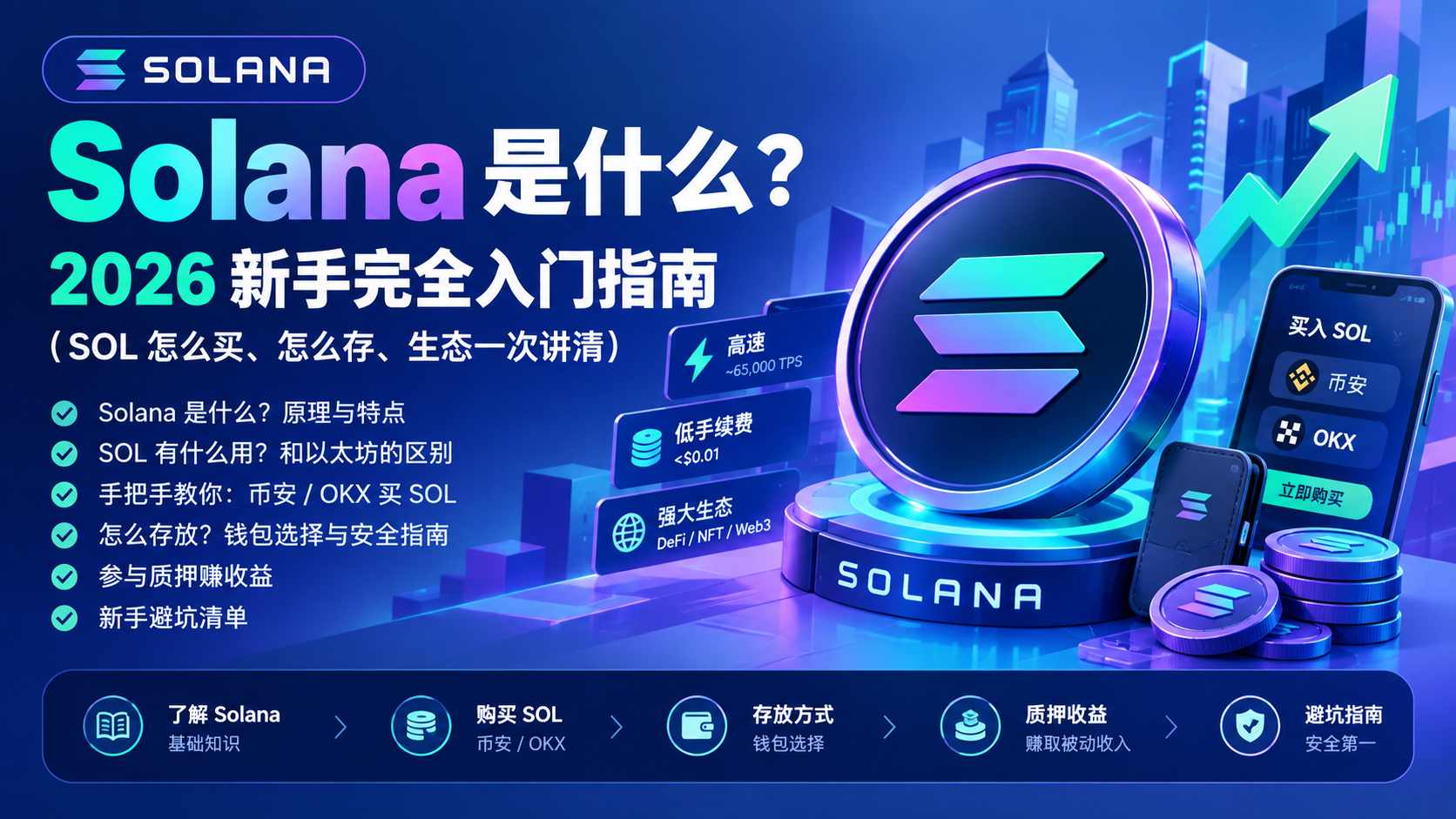
What Is Solana? 2026 Beginner's Complete Guide (How to Buy, Store, and Use SOL)
Solana is a public blockchain built for high speed and low fees, and its native token SOL became the third cryptocurrency — after Bitcoin and Ethereum — to get a US spot ETF in October 2025. This guide explains Solana from zero: how it works, what SOL is for, how it differs from Ethereum, and walks you through buying SOL on Binance/OKX, choosing where to store it, and staking for yield, plus a beginner's mistake checklist.
TL;DR
Solana is a public blockchain built for "high speed and low fees," and its native token SOL is the third cryptocurrency — after Bitcoin and Ethereum — to get a US spot ETF (trading started October 2025). As a beginner, you only need to remember three things: ① SOL is the "fuel + equity" of the Solana network — used to pay fees, stake to secure the network, and participate in governance; ② the easiest way to buy SOL is the Binance/OKX spot market (register → verify identity → buy USDT via C2C → buy SOL in spot), and you can start with a few dozen dollars; ③ after buying, small amounts are fine on the exchange, and consider a Phantom wallet or cold wallet once the amount grows. To earn passive income you can stake SOL — roughly 5%–6% nominal annualized in 2026 — but that's a "yield," not a guarantee, and a governance proposal is pushing it lower.123
🎁 No exchange account yet? Signing up with the invite codes below costs you nothing extra; we may receive a commission from the platform: Binance: https://www.bsmkweb.cc/register?ref=BINANBT invite code BINANBT OKX: https://www.promooboost.com/join/60895497 invite code 60895497
1. What Is Solana (In One Sentence)
Solana is a smart-contract-enabled public blockchain launched in 2020 by Anatoly Yakovenko and the Solana Labs team, with a very direct goal: keep it decentralized while making transactions "fast and cheap."1
Its best-known technical label is Proof of History (PoH), used together with the more familiar PoS (Proof of Stake). You can think of PoH as "a precise clock built into the block" — every node naturally agrees on the order in which transactions happened, without needing Ethereum-style network-wide rebroadcasting and slow confirmation to queue them up. This has two direct consequences:
- Fast: it can theoretically process thousands of transactions per second, and its real throughput far exceeds many older chains;
- Cheap: a transfer's gas fee is usually under $0.01, while Ethereum mainnet can cost several dollars or even tens of dollars per transaction at peak times.
For a beginner, the most tangible payoff of this "low fees + high speed" is that when you use on-chain apps on Solana (DeFi, NFT, even launching a meme coin), you barely have to worry about fees and can experiment freely. That's a big reason Solana became the main battleground for retail investors and the meme-coin boom in 2024–2026.
To fill in the most basic concepts first, read the first crypto beginner lesson; to understand what "public chain / smart contract" means, read What is Ethereum? Smart Contracts and Layer 2 — the complete guide.
2. What Is the SOL Token Actually Used For?
SOL is the native token of the Solana network, and its value comes from real, concrete uses on the network rather than empty speculation. Boil it down to four:
| Use | What it means | What a beginner needs to do |
|---|---|---|
| Pay fees | Every transfer or interaction burns a little SOL as gas | Keep a tiny bit of SOL in your account (0.01 SOL lasts a long time) |
| Stake to secure the network | Delegate SOL to validators in exchange for network rewards | You can stake to earn annualized yield (see Section 7) |
| Governance voting | Holders can vote on network upgrade proposals (like SIMD-550) | Beginners can ignore this for now |
| Ecosystem settlement | DeFi, meme coins, and NFT trading are all priced in SOL | Just understand that "to use the ecosystem you first need SOL" |
In one sentence: SOL is to Solana what ETH is to Ethereum — it's the chain's "fuel" and "equity." Once you get this, questions like "is SOL a pyramid scheme?" won't throw you off.
3. Solana vs. Ethereum: What's the Difference?
Beginners most often confuse these two chains. They aren't a "one replaces the other" relationship — they are two public chains that chose different scaling routes:
| Dimension | Solana | Ethereum |
|---|---|---|
| Core idea | Single high-performance chain, directly raising the chain's own speed | Mainnet stays robust, scales via Layer 2 (Arbitrum/Base/Optimism) |
| Consensus | PoH + PoS | PoS (after the 2022 Merge) |
| Fees | Very low, usually under $0.01 per transaction | Mainnet higher (several dollars and up), L2 lower |
| Smart-contract language | Mainly Rust | Mainly Solidity |
| Ecosystem focus | DeFi, meme coins, DePIN, payments | DeFi, RWA, institutional finance |
| Spot ETF | Approved and listed October 2025 | Approved and listed January 2024 |
The conclusion for beginners: if you're here for "low fees to play on-chain and try DeFi/meme," Solana is smoother; if you care more about "the oldest, most decentralized, thickest institutional money," Ethereum is steadier. The two can coexist — there's no standard answer. For a more detailed comparison, read Ethereum vs Solana: 2026 Layer 1 comparison.
4. What's in the Solana Ecosystem (2026)
Whether a chain is worth watching ultimately comes down to whether people actually use its ecosystem. Solana now has a fairly complete application landscape:
| Sector | Representative projects / phenomena | What a beginner can do |
|---|---|---|
| Decentralized exchange (DEX) | Jupiter, Raydium | Swap tokens on-chain, provide liquidity |
| Staking / liquid staking | Marinade (mSOL), Jito (jitoSOL) | Stake SOL for yield, and get a liquid-staking voucher |
| Meme coins | Bonk (BONK), dogwifhat (WIF), Pump.fun | High-risk speculation — strongly not recommended for beginners to go heavy |
| Stablecoins | USDC, USDT (Solana versions), PayPal's PYUSD | Hold dollar-pegged assets on-chain |
| Wallets | Phantom | The entry point for all on-chain actions |
At the institutional level, Solana's "mainstream breakout" is accelerating too: the SOL spot ETF began trading in the US on October 28, 2025, with issuers including Bitwise, Grayscale, 21Shares, Fidelity, and VanEck; in March 2026, the SEC and CFTC jointly classified SOL as a "digital commodity" (the same category as BTC and ETH); in June 2026, Morgan Stanley's SOL ETF (ticker MSOL, with fees as low as 0.14%) was also approved and listed.4 These signals mean SOL is moving from a "speculative asset" toward "a mainstream asset recognized by traditional finance."
5. How to Buy SOL (Binance / OKX Step-by-Step)
For a beginner, the simplest and least error-prone way to buy SOL is through a centralized exchange's spot market, without touching an on-chain wallet. The full path is four steps:
- Register on an exchange: choose Binance or OKX and register with an invite code (no extra cost to you; we may receive a commission).
- Complete identity verification (KYC): upload your ID and do face recognition as prompted — usually a few minutes to a few hours.
- Buy USDT with fiat via C2C: on the C2C page pick a large merchant with a "shield/verified" badge, pay from your own real-name account, and the merchant transfers USDT to you.
- Buy SOL in the spot market: open spot trading, search SOL/USDT, enter an amount, and buy.
Minimum purchase and fees for buying SOL (2026-09, subject to the live platform page):5
| Platform | SOL purchase channel | Minimum | Spot fee (standard tier) |
|---|---|---|---|
| Binance | Spot SOL/USDT | Major pairs start around 5 USDT | About 0.1% (cheaper with BNB discount or rebate) |
| OKX | Spot SOL/USDT | Around $1 equivalent and up | About 0.08%–0.1% |
Let's actually calculate the fee: say you spend 1,000 USDT to buy SOL at 0.1% — the fee is about 1 USDT. That doesn't sound like much, but if you trade frequently the cost compounds — so beginners should avoid high-frequency short-term trading; buying in batches and lowering trade frequency helps more than agonizing over a 0.02% rate difference.
👉 Register on Binance (invite code BINANBT): https://www.bsmkweb.cc/register?ref=BINANBT 👉 Register on OKX (invite code 60895497): https://www.promooboost.com/join/60895497
Registration and deposits have details worth noting — see the Binance registration guide and the OKX registration guide; to compare buying channels side by side, see How to buy Bitcoin? 2026 platform comparison.
6. How to Store SOL After Buying (3 Options)
After buying SOL, "where to keep it" is the second most common beginner question. The three options each have trade-offs:
| Option | Best for | Pros | Cons |
|---|---|---|---|
| Exchange account | Small amounts, frequent trading, absolute beginners | Simple, recoverable password, can stake directly | Platform risk (extreme cases of hack/exit) |
| Self-custody wallet (Phantom) | Medium/long-term holding, playing in the on-chain ecosystem | You control your keys, usable with all DApps | Lose or leak your keys and the coins are gone |
| Cold wallet (hardware wallet) | Large amounts, long-term holding | Keys are offline, most secure | Higher barrier to use, need to buy hardware |
Default advice for beginners: a few hundred dollars' worth of SOL is fine sitting on the exchange; once the amount grows and you want to try the Solana on-chain ecosystem, learn the Phantom wallet and move some over to practice; use a cold wallet for the large amount (the part you truly can't afford to lose). The principle is "small amounts for convenience, large amounts for safety."
On choosing wallets and the hot/cold difference, see Crypto wallets 2026 complete guide; to understand the overall framework of on-chain assets like Solana, see What are on-chain assets? A beginner's guide.
7. How to Earn from SOL Staking
Staking is essentially this: you delegate SOL to a network "validator" node to help it produce blocks, and the network shares newly minted SOL with you as a reward. It's a native form of passive income on Solana and part of SOL's inflation mechanism.
Three ways to stake, compared:
| Method | Reference annualized yield | Notes |
|---|---|---|
| Exchange one-click staking (Binance Earn / OKX Earn) | Per the platform page | Easiest — click and you're staked, but the platform takes a cut |
| Native delegated staking (pick a validator in the Phantom wallet) | About 5%–6% (2026 network average 6.38%)2 | Higher yield, more decentralized, but you choose a trustworthy validator yourself |
| Liquid staking (swap for mSOL / jitoSOL) | Close to native | After staking you get a tradable voucher token you can deploy in DeFi, but with an extra layer of contract risk |
Let's actually calculate the return: say you stake 100 SOL at roughly 6% annualized — you'd earn about 6 SOL a year (denominated in SOL). Two things to note: first, the return is most accurate when denominated in SOL — if the price rises you "double-win," but if it falls the yield may not cover your shrinking principal; second, Solana's advancing governance proposal SIMD-550 will accelerate lowering inflation, and if it passes, staking yield could gradually drop to around 2%–3% over the next two to three years.3
How to choose as a beginner: if you just want it easy, use exchange one-click staking; if you're willing to learn a bit and get a higher yield, use Phantom native delegation. Either way, don't treat "staking yield" as bank interest — your principal (the price) fluctuates far more than that 5%–6% yield.
8. The Mistakes Beginners Make Most with Solana
Solana is a good experience, but beginners still step on rakes. Remember these four:
Watch the network and address format when transferring SOL. A Solana address is base58 (a short string of letters and numbers, roughly 32–44 characters), completely different from Ethereum's 0x addresses. When withdrawing SOL from an exchange to a Phantom wallet, always pick the Solana network and copy the correct address from Phantom — sending on the wrong chain (e.g. the Ethereum chain) can mean permanent loss.
Don't treat meme coins as investments. Thousands of meme coins are born on Pump.fun every day, 99% go to zero, and there's plenty of "insider-sniping," "honeypots," and "rug pulls." If you must touch them, use only a tiny amount you can afford to lose and assume it goes to zero. To learn how to spot scams, see How to spot honeypot tokens and How to spot rug pulls in scam coins.
Solana has had outages. Between 2021 and 2023 it repeatedly went down for hours at a time due to high load or bugs — its most-criticized weakness relative to Ethereum. Upgrades (QUIC, the Firedancer client, etc.) have clearly improved stability, but know this history and don't treat "Solana never goes down" as a belief.1
Be wary of "high-yield staking / wealth management." Any unofficial channel promising "deposit SOL and earn X% daily" is basically a Ponzi or a scam. Legitimate staking yield is on the order of 5%–6%; an absurdly high yield means someone is after your principal.
9. FAQ
What's the difference between Solana and Ethereum?
Different positioning: Solana is a "high-performance single chain" that keeps fees low and speed high by directly raising the chain's own performance; Ethereum's mainnet has high fees and limited speed and scales mainly through Layer 2 (Arbitrum, Base, etc.). For a beginner, fees on Solana are almost negligible when you play in the on-chain ecosystem, while on Ethereum mainnet you must think about gas costs first.
What is the SOL token used for?
SOL is the native token of the Solana network, with three main uses: paying transaction fees (gas), staking to secure the network and earn rewards, and voting on governance. It's also the settlement unit for DeFi and trading in the Solana ecosystem — like ETH is to Ethereum.
How do beginners buy SOL? How much do I need?
The most convenient way is a centralized exchange: register on Binance or OKX, complete identity verification, buy USDT with fiat via C2C, then buy SOL with USDT in the spot market. Major pairs usually let you start with a few dozen dollars (Binance spot starts around 5 USDT) — you don't need to buy a whole SOL at once.
Where is it safest to keep SOL after buying?
Small amounts (a few hundred dollars) are most convenient on the exchange, which also makes later staking and trading easier. For larger amounts or long-term holding, move to a self-custody wallet (like Phantom) where you control the keys — but if the keys are lost or leaked, the coins are gone. For beginners, keeping a small amount on the exchange first and learning wallets later is the safer path.
How much can SOL staking earn?
In 2026, the Solana network's nominal staking annualized yield is about 5%–6% (it fluctuates with network inflation and validator performance, and the SIMD-550 governance proposal may push it lower). This is a "yield," not a principal guarantee — the price itself goes up and down, so denominating in SOL is more accurate; don't treat it as a risk-free deposit.
Is Solana safe? Has it ever gone down?
Solana's consensus and cryptographic algorithms are secure, but it did suffer multiple network-wide outages in its history (2021–2023), later improved through upgrades like QUIC and the new Firedancer client, so stability has clearly improved. Outage risk is one of its weaknesses relative to Ethereum; a beginner only needs to be aware of this, not panic over it.
10. Summary: Three Sentences to Remember
First: SOL is Solana's "fuel + equity," not a worthless coin. It pays fees, stakes, governs, and has ETF and institutional backing — a mainstream crypto asset with real uses.
Second: buy SOL via "Binance/OKX spot," and you can start with a few dozen dollars. Register → KYC → buy USDT via C2C → buy SOL in spot. Four steps. Don't jump straight into an on-chain wallet.
Third: yield is secondary — protect your principal first. The 5%–6% staking yield is just a bonus; the real risk is price swings and meme-coin speculation. Only use money you can afford to lose, start small, and stay away from "X% daily" temptations — do that and you're already ahead of most beginners.
If you haven't registered yet, go through the official links (the invite codes cost you nothing extra):
🎁 Binance registration link: https://www.bsmkweb.cc/register?ref=BINANBT invite code: BINANBT 🎁 OKX registration link: https://www.promooboost.com/join/60895497 invite code: 60895497
About the Author
CoinVado Research is CoinVado's content research team, focused on blockchain technology education, on-chain data interpretation, and cryptocurrency investment education. We insist that all data be verifiable and never fabricated, helping beginners build correct crypto knowledge and risk awareness.
⚠️ Risk warning: This article is for educational purposes only and does not constitute investment advice. Cryptocurrency prices are highly volatile and may fall sharply or even to zero; only participate with assets you can afford to lose, and verify each platform's latest rules, fees, and staking yields yourself before acting.
📖 Related reading:
- Ethereum vs Solana: 2026 Layer 1 comparison — the battle between two chains' roadmaps
- What is Ethereum? Smart Contracts and Layer 2 — complete guide — understand public chains and smart contracts
- What are on-chain assets? A beginner's guide — the framework from wallets to RWA
- Binance 2026 registration guide — account opening, KYC and deposits
- OKX 2026 registration guide — account opening, KYC and deposits
- Crypto wallets 2026 complete guide — hot vs cold wallets
- How to spot honeypot tokens — avoid on-chain scams
- On-Chain Guide (CoinVado) — more on-chain data and crypto education
Footnotes
-
Solana official website (https://solana.com/) and official docs (https://solana.com/docs) — Solana's positioning, PoH consensus mechanism, historical outages and upgrades (QUIC, Firedancer). Verified 2026-09-06. ↩ ↩2 ↩3
-
Coinbase, "Q2 2026 Solana Validator Performance Report" — Q2 2026 Solana network average staking APY of about 6.38% (Coinbase's own validator 6.52%). Verified 2026-09-06. ↩ ↩2
-
21Shares, "Solana SIMD-550 / SIMD-553 Staking Yield Analysis" — current nominal staking yield about 5.25%; if SIMD-550 passes, it could drop to around 2%–3% over the next two to three years (https://www.21shares.com/de-eu/insights/solana-simd-550-simd-553-staking-yield). Verified 2026-09-06. ↩ ↩2
-
Everstake, "SOL ETF in 2026: Inflows, Tokenized Equities, Institutions" and multiple reports — the SOL spot ETF listed 2025-10-28; SEC/CFTC classified SOL as a digital commodity in 2026-03; Morgan Stanley's MSOL approved 2026-06 (fee 0.14%). Verified 2026-09-06. ↩
-
Binance spot trading rules (https://www.binance.com/zh-CN/support/faq/detail/115000594711) — minimum amount and minimum order size vary by spot pair, with no uniform threshold; check the trading page. Verified 2026-09-06. ↩