


TL;DR: The Bottom Line First
For bridging stablecoins, the best choice for most people isn't a "bridge" — it's an exchange, or USDC's CCTP native transfer. The three methods differ by an order of magnitude in risk.
The five facts that matter most:
- There are three ways to bridge, not just bridges: ① a cross-chain bridge (fast, contract risk), ② exchange deposit-and-withdraw (simple and safe, needs KYC), ③ USDC's CCTP native transfer (burn-and-mint, the safest). Most people should use ② or ③1.
- "Wrapped stablecoins" aren't real stablecoins. USDT.e and legacy USDC.e are bridge IOUs backed by the bridge's contract; if the bridge is hacked, the IOU may not be redeemable. Native USDC (CCTP-minted) is the real, burned-and-reminted coin2.
- Bridges are crypto's biggest attack surface. Since 2021, roughly 50 bridge incidents totaling about $4B lost — Ronin ~$625M, Wormhole ~$325M, Poly Network ~$611M3.
- Cheaper ≠ safer. Third-party bridges (Across, Stargate) are fast and cheap (~0.02–0.08%) but carry smart-contract and relayer trust assumptions; exchanges carry custodial risk; CCTP trusts Circle the issuer.
- The beginner's takeaway: use CCTP for USDC, an exchange for USDT, Across/aggregators for small fast transfers; never push large amounts through a third-party bridge; bookmark the official bridge before you need it.
Let's unpack "bridging" from the top.
Table of Contents
- First, what bridging actually is
- Three methods: bridge, exchange, CCTP
- Key concept: wrapped vs native stablecoins
- Why bridges are crypto's biggest attack surface
- How to choose: a framework by amount × chain × trust
- 5 contrarian points beginners most need
- 3 red lines to avoid
- FAQ
- Further reading
First, what bridging actually is
"Bridging" sounds arcane, but it's one sentence: moving a stablecoin from one chain to another so it's usable on the destination chain.
Why bridge at all? Because stablecoins like USDT and USDC are issued across multiple chains — the same USDC exists in separate versions on Ethereum, Arbitrum, Base, Solana, and so on. USDC on Ethereum can't be "wired" straight to Arbitrum to earn yield there; it has to cross a bridge first.
Here's the trap beginners hit: bridging ≠ withdrawing, and ≠ a normal transfer.
- Withdraw / transfer: moving coins between addresses within one network. The coin never changes chains; it's minutes and cents.
- Bridging: moving coins from chain A to chain B. It's not a simple address transfer — you're turning "coins on this chain" into "coins on that chain," which requires a mechanism to "lock the old and issue the new." That mechanism is where the risk lives.
That's why the three methods differ so much in risk: the risk isn't the "moving" itself, it's who guarantees the move — a bridge's contract, a centralized exchange, or the stablecoin issuer itself.
Three methods: bridge, exchange, CCTP
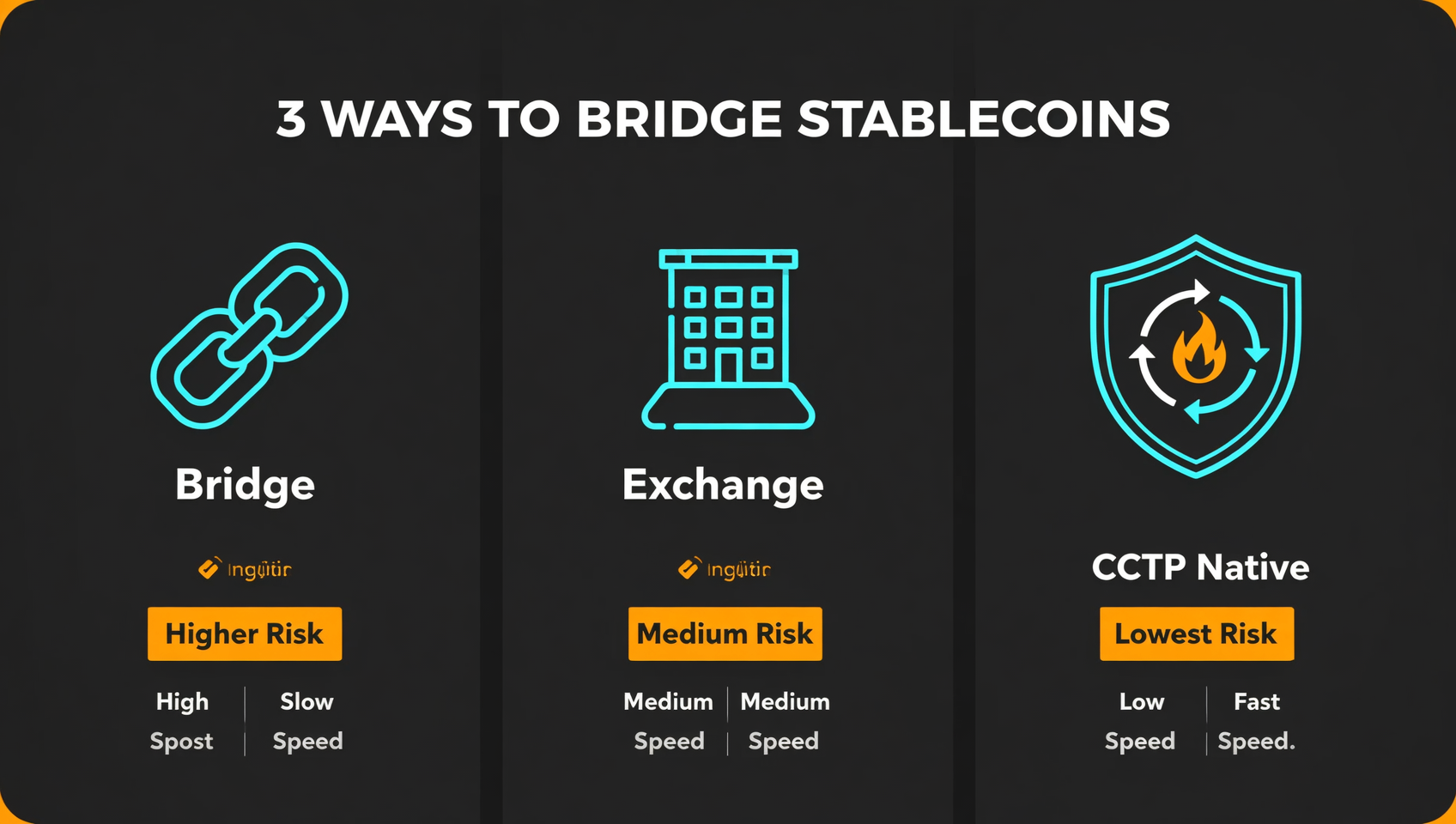
Method 1: Cross-chain bridge
Use a protocol like Stargate, Across, or Hop to move coins from chain A to chain B on-chain, without an exchange.
- How: pick "A chain → B chain" in the bridge UI, enter the amount, sign, and it arrives in minutes.
- Cost: third-party bridges ~0.02–0.08% + gas (cheap for small amounts — about $1 for $500); legacy lock-and-mint bridges cost more ($6–12 when congested)4.
- Speed: seconds to minutes.
- Risk: high. You trust the bridge's smart contracts and relayer; if it's hacked, your funds can be gone. The riskiest of the three.
Method 2: Exchange deposit-and-withdraw (CEX bridge)
Deposit stablecoins from chain A into Binance/OKX, then withdraw to chain B.
- How: deposit (choose chain A) → funds arrive → withdraw (choose chain B). All inside the exchange.
- Cost: deposit is usually free, withdrawal is a flat fee (USDC/USDT generally $0.1–1 depending on chain)4.
- Speed: depends on the exchange, usually minutes to half an hour.
- Risk: medium. You're trusting a centralized exchange (custodial risk, KYC, frozen funds), but not a bridge's contract. The easiest option for most people.
Method 3: CCTP native transfer (USDC only)
Circle's official Cross-Chain Transfer Protocol, using a burn-and-mint model.
- How: in a CCTP-enabled wallet or aggregator (like Jumper), pick "USDC CCTP", burn USDC on chain A, and native USDC is minted on chain B.
- Cost: about $0.3–1 plus gas, some sources as low as $0.0134.
- Speed: V2 fast mode ~30 seconds.
- Risk: low. Because Circle is the USDC issuer, it burns on the source chain and mints native USDC on the destination — no locked pool, no wrapped IOU, no liquidity pool to drain2.
In one line: bridges are fast but riskiest; exchanges are convenient but centralized; CCTP is safest but USDC-only.
Key concept: wrapped vs native stablecoins
This is the most important concept in the whole guide. Master it and you've got bridging.
What a "wrapped stablecoin" is
Traditional bridges use a lock-and-mint model:
- You lock real USDT in the bridge's contract (say, on Ethereum);
- The bridge "mints" an equivalent token for you on the destination chain (say, Avalanche), called USDT.e (the
.emeans bridged/wrapped); - To get back, you return the USDT.e to the bridge, and it gives you the locked real USDT.
The problem: USDT.e isn't actually USDT — it's an IOU from the bridge. Its value depends entirely on the bridge's contract. If the bridge is hacked and the locked coins are stolen, your USDT.e becomes a worthless note. Wormhole and Ronin lost exactly this kind of "locked real coins."
What a "native stablecoin" is
CCTP's burn-and-mint works the opposite way:
- You burn USDC on the source chain (the coins are truly gone);
- Circle's Iris service signs an attestation that the burn happened;
- The destination chain mints the same amount of native USDC for you.
No lock, no IOU, no pool to drain — what you receive is genuine Circle-issued USDC on the destination chain, identical to USDC minted for anyone else2.
In one line: a wrapped stablecoin is the bridge's IOU; a native stablecoin is minted by the issuer itself. That's why USDC can bridge "natively" (Circle is the official issuer), while USDT currently relies more on bridges and exchanges (Tether has no widely adopted native bridge like CCTP).
Why bridges are crypto's biggest attack surface
Bridges aren't "occasionally hacked" — they're structurally high-risk, because to sustain "lock A, issue B," a bridge must hold huge amounts of locked funds, which is a giant vault sitting on-chain, and the key to that vault is smart-contract code.
A few numbers for perspective3:
| Event | Date | Loss |
|---|---|---|
| Poly Network | Aug 2021 | ~$611M (mostly returned) |
| Wormhole | Feb 2022 | ~$325M (covered by Jump Crypto) |
| Ronin Network (Axie Infinity) | Mar 2022 | ~$625M (Lazarus Group) |
And that's not all — since 2021, bridge-related incidents total roughly 50 events and about $4B in losses.
The key insight: this isn't "old history," it's a structural weakness of the bridge design itself — as long as a bridge locks large funds with the lock-and-mint model, it's the juiciest target for hackers. So:
- When you need to bridge, prefer options that don't rely on locking: CCTP (burn-and-mint) or an exchange (centralized custody);
- If you must use a third-party bridge (Stargate, Across), keep it small, do it once, and revoke approvals after — don't leave large amounts parked on a bridge long-term.
How to choose: a framework by amount × chain × trust
There's no one-size-fits-all bridge route, only "pick by your situation."
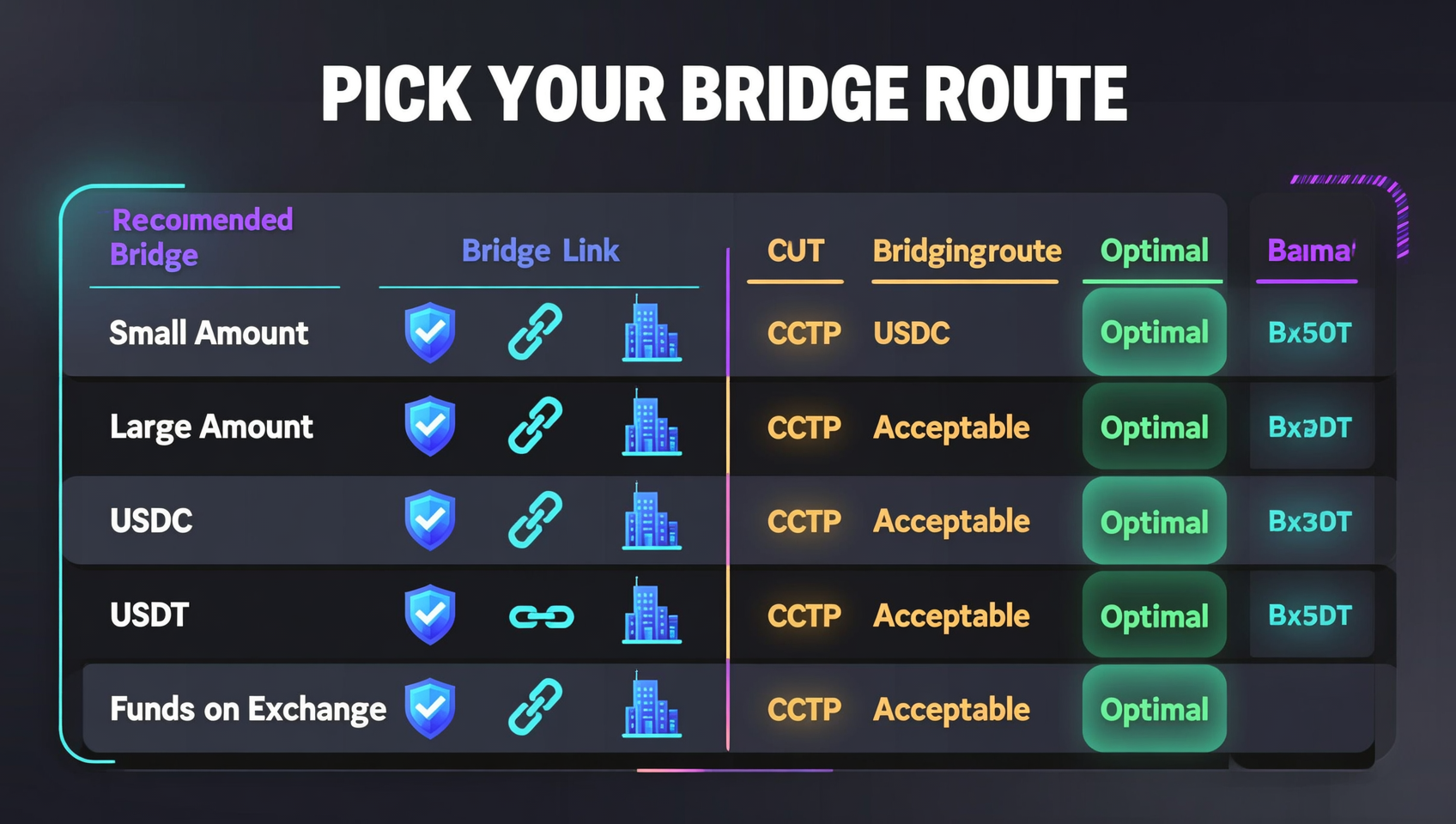
| Situation | Recommended | Why |
|---|---|---|
| USDC, any amount, max safety | Circle CCTP | Native USDC, no lock, no IOU, safest |
| Small (<$2,000), want speed | Across or an aggregator (Jumper/LI.FI) | Percentage fee beats CEX flat fee, seconds to fill |
| Large same-coin, many chains | Stargate | Unified liquidity pool, deep, 30+ chains |
| Funds already on an exchange | Withdraw directly to the target chain | Skip bridging, $0.1–1 |
| Large (>$50,000), need safety | Exchange withdrawal or OTC | Flat fee wins, no bridge-contract bet |
| Unsure of route | Aggregator quote (Jumper/LI.FI) | Compare 15+ routes at once |
A decision flow:
- Check the coin: USDC? → prefer CCTP. USDT? → prefer exchange or bridge;
- Check the amount: large (>$50,000) → exchange/OTC; small → bridge or aggregator;
- Check the chain: EVM/L2 destination → Across works; non-EVM (Solana/Tron/Aptos) → Stargate or exchange;
- Check trust: okay with centralization → exchange; only trust the issuer → CCTP; must be decentralized → third-party bridge (but keep it small).
5 contrarian points beginners most need
The best bridging route usually isn't a "bridge." Beginners search "cross-chain bridge" first, but for most people (especially large amounts, USDC, or funds already on an exchange), an exchange or CCTP is cheaper and safer. "Using a bridge" is one option, not the default answer.
A "wrapped stablecoin" isn't a real stablecoin. USDT.e and USDC.e are bridge IOUs, not USDT/USDC themselves. Holding one as if it were USDT means trusting the bridge's contract. For any stablecoin, first ask: is it native or wrapped?
"Cheaper" doesn't mean "safer." Third-party bridges (Across/Stargate) are cheaper than legacy bridges because of intent/liquidity-pool mechanisms, but they still carry contract and relayer trust assumptions. The cents you save don't buy back your funds if the bridge gets hacked.
CCTP's burn-and-mint is "real" bridging. Legacy bridges "lock A, issue B" (leaving a vault); CCTP "burns A, mints B" (no vault). Circle can do this because it's the USDC issuer and can actually burn and mint. It's a safety advantage unique to USDC that USDT doesn't currently enjoy to the same degree.
The enemy of large transfers isn't fees, it's trust. Small transfers compete on fees; large transfers compete on "how much am I willing to hand to whom" — a bridge contract, an exchange, or the issuer. The bigger the amount, the more you should pick the option with the fewest trust assumptions (CCTP or exchange), not the lowest fee.
3 red lines to avoid
- Don't click "cross-chain bridge" in search-engine ads. Fake bridges are a phishing hotspot — hackers buy ad slots and get you to sign on a fake bridge page, draining your assets. Always reach bridges from bookmarks, never ads.
- Don't park large amounts on a third-party bridge long-term. A bridge's locked pool is a target; move funds off immediately after a large bridge, don't let them sit overnight.
- Don't send to the wrong network or address type. Confirm the destination chain supports your coin and the receiving address format is correct (Solana/Tron addresses differ from EVM). Funds sent to the wrong network are extremely hard — sometimes impossible — to recover.
FAQ
How do I bridge stablecoins? What are my options?
Three ways: ① a cross-chain bridge (Stargate/Across, fast but contract risk), ② exchange deposit-and-withdraw (simple and safe but needs KYC), ③ USDC's CCTP native transfer (safest, USDC only). Most people should use ② or ③.
Which is cheaper, a bridge or an exchange?
It depends on amount. Under ~$2,000 a bridge is cheaper; above ~$2,000 an exchange's flat fee wins; above $50,000 use OTC/exchange. But cheaper ≠ safer — bridges carry contract risk.
What's a "wrapped stablecoin"? Is USDT.e the same as USDT?
No. USDT.e is a bridge's IOU (lock real coins, issue an IOU); its value depends on the bridge's contract. Native USDC (CCTP burn-and-mint) is the real coin.
Are bridges safe? What has gone wrong?
Bridges are one of crypto's biggest attack surfaces — ~50 incidents and ~$4B lost since 2021: Ronin $625M, Wormhole $325M, Poly Network $611M.
What is USDC's CCTP?
Circle's official USDC cross-chain protocol: burn on the source chain, Circle signs the attestation, mint native USDC on the destination. No lock, no IOU — one of the safest ways, ~$0.3–1.
What should I watch out for when bridging?
Confirm the chain and address type, prefer CCTP or exchange for large amounts, use bookmarks (not ads) for bridges, and revoke approvals after. Test small first.
Further reading
- Stablecoin Complete Guide: USDT, USDC, DAI — what stablecoins exist, native vs wrapped
- How USDT Actually Works: Minting, the $1 Peg, Reserves and Freezing — USDT's cross-chain flow and why TRON is the biggest chain
- USDT vs USDC 2026: Stability, Transparency & Use Cases — USDC's native edge on cross-chain safety
- Cross-Chain Bridge Security: Safest Multi-Chain Transfer Compared — bridge security risks in depth
- Binance Withdrawal Networks: BEP20 vs ERC20 — how to pick the network when bridging via an exchange
- On-chain Guide — more blockchain fundamentals and on-chain tutorials
Data verification: bridge attack history, CCTP mechanics, and bridging fees were verified on 2026-10-15; see footnotes1234. Bridge fees, chain support, and CCTP coverage are live data — check official bridge pages, Circle docs, and wallet quotes before acting.
This article is not investment advice. Bridging involves smart-contract risk, bridge-protocol risk, exchange custodial risk, and operational risk (wrong network/address); crypto prices are highly volatile. Decide based on your own risk tolerance and comply with local laws.
Footnotes
-
Three bridging methods: cross-chain bridge (lock-and-mint or intent/liquidity-pool), exchange deposit-withdraw (centralized custody), USDC CCTP (burn-and-mint native). Source: Circle CCTP docs, QuickNode "Cross-chain bridging", bridge docs (queried Oct 2026). ↩ ↩2
-
CCTP mechanics: Circle's Cross-Chain Transfer Protocol uses a burn-and-mint model — the user calls TokenMessenger#depositForBurn to burn USDC on the source chain, Circle's Iris off-chain attestation service signs that the burn happened, and the destination MessageTransmitter#receiveMessage mints equivalent native USDC; no locked pool, no wrapped IOU, no liquidity pool to drain; V2 adds faster finality and hooks, V1 phased out by 2026-07-31. Source: Circle Docs (developers.circle.com/cctp), Stellar Docs (queried Oct 2026). ↩ ↩2 ↩3 ↩4
-
Bridge attack history: Ronin Network (Axie Infinity) Mar 2022 ~$625M stolen (173,600 ETH + 25.5M USDC, FBI attributed to Lazarus Group); Wormhole Feb 2022 ~$325M (~120,000 wETH, covered by Jump Crypto); Poly Network Aug 2021 ~$611M (mostly/fully returned); roughly 50 bridge-related incidents and ~$4B lost since 2021. Source: The Verge, Tanium, HTX and cross-confirmed reporting (queried Oct 2026). ↩ ↩2 ↩3
-
Bridging fees and choice: Across (intent-based) ~0.02–0.08% + gas, ~$0.8–1.4 for a $500 EVM transfer, seconds to fill, EVM/L2 only; Stargate (LayerZero unified liquidity pool) ~0.06% + gas, 1–3 minutes, 30+ chains incl. non-EVM; exchange USDC withdrawal flat fee ~$0.1–1; CCTP ~$0.3–1 + gas (some sources as low as ~$0.013); break-even ~$2,000 (below it a bridge's percentage fee is cheaper, above it a CEX flat fee wins), ~$50,000+ OTC/CEX optimal. Source: Eco/Coinpaprika/learnblockchain 2026 bridging-fee comparisons (queried Oct 2026). ↩ ↩2 ↩3 ↩4