


Table of Contents
- TL;DR
- Three terms first: margin, notional value, liquidation price
- What leverage actually changes: liquidation distance from 2x to 150x
- The math on 1,000 USDT: 10x vs 5x
- Binance's max leverage is 150x — but new accounts only get 20x
- Decision table: which leverage fits your situation
- Isolated vs cross margin: beginners default to isolated
- What actually happens when you get liquidated
- The 5 mistakes beginners make most
- FAQ
- Summary: the one line to remember
TL;DR
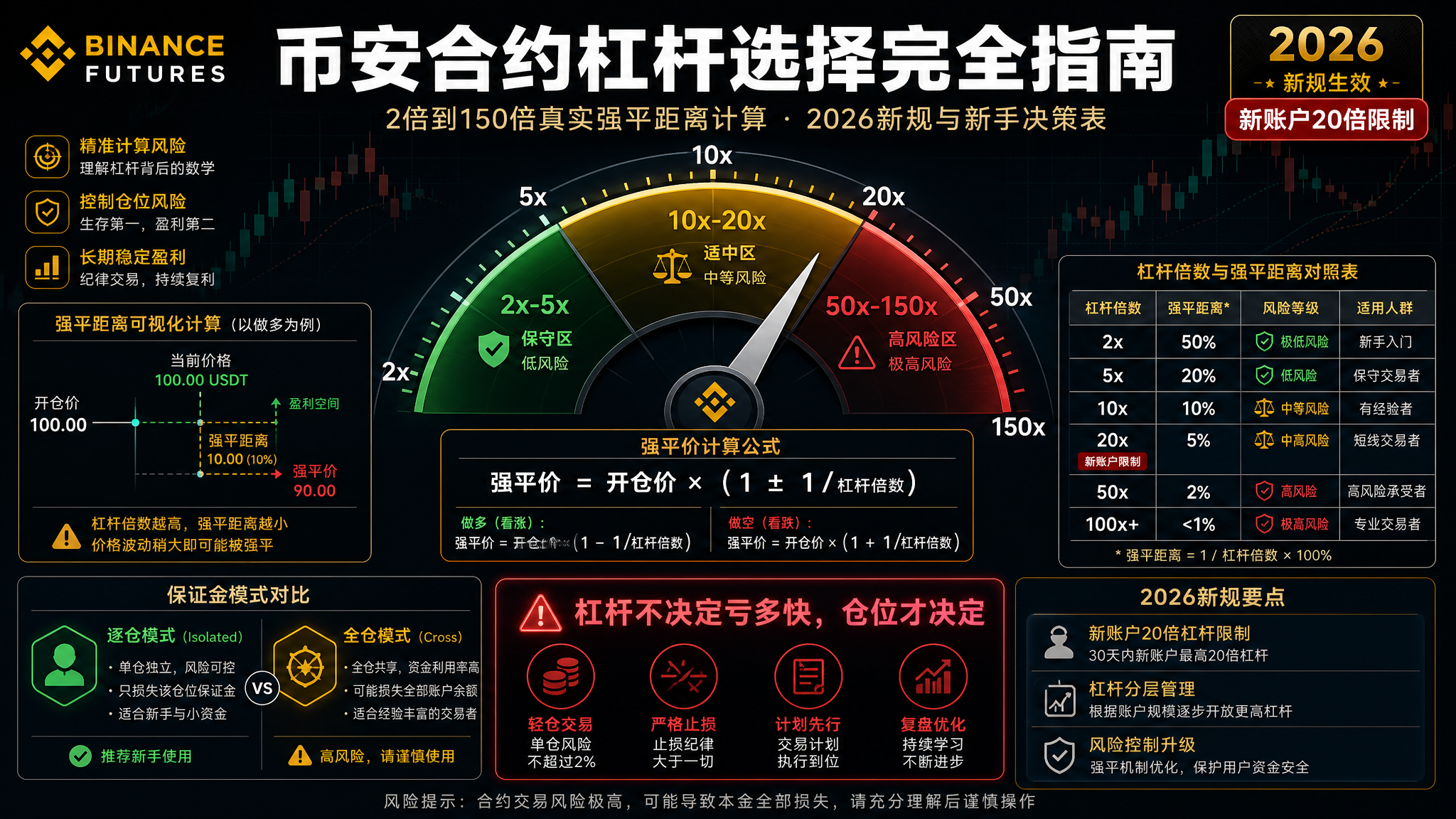
The short answer: beginners should run 2–3x, isolated margin, with notional exposure under 20% of the account; disciplined swing traders 3–5x. The reason: the leverage dial doesn't control how fast you make money — it controls how close you sit to liquidation. At 10x, a ~9.6% move against you liquidates you; at 20x, 4.6%; at 150x, 0.27%12. And what decides how fast you lose is never the leverage — it's the notional size of the position. The same 10,000 USDT position loses 300 USDT on a 3% drop no matter what leverage it was opened with. Two official facts most guides haven't caught up with: BTCUSDT/ETHUSDT perpetuals now allow up to 150x in tier 1 — not the 125x still quoted everywhere1 — and since December 7, 2025, brand-new futures accounts are capped at 20x for their first 30 days3. For beginners, that cap is a feature.
Three terms first: margin, notional value, liquidation price
The thing that actually determines your risk is the notional value — not the leverage number itself. One sentence ties the three terms together:
Notional value = margin × leverage
Liquidation price = where the mark price sits when your losses have nearly eaten the margin
- Margin: the money you actually put up. Open 10x with 1,000 USDT and your margin is 1,000.
- Notional value: the size of the position you control. 1,000 × 10x = a 10,000 USDT position. A 3% price drop loses 3% of notional — 300 USDT.
- Liquidation price: the price at which losses have burned the margin down to the required "maintenance margin". Hit it and the exchange force-closes the position — the famous "liquidation".
Once these three are clear, everything that follows becomes obvious: higher leverage = more notional per dollar of margin = a liquidation price closer to entry. The root of risk is notional value; leverage only decides how much margin you back it with.
What leverage actually changes: liquidation distance from 2x to 150x
Every time leverage doubles, your distance to liquidation is cut in half. Here's the key table. The rough column uses the simplest formula — "liquidation distance ≈ 100% ÷ leverage"; the adjusted column corrects for the 0.4% maintenance margin rate of BTCUSDT perpetual tier 112 (isolated, one-way long, fees ignored; 100,000 is a hypothetical entry price for clean math, not a market call):
| Leverage | Openable with 1,000 USDT margin | Rough: wiped out at a 1/L move | Real liquidation distance (with 0.4% MMR) |
|---|---|---|---|
| 2x | 2,000 USDT | 50% | ≈ 49.8% |
| 3x | 3,000 USDT | 33.3% | ≈ 33.1% |
| 5x | 5,000 USDT | 20% | ≈ 19.7% |
| 10x | 10,000 USDT | 10% | ≈ 9.6% |
| 20x | 20,000 USDT | 5% | ≈ 4.6% |
| 50x | 50,000 USDT | 2% | ≈ 1.6% |
| 100x | 100,000 USDT | 1% | ≈ 0.6% |
| 150x | 150,000 USDT | 0.67% | ≈ 0.27% |
Two takeaways:
- The real liquidation distance is always a bit closer than the rough estimate. The naive formula treats 1/leverage as the kill line, but the actual rule is: once losses leave you with only the maintenance margin (0.4% of notional in tier 1), liquidation triggers — and fees plus funding costs push the real point even earlier. The "estimated liquidation price" on the order panel is the number to trust.
- Above 100x there is nothing operationally meaningful left for small accounts. A 0.6% liquidation distance means a one-minute wick can wipe you out before you can even react.
The math on 1,000 USDT: 10x vs 5x
For the same notional position, different leverage loses money at exactly the same speed — only the liquidation price moves. This is the single most valuable line in this article. Here's the arithmetic:
Opening A: 10x leverage, a 10,000 USDT notional long
- Margin used: 1,000 USDT (assume BTC at 100,000, i.e. 0.1 BTC)
- Down 3% (to 97,000): loss 300 USDT, margin left 700
- Down ~9.6% (to 90,361): liquidated
Opening B: 5x leverage, same 10,000 USDT notional long
- Margin used: 2,000 USDT
- Down 3% (to 97,000): loss 300 USDT, margin left 1,700
- Down ~19.7% (to 80,321): liquidated
See it? At a 3% drop both openings lose exactly 300 USDT. What 5x buys over 10x is not "slower losses" — it's a liquidation price moved from 90,361 down to 80,321. The extra 1,000 USDT of margin purchased a wider survival band.
The reverse holds too: open 10x with only 5,000 USDT notional (margin 500) and a 3% drop costs 150 — far safer than 5x with 20,000 USDT notional (a 3% drop costs 600). So the conclusion: "low leverage + big position" can easily be more dangerous than "high leverage + small position." To judge risk, always look first at notional as a share of your account, then at whether the liquidation distance survives that asset's normal swings.
Binance's max leverage is 150x — but new accounts only get 20x
Binance's maximum leverage depends on notional value: the bigger the position, the lower the cap. Two official facts — the first one most guides still get wrong:
First, the cap is now 150x, not 125x. Binance's official leverage and margin table (updated August 19, 2025) shows tier 1 of BTCUSDT and ETHUSDT perpetuals at a 150x maximum1. The "Binance max 125x" you see everywhere is stale. Glance at the tier structure and you'll understand what "bigger position, lower cap" means:
| Notional tier (USDT) | Max leverage | Maintenance margin rate | Quick deduction |
|---|---|---|---|
| 0 – 300,000 | 150x | 0.40% | 0 |
| 300,000 – 800,000 | 100x | 0.50% | 300 |
| 800,000 – 3,000,000 | 75x | 0.65% | 1,500 |
(All 12 tiers: check Binance's official leverage table for live values.)
Second, new accounts are capped at 20x for 30 days. Under Binance's official rule, since December 7, 2025, newly opened futures accounts cannot use leverage above 20x during their first 30 days, and the restriction lifts gradually after that; separately, since August 12, 2025, sub-accounts of regular users cannot use leverage above 5x3.
For beginners the second rule is protection: even if you wanted to open 150x, the system won't let you for the first 30 days. By the time the cap lifts, the hope is you've read this piece — and thought it through.
Decision table: which leverage fits your situation
There is no single "best" multiplier — only a multiplier that matches your size, horizon, and discipline. Find your row:
| Your situation | Suggested leverage | Conditions | Why |
|---|---|---|---|
| First contact with futures, learning the mechanics | 2–3x | Isolated; notional ≤ 20% of account; money you can afford to lose | The goal is learning, not earning |
| Spot holder trading swings | 3–5x | Isolated; notional ≤ 30%; stop-loss mandatory | Normal pullbacks run ±5–10%; the liquidation line must sit outside the swing range |
| Hedging existing spot | 1–2x | Short side; size matched to the hedge ratio | The goal is locking risk, not amplifying returns |
| Disciplined day trader | 5–10x | Isolated; risk per trade ≤ 1–2% of account | The stop must fire before the liquidation price, or liquidation becomes your stop |
| Chasing short-term hype and wicks | 10x+ | Notional ≤ 10% of account; accept instant liquidation | Almost no margin for error — not recommended for beginners |
| Trying to win it all back with high leverage | Not suitable | —— | Leverage amplifies outcomes; it cannot fix bad judgment. The more desperate, the lower it should be |
One-line summary: the leverage you pick is the distance you're willing to let the market shake you out over. A liquidation line that's too close is a math problem; fumbling exits is a psychology problem — fix the math problem first.
Isolated vs cross margin: beginners default to isolated
📺 Want to see how leverage and margin mode are set in the actual order panel? Watch the Binance futures trading panel video.
Isolated margin caps the maximum loss of a single position at that position's margin — beginners should default to it. The real difference is blast radius when things go wrong:
| Comparison | Isolated | Cross |
|---|---|---|
| Margin source | Only the funds allocated to that position | The entire account balance |
| Loss ceiling | That position's margin | In theory, the whole account |
| Volatility absorption | Weaker (liquidation price closer) | Stronger (liquidation price further) |
| Who it's for | Beginners, experiments, single strategies | Mature strategies, hedged portfolios |
The beginner case for isolated comes down to one thing: it's the physical backstop for a forgotten stop-loss — even if you forget to set one, the loss is capped at that one block of margin. Cross margin's further liquidation price has a price tag: one bad judgment can touch the entire account.
One official rule that's easy to miss: in cross margin mode you can raise or lower leverage any time with the "adjust leverage" button; in isolated margin mode you cannot lower it once the position is open3. So decide the multiple before you open an isolated position — after entry you can only go up, and up is exactly the dangerous direction.
What actually happens when you get liquidated
Liquidation triggers on the mark price and follows a "cancel orders, then partially reduce" protocol — and it costs more than closing the position yourself. A few details of Binance's liquidation mechanics beginners don't know4:
- It watches the mark price, not the last traded price. The mark price blends multiple spot exchanges plus funding data — designed so a wick on one exchange can't needlessly kill you.
- Binance recommends keeping the margin ratio below 80%. Margin ratio = maintenance margin ÷ margin balance. At 80% you should already be reducing or adding margin — don't wait for 100%.
- "Smart liquidation" isn't a one-click wipe. On trigger, your open orders are cancelled first, then the engine attempts to reduce the position partially with immediate-or-cancel orders to fill the margin gap — full liquidation is the last resort, not the first move.
- Liquidation charges a clearance fee. A liquidated position pays a liquidation clearance fee calculated from the rate applied to notional value — meaningfully more expensive than clicking close yourself.
- Counter-intuitive: smaller positions are more likely to be wiped in one shot. Binance's own words: smaller positions are more likely to be fully liquidated than larger ones — because a small position's effective maintenance margin can fall below the liquidation clearance fee, sending it straight to bankruptcy on trigger4. A small position is not a talisman. Low leverage plus a stop-loss is.
The 5 mistakes beginners make most
- Treating leverage as an earnings multiplier. 10x doesn't mean "profits 10x faster" — it means "liquidation about 10x closer." What you earn is decided by notional and direction; leverage only decides whether you survive to see it.
- Big position, low leverage. 3x on the whole account is far more dangerous than 10x on 10% of it. Risk tracks notional as a share of the account, not the multiplier.
- No stop-loss, just watching the liquidation price. The liquidation price is the last line of defense, not a target line. Place the stop before it — keep the closing decision in your hands, not the liquidation engine's.
- Trying to lower leverage after opening in isolated mode. You can't — it's an official rule3. Set the multiple before entry.
- Ignoring the constant drip of funding and fees. On a leveraged position held over time, funding settled every 8 hours plus opening/closing fees keep gnawing at the margin, so the real liquidation point arrives earlier than the estimate. To cut fee costs, see the Binance fee reduction guide.
FAQ
What's the maximum leverage on Binance futures?
Per Binance's official leverage table, tier 1 of BTCUSDT and ETHUSDT perpetuals allows up to 150x (updated August 2025). The larger the position's notional value, the lower the cap — above 300,000 USDT notional it drops to 100x. But brand-new futures accounts are capped at 20x for their first 30 days. Always defer to Binance's live table.
How much leverage should a beginner use in crypto futures?
It depends on position size and stop-loss discipline — there is no magic number. Beginners: 2–3x, isolated margin, notional under 20% of the account. Disciplined swing traders: 3–5x. The core principle: leverage sets the liquidation distance; position size sets the speed of loss — evaluate them separately.
How much can the price drop before a 10x position gets liquidated?
Roughly 10% (100% ÷ 10); adjusted for the tier-1 maintenance margin rate of 0.4%, about 9.6%. That's the theoretical figure for an isolated one-way long ignoring fees — the "estimated liquidation price" on the trading page is the accurate one, and it's usually slightly closer than theory.
Why was my small position liquidated in one shot?
Because a small position's maintenance margin can be lower than the liquidation clearance fee, so liquidation sends it straight into bankruptcy. Binance's official liquidation protocol states this plainly: smaller positions are more likely to be fully liquidated than larger ones. What protects your capital is low leverage plus a stop-loss — not small size.
Should I use isolated or cross margin?
Beginners should use isolated margin — the maximum loss is locked at that position's margin. Cross margin pushes the liquidation price further and absorbs volatility better, but one bad position can drag the entire account balance. Note that isolated positions cannot lower leverage after opening — set it before entry.
Why can't I open high leverage on a new Binance futures account?
It's a protective rule enforced since December 7, 2025: new futures accounts are capped at 20x leverage for their first 30 days, lifting gradually afterward. The point is to limit new traders' liquidation risk at high leverage. Separately, sub-accounts of regular users have been capped at 5x since August 12, 2025.
Summary: the one line to remember
Leverage decides how far you sit from liquidation; position size decides how fast you lose — beginners: 2–3x, isolated margin, notional under 20% of the account, stop-loss ahead of the liquidation price. No multiplier replaces position management.
Fill in the prerequisites in order: start with spot vs futures trading to decide whether to touch futures at all, then the Binance futures trading guide for order mechanics, USDT-margined vs coin-margined contracts to pick the right pair — and come back to this piece to set the leverage. For how liquidation works in DeFi, see the DeFi liquidation mechanism guide.
No Binance account yet? Register on Binance (referral code: BINANBT) — the signup, KYC, and first-deposit walkthrough is in the Binance registration and deposit guide. You can also use OKX (referral code: 60895497) — both support futures.
📚 Further reading: the on-chain guide — a free lighthouse for learning blockchain and on-chain data from zero.
Disclaimer: This content is for educational purposes only and does not constitute investment advice. Futures trading involves leverage and carries far higher risk than spot — you can lose your entire principal. Make decisions based on your own circumstances.
Footnotes
-
Binance, "Leverage & Margin Table (USDS-M Futures)" (https://www.binance.com/en/futures/trading-parameters/perpetual/leverage-margin): BTCUSDT perpetual tier 1 (notional 0–300,000 USDT) allows max 150x leverage with a 0.40% maintenance margin rate and 0 quick deduction; tier 2 is 100x at 0.50%; the USDⓈ-M contracts with 150x max leverage include BTCUSDT and ETHUSDT perpetuals; table updated 2025/08/19. Verified 2026-08-28. ↩ ↩2 ↩3 ↩4
-
Binance, "How to Calculate the Liquidation Price of USDⓈ-M Futures" (https://www.binance.com/en/support/faq/detail/b3c689c1f50a44cabb3a84e663b81d93): in isolated mode the wallet balance is the position's isolated wallet balance with cross margin and unrealized PnL treated as zero — plug position size, MMR, and the quick deduction into the official formula. The "real liquidation distance" column here simplifies that formula for tier 1 (0.4% MMR, zero deduction) ignoring fees. Verified 2026-08-28. ↩ ↩2
-
Binance, "Leverage and Margin of USDⓈ-M Futures" (https://www.binance.com/en/support/faq/detail/360033162192): since 2025-12-07, newly opened futures accounts cannot use leverage above 20x in their first 30 days, with the restriction lifting gradually afterward; since 2025-08-12, sub-accounts of regular users cannot use leverage above 5x; maintenance margin = notional position value × maintenance margin rate − quick deduction; in cross margin mode the "adjust leverage" button raises or lowers leverage, while isolated positions cannot lower it. Verified 2026-08-28. ↩ ↩2 ↩3 ↩4
-
Binance, "Binance Futures Liquidation Protocols" (https://www.binance.com/en/support/faq/detail/360033525271): liquidation price and unrealized PnL are calculated with the mark price; margin ratio = maintenance margin ÷ margin balance, and Binance recommends keeping it under 80%; the liquidation flow is cancel open orders → immediate-or-cancel partial reduction → insurance fund takeover → auto-deleveraging (ADL); a liquidation clearance fee applies based on the rate and notional value; smaller positions are more likely to be fully liquidated than larger ones. Verified 2026-08-28. ↩ ↩2