


TL;DR: The Bottom Line First
Trading perpetual futures on stocks, commodities and forex with crypto splits into two camps: on-chain DEXs are self-custodial, oracle-priced and trade 24/7, while centralized exchanges run CFDs via MT5 with traditional trading hours and regulated leverage caps. Both give you price exposure, not the underlying asset.
Five facts that matter most:
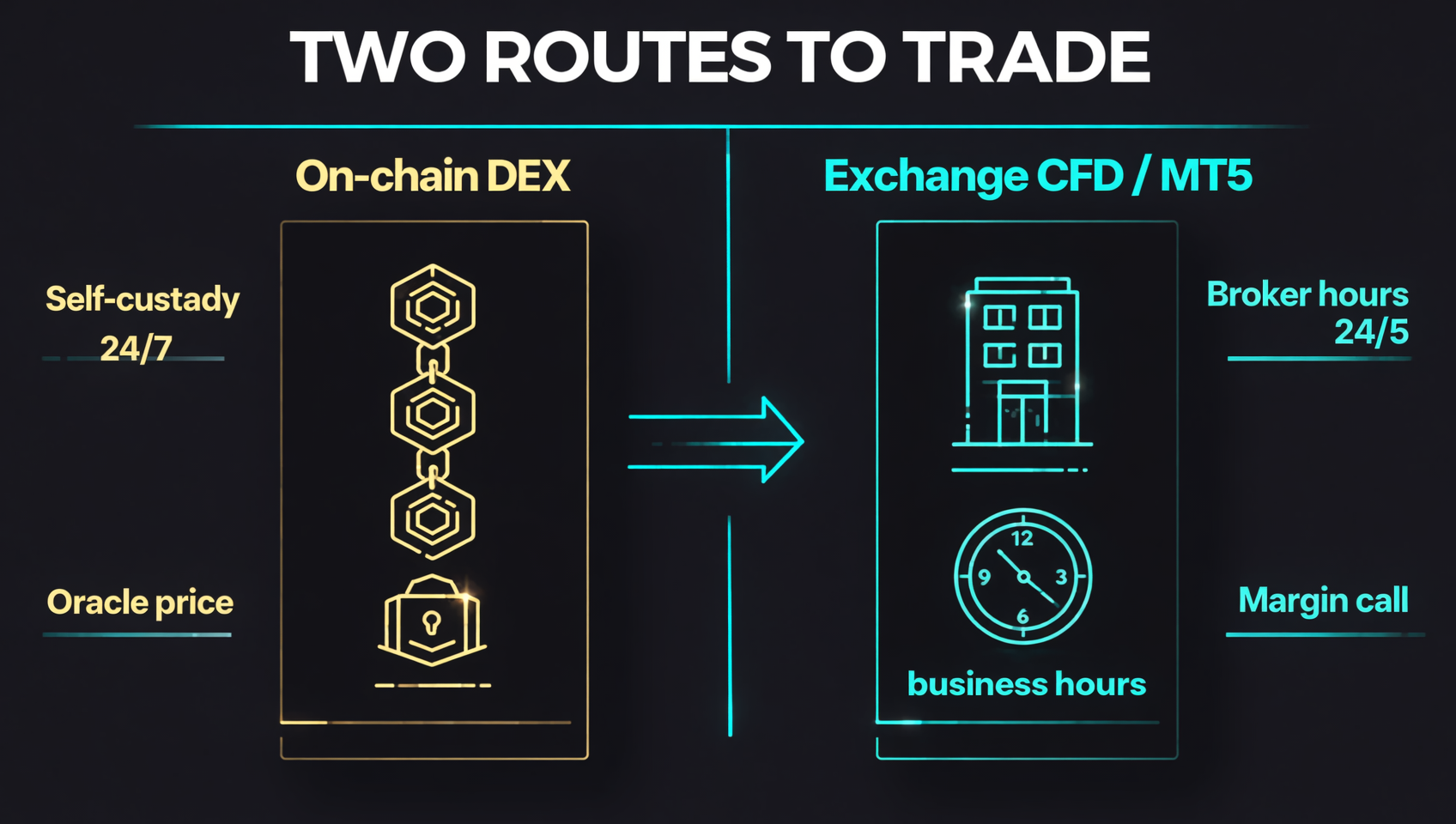
- Two routes. On-chain DEXs (Gains Network gTrade, Ostium) use USDC margin + oracle feeds with no expiry and 24/7 trading; centralized exchanges (Bybit, Bitget, Gate) trade stock/gold/forex CFDs through MT5 accounts on 24/5 hours12.
- Leverage varies hugely. gTrade reaches ~1000x on forex and ~50x on stocks; Ostium ~200x on forex; exchange CFDs up to 500x on some products, but EU ESMA caps retail leverage at 30:1 down to 2:123.
- Holding costs money. Perpetuals charge funding, CFDs charge overnight swap — holding bleeds fees continuously, so these are not long-term investments2.
- Different risk types. DEXs carry smart-contract + oracle + market-gap risk; exchange CFDs carry custody + regional regulatory risk. Neither is absolutely safer4.
- Tokenized stocks ≠ perpetuals. The former are equity tokens (withdrawable, dividend-bearing); the latter are leveraged derivatives (long/short, no settlement). Don't confuse them.
Here's both routes, three representative platforms, fees and risk, in full.
Table of Contents
- Clarify three concepts: tokenized stocks, stock perpetuals, RWA perpetuals
- Route 1: On-chain DEXs (gTrade, Ostium)
- Route 2: Exchange CFDs / MT5
- Leverage & fee comparison table
- Decision table: match your needs
- 4 risks you must know
- FAQ
- Further reading
Clarify three concepts: tokenized stocks, stock perpetuals, RWA perpetuals
Before you start, separate three things that look alike but are not the same — this is where beginners trip.
- Tokenized stocks (Equity Tokens): Binance bStocks, Bitget rToken, Gate xStocks — equity tokens pegged to a real share price. They focus on holding, withdrawal and dividends, trade on market hours, and mostly carry no leverage.
- Stock perpetuals: Binance's NVDA perpetual — a leveraged contract to go long or short a single stock index, with no expiry and a funding rate.
- RWA perpetuals: the focus of this article. On-chain protocols like Gains Network gTrade and Ostium turn stocks, commodities, forex and indices into synthetic perpetuals priced by oracles and settled in USDC, with no real-asset delivery1.
In one line: tokenized stocks are "holding certificates"; perpetuals/CFDs are "leveraged bets" — the former wants to own, the latter wants to speculate on direction. This article only covers the latter two.
Route 1: On-chain DEXs (gTrade, Ostium)
On-chain RWA perpetuals share three traits: self-custody (funds in your own contract), oracle pricing, 24/7 trading, USDC settlement. They differ mainly in "pool counterparty" versus "hedged" models.
Gains Network gTrade: the pioneer of the pool-counterparty model
gTrade is the oldest still-running protocol in this niche, deployed on Arbitrum, Base, Solana and other chains1.
- Assets: 270+ trading pairs across crypto, forex, commodities, US stocks and indices.
- Leverage: major forex up to ~1000x, gold ~250x, BTC/ETH ~200x, most crypto ~150x, US stocks ~50x.
- Fees: charged on leveraged position size — BTC/ETH ~0.035% per side + 0.005% spread; major forex ~0.012% per side + 0.005% spread; commodities and stocks priced per pair2.
- Mechanism: a USDC/DAI vault is the counterparty to everyone — trader profits come out of it, losses go into it. Profits buy back and burn GNS; losses mint GNS to recapitalize — its most distinctive and contested feature14.
One-line fit: for users chasing extreme leverage (1000x forex) and broad asset coverage who can accept vault-counterparty risk.
Ostium: the challenger to traditional FX/CFD brokers
Ostium launched on Arbitrum in 2025, raised $20M (led by General Catalyst and Jump Crypto), and passed $50B in cumulative volume by May 20262.
- Assets: 50+ across forex (EUR/USD, USD/JPY), commodities (gold, silver, oil, copper), indices (S&P 500, Nasdaq, Dow Jones) and some US stocks/ETFs.
- Leverage: forex up to ~200x, gold ~150x, crypto/indices ~100x, oil/copper ~50x.
- Fees: 2–10 bps opening fee by asset class, no closing fee on normal exits; forex rollover ~3–5% annualized (tracking real financing rates, not broker-set swaps)2.
- Mechanism: self-custodial smart contracts + Stork Network (RWA feeds) + Chainlink (crypto feeds), positioning itself as a replacement for traditional FX brokers.
One-line fit: for users who want self-custody as a replacement for FX/CFD brokers, low fees and institutional-grade price feeds.
A historical note: Synthetix listed synthetic stocks like sTSLA and sAAPL in 2020–2021, but without active hedging and with prices stuck during US market closures, it was repeatedly attacked and mostly delisted its RWA assets after 20214. The lesson for everyone after it: the hard part of RWA perpetuals isn't building them — it's handling market closures and oracles safely.
Route 2: Exchange CFDs / MT5
Bybit, Bitget and Gate take a different path: instead of an on-chain protocol, they plug into the traditional MT5 brokerage system and offer stocks, gold and forex as contracts for difference (CFDs).
- How it works: open a separate MT5 account on the exchange and deposit USDT/USDC to trade CFDs.
- Trading hours: follows traditional markets, 24/5 (stocks/forex by their own sessions), not crypto's 24/7.
- Leverage: fixed and non-adjustable per instrument, up to 500x on some products; EU ESMA rules cap retail leverage from 30:1 (major FX) down to 2:1 (crypto)3.
- Fees: spread + per-lot commission + overnight swap; liquidation triggers on margin level, not the mark-price logic of crypto perpetuals.
Context: according to a CoinGecko study (June 2026), tokenized traditional-asset market cap across Binance, OKX, Bybit, Bitget, Gate and MEXC grew from $1.4B in January 2025 to $6.6B by June 2026, with perpetuals at 98.5% of activity and US-stock perpetuals overtaking precious metals by mid-20265.
One-line fit: for mainstream users who want exchange backing, custody-grade protection (negative-balance protection, leverage caps) and regulation — at the cost of trading hours and funds sitting on the platform.
💡 Want a mainstream exchange to start? Binance takes a third route — turning US stocks into "stock token perpetuals" with a funding rate (rather than MT5 CFDs). Register on Binance (code BINANBT) to trade NVDA and more, at no extra cost to you.
Leverage & fee comparison table
Data checked 2026-10-16. Fees reflect each platform's live pages; leverage figures are maximums that adjust with market conditions.
| Dimension | gTrade (on-chain DEX) | Ostium (on-chain DEX) | Exchange CFD (Bybit/Bitget/Gate) |
|---|---|---|---|
| Custody | Self-custody (contract) | Self-custody (contract) | Platform custody (MT5 account) |
| Settlement | USDC/DAI | USDC | USDT/USDC etc. |
| Trading hours | 24/7 | 24/7 | 24/5 (traditional markets) |
| Forex leverage | Up to ~1000x | Up to ~200x | Up to 500x (ESMA cap 30:1) |
| US stock leverage | ~50x | Indices ~100x | Per product, regional caps |
| Opening fee | BTC/ETH from 0.035% | 2–10 bps | Spread + commission |
| Holding cost | Funding rate | Rollover 3–5% annualized | Overnight swap |
| Regulation | Unlicensed, protocol-based | Unlicensed, protocol-based | Licensed / regionally regulated |
| KYC | Usually none | Usually none | Required |
Decision table: match your needs
| Your need | Recommended route | Why |
|---|---|---|
| Self-custody + 24/7 trading | On-chain DEX (Ostium / gTrade) | Funds in your own contract, no market-closure limits |
| Forex with extreme leverage | gTrade | Forex up to ~1000x, but risk scales with it |
| Low fees + institutional feeds | Ostium | 2–10 bps opening, no closing fee |
| Exchange backing + regulatory protection | Exchange CFD | Negative-balance protection, ESMA caps, licensed |
| Just want to "hold" US stocks, not bet | Tokenized stocks (bStocks etc.) | That's the "own" logic, not the leveraged tool here |
One-line summary: decide whether you want to "own" or "bet on direction", and whether you can accept self-custody + protocol risk versus platform custody + regulation — that's the first fork in choosing a platform.
4 risks you must know
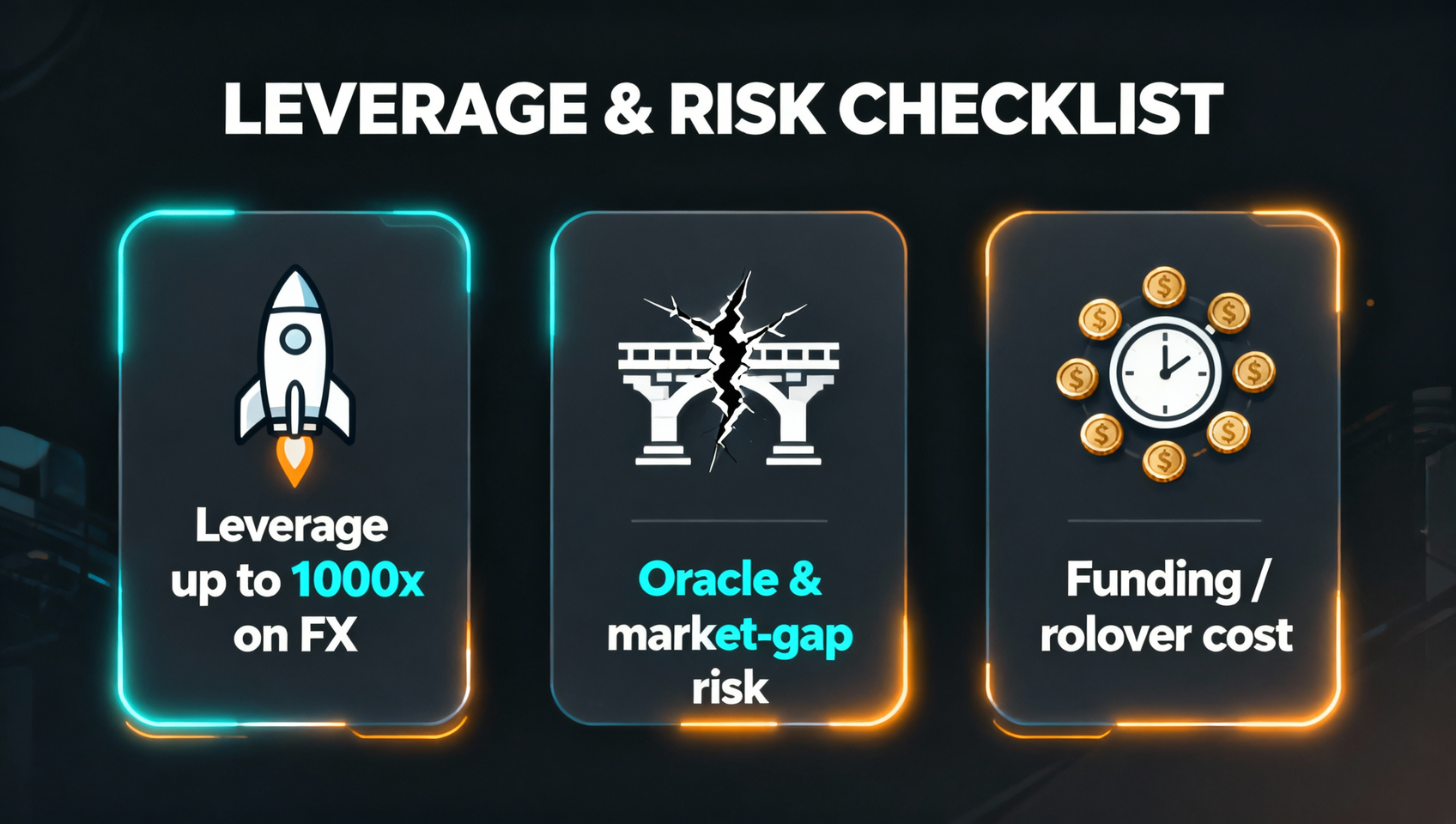
Leverage is a real double-edged sword. 1000x forex means a 0.1% adverse move nearly liquidates you. Higher leverage isn't "easier profit" — it's "faster liquidation".
Oracle and market-gap risk. RWA perpetuals rely on oracle feeds; when the underlying is closed (weekends, holidays), a failed oracle or price gap can cause unfair liquidations — the exact place Synthetix stumbled4.
Pool-counterparty risk. gTrade's vault is the counterparty to everyone; large trader profits drain it, triggering GNS minting to recapitalize — a "death spiral" risk. Whether your profit pays out depends on the vault's solvency4.
Holding costs eat you slowly. Perpetual funding and CFD overnight swap are "rent for holding overnight". Holding these long-term can cost more than the trade earns.
FAQ
Can I trade perpetual futures on stocks, gold and forex with crypto?
Yes. On-chain DEXs (Gains Network gTrade, Ostium) use USDC margin and oracle pricing to trade stock, commodity and forex perpetuals 24/7; centralized exchanges (Bybit, Bitget, Gate) offer stock, gold and forex CFDs through MT5 accounts. Both give you price exposure, not the underlying asset.
What's the difference between stock perpetuals and tokenized stocks?
Tokenized stocks (Binance bStocks, Bitget rToken) are equity tokens pegged to a share price, focused on holding, withdrawal and dividends. Perpetual futures are leveraged derivatives focused on long/short with no expiry and no real-asset settlement, and they charge a funding or rollover fee.
Which is safer, an on-chain DEX or an exchange CFD?
Each has different risks. On-chain DEXs are self-custodial but carry smart-contract, oracle and market-gap risk. Exchange CFDs are licensed with negative-balance protection but funds sit on the platform, subject to regional rules and 24/5 hours. Neither is absolutely safer.
What's the maximum leverage for forex perpetuals?
gTrade reaches roughly 1000x on major forex pairs, Ostium about 200x, and exchange CFDs up to 500x on some products — but EU ESMA rules cap retail leverage at 30:1 down to 2:1. Higher leverage means faster liquidation.
Is holding these perpetuals / CFDs long-term worth it?
Usually not. Perpetuals charge a funding rate and CFDs charge an overnight swap, so holding bleeds fees. These are short-term hedging or directional tools, not long-term investments.
Can users in my region use these platforms?
Check your local laws. On-chain DEXs usually require no KYC, but some countries ban leveraged derivatives. Exchange CFDs generally have regional restrictions and require KYC. This is not compliance advice.
Further reading
Recommended exchange: to trade US-stock and crypto perpetuals, Register on Binance (code BINANBT) — supports NVDA and other stock token perpetuals, at no extra cost to you.
- How to buy NVDA on Binance: perpetuals & stock tokens guide — a single-stock perpetual case study
- Binance bStocks vs OKX/Bitget/Gate: tokenized US stocks — to "hold" stocks rather than bet on direction
- USDT vs coin-margined futures on Binance — perpetual margin mechanics
- Binance funding rate guide: why holding overnight costs money — where the holding cost comes from
- On-chain guide — more blockchain fundamentals and DeFi tutorials
Data check: platform leverage, fees, assets and volume figures (gTrade, Ostium, Synthetix, exchange CFD route) were checked on 2026-10-16 against official docs and primary reporting, sourced in footnotes1–5. Leverage figures are maximums; fees adjust per pair and should be confirmed on each platform's live page.
Disclaimer: This content is for educational purposes only and is not investment advice. Perpetual futures and CFDs are highly leveraged derivatives that can result in the loss of your entire principal, and leverage rules vary by region. Trade according to your own risk tolerance and comply with local laws.
Footnotes
-
Gains Network gTrade mechanism and assets: gTrade is a decentralized leveraged-trading protocol deployed on Arbitrum, Base, Solana and other chains, covering 270+ pairs across crypto, forex, commodities, US stocks and indices, using a USDC/DAI vault as counterparty, oracle pricing + fixed spread, with up to ~1000x forex, ~150x crypto and ~50x US-stock leverage. Source: Gains Network official docs (docs.gains.trade, accessed 2026-10). ↩ ↩2 ↩3 ↩4 ↩5
-
Ostium mechanism and fees: Ostium is an RWA perpetuals protocol launched on Arbitrum in 2025, covering 50+ forex/commodity/index/stock assets, USDC-settled and self-custodial, up to ~200x forex leverage, 2–10 bps opening fee, no normal closing fee, ~3–5% annualized forex rollover; over $50B cumulative volume by May 2026 and a $20M Series A (led by General Catalyst and Jump Crypto) in December 2025. Source: Ostium website (ostium.com) and official blog (accessed 2026-10). ↩ ↩2 ↩3 ↩4 ↩5 ↩6
-
Exchange CFD route and regulation: Bybit, Bitget, Gate and others offer stock, gold and forex CFDs via MT5 accounts, with fixed leverage up to 500x on some products; EU ESMA rules cap retail leverage from 30:1 (major FX) down to 2:1 (crypto). Source: exchange announcements and ESMA product-intervention rules (accessed 2026-10). ↩ ↩2
-
Synthetix history and pool-counterparty risk: Synthetix launched synthetic stocks such as sTSLA and sAAPL in 2020–2021, was repeatedly attacked due to a lack of active hedging and prices stalling during US market closures, and largely delisted RWA assets after 2021; pool-counterparty models can trigger token minting to recapitalize ("death spiral") when traders profit heavily. Source: Synthetix official blog and industry research (accessed 2026-10). ↩ ↩2 ↩3 ↩4 ↩5
-
Tokenized traditional-asset market size: per a CoinGecko study (June 2026), tokenized traditional-asset market cap across Binance, OKX, Bybit, Bitget, Gate and MEXC grew from ~$1.4B in January 2025 to ~$6.6B in June 2026, with perpetuals at 98.5% of activity. Source: CoinGecko research report (2026-06). ↩ ↩2