


TL;DR
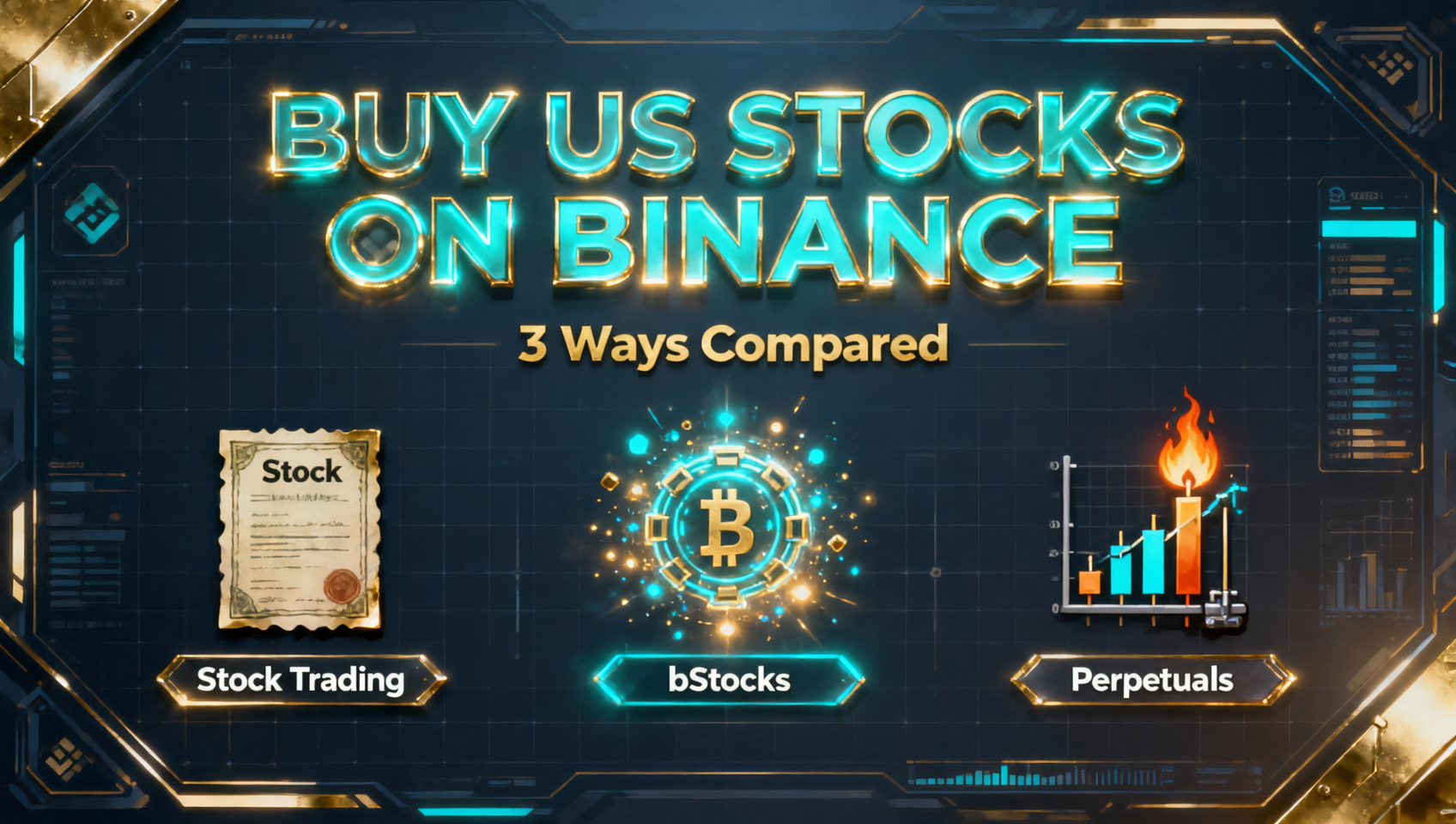
"Buying US stocks on Binance" is not one thing — it is three products with completely different natures. Most people searching "buy US stocks on Binance" think there is a single entry point; there are actually three, and picking the wrong one means buying the wrong thing:
- Stock Trading — buy real US shares with USDC. You are the beneficial owner, with shareholder rights and cash dividends. 7000+ tickers, T+2 settlement. Best for long-term holding.
- bStocks — BEP-20 tokens that track a stock 1:1. 24/7, ~1-second settlement, withdrawable to your own wallet. For flexible trading and DeFi.
- Stock perpetual contracts — cash-settled derivatives for going long or short with USDT leverage. You can short, there is liquidation risk, and you pay funding fees. Short-term traders only.
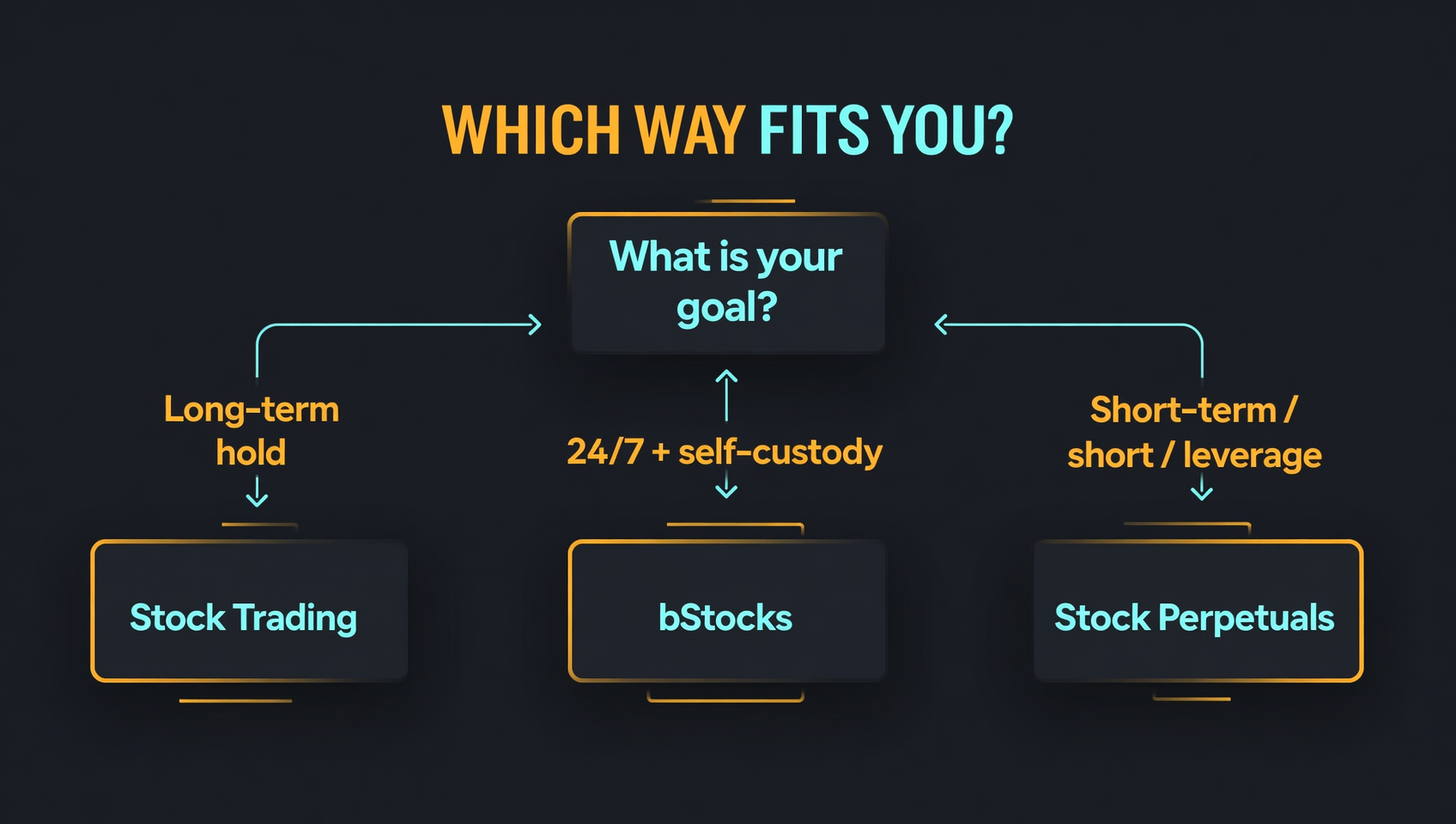
One-line decision: long-term hold → Stock Trading; 24/7 + self-custody → bStocks; shorting/leverage → perpetuals.
The critical caveat first: none of the three is available to mainland China or US users; eligibility is determined at registration. Don't bypass with VPN or borrowed identity.
Table of Contents
- The conclusion up front: one table
- Way 1: Stock Trading — real shares
- Way 2: bStocks — tokenized stocks
- Way 3: Stock perpetuals — leveraged derivatives
- How to choose: the decision table
- Hidden costs: look beyond the visible fees
- Risk and compliance: four rules before you trade
- FAQ
- Further reading
The conclusion up front: one table
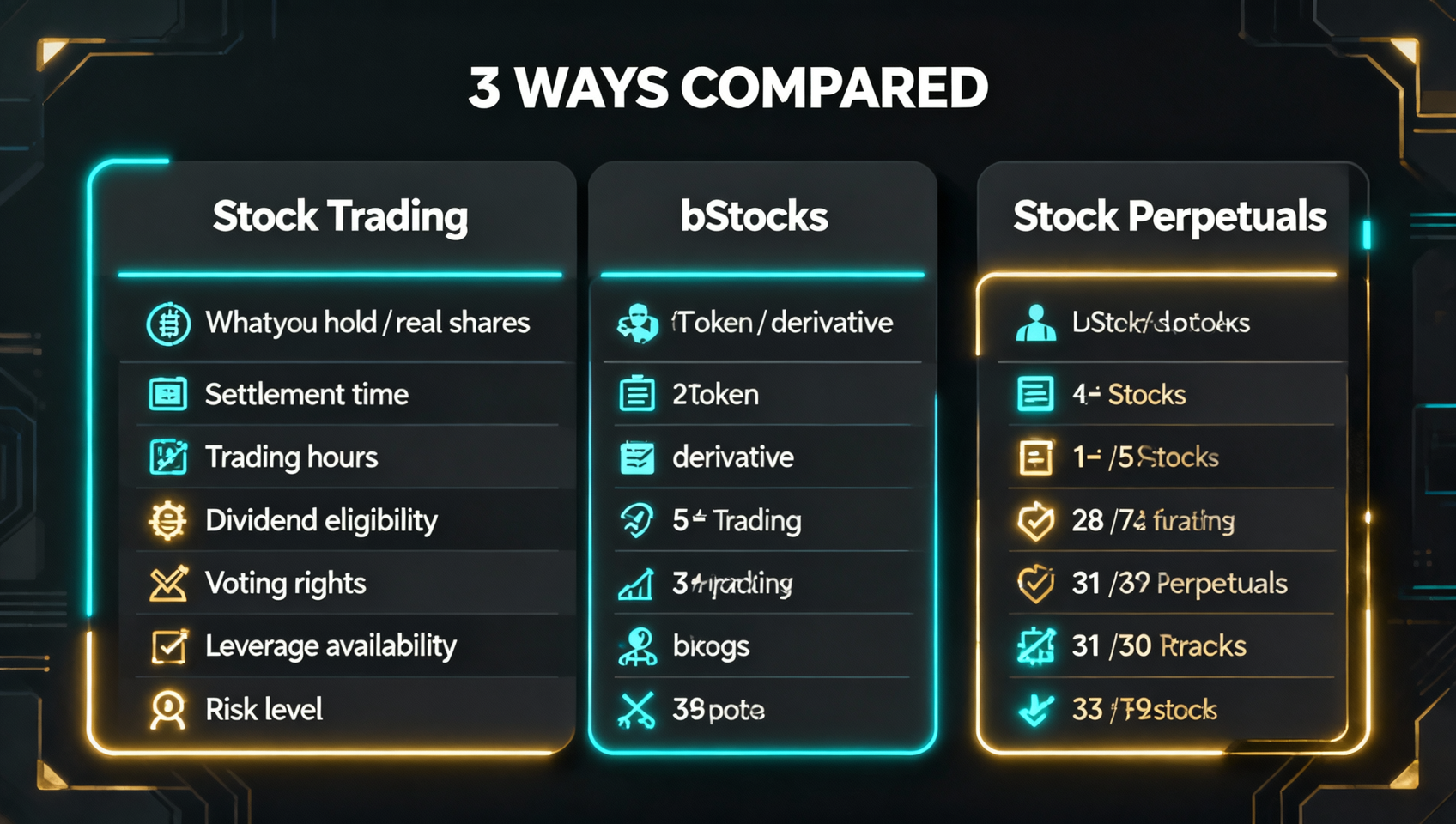
These are three fully separate entry points in the Binance app — Stock Trading is under "Trade → Stocks", bStocks are found by searching the code (e.g. TSLAB) under "Trade → Spot", and perpetuals are searched under "Futures" (e.g. NVDAUSDT). The table below is the core of this article — scan it first:
| Dimension | ① Stock Trading | ② bStocks | ③ Stock perpetuals |
|---|---|---|---|
| What you hold | Real shares, beneficial owner | BEP-20 token tracking the price 1:1 | Cash-settled derivative contract |
| Tickers | 7000+ stocks/ETFs | ~80+ (growing) | Dozens of hot stocks (growing) |
| Settlement | USDC, T+2 | USDT/USDC, ~1s | USDT, real-time |
| Trading hours | US hours + pre/post market | 24/7 | 24/7 |
| Can you short | ❌ | ❌ | ✅ |
| Leverage | None | None | 5–20x (higher on some) |
| Dividends | Cash in USDC | Auto-reinvested (30% tax withheld) | None |
| Voting rights | ✅ (beneficial owner) | ❌ | ❌ |
| On-chain self-custody | ❌ | ✅ (BSC) | ❌ |
| Main cost | $0.35 platform fee / 0.1% spread | Zero spot commission, free conversion | Trading fees + funding rate |
| Liquidation risk | None | None | ✅ Yes |
Remember their essence in one line: ① is equity, ② is a certificate, ③ is a contract.
Way 1: Stock Trading — real shares
This is the one that most resembles "buying stocks", and the only one that gives you real equity. Binance launched stock trading in June 2026, provided by licensed Nest Trading Limited (ADGM-regulated) with clearing by US broker Alpaca Securities1.
Key points:
- You buy real US shares — you become the beneficial owner with dividends and corporate action rights, not a CFD or a demo account
- 7000+ US stocks and ETFs, including HK ADRs like Tencent (TCEHY) and Alibaba (BABA)
- USDC settlement, T+2 — funds are locked ~2 trading days after selling, but usable inside Binance (buying crypto, Earn, etc.)
- Zero commission, from $5, fractional shares supported; $0.35 platform fee for orders ≤$350, 0.1% spread above $350
- Dividends arrive as USDC cash — this is the biggest experience difference from bStocks' auto-reinvestment
Who it's for: people who want long-term holding, cash dividends, and shareholder rights. Full walkthrough in the Binance stock trading guide (USDC, real shares + ADRs).
The trade-off: you can only trade during US market hours (Beijing time 21:30–04:00), you can't trade 24/7, and you can't withdraw shares to an on-chain wallet.
Way 2: bStocks — tokenized stocks
bStocks are "tokenized stocks" — you buy a BEP-20 token that maps 1:1 to a real share, not the stock itself. Issued by BTech Holdings (a Binance-group affiliate) in Abu Dhabi's ADGM: real shares are first held in custody, then tokens are minted on BNB Chain at 1:12.
Key points:
- ~80+ tickers (growing weekly), named by appending "B": Tesla
TSLAB, NvidiaNVDAB, MicrosoftMSFTB, MetaMETAB, Nasdaq-100 ETFQQQB, etc.3 - 24/7 trading, ~1-second settlement, from $5, fractional shares supported
- Free 1:1 stock ↔ bStock conversion — you can always convert a token back into real shares at no fee
- Withdrawable to a BSC wallet (Trust Wallet, hardware wallet) and usable in DeFi
- Dividends auto-reinvest: net dividends (after ~30% US withholding tax) are reinvested into the underlying stock via the Multiplier mechanism, so your balance quietly grows — not a cash deposit
- No voting rights — legally a "certificate representing a financial instrument", not shares in a Nasdaq account
Who it's for: people who want to trade stock prices 24/7 with crypto assets and move holdings on-chain for DeFi. Full walkthrough in the Binance bStocks tutorial.
The trade-off: not real shares, no voting rights, dividends aren't paid in cash, and your final risk = stock-price risk + issuer/custodian counterparty risk.
Way 3: Stock perpetuals — leveraged derivatives
This is the riskiest of the three: you trade a cash-settled derivative that bets on price direction — you hold no shares and collect no dividends. Binance started with a single TSLA contract in early 2026 and has expanded to Nvidia, Apple, Meta, Alphabet, Microsoft, Amazon and more, with plans to grow past 50 tickers4.
Key points:
- You can short and use leverage — the only one of the three that supports two-way trading, generally 5–20x (higher on some tickers, per the futures page in real time)
- USDT margin, 24/7, open a position with a few dozen USDT; minimum trade size is small (e.g. 0.01 NVDA)
- Funding rate settles every 8 hours — paid between longs and shorts; when funding is positive, holding a long costs you continuously
- Cash-settled, no delivery — you get price exposure only, with no share ownership
- Liquidation risk — the higher the leverage, the smaller the adverse move needed to force-close your position
Who it's for: short-term traders who want to short or amplify moves with leverage. The full NVDA walkthrough is in the Binance NVDA guide (perpetuals + tokens).
The trade-off: no dividends, no equity, funding fees are an ongoing cost, and liquidation risk is real — this is a trading tool, not a "buy and hold" substitute. Holding it long term can cost you double-digit percentages a year in funding alone.
How to choose: the decision table
Don't ask "which is best" — ask "what am I actually trying to do". No option is universally better; it depends on your goal:
| Your actual need | Use | Why |
|---|---|---|
| Long-term hold, cash dividends, shareholder rights | ① Stock Trading | The only way to hold real equity |
| 24/7 flexible trading + on-chain self-custody | ② bStocks | Tokens, withdrawable to BSC, DeFi-ready |
| Short-term long/short with leverage | ③ Perpetuals | The only way to short + use leverage |
| Small capital, want to dip a toe into price moves | ② bStocks or ③ perpetuals | Both start from $5 / a few dozen USDT |
| Passive price exposure without tinkering | ① Stock Trading | Simplest, with real equity as the backstop |
A practical decision order:
- First ask can you even use it — mainland China/US users likely can't use any of the three; confirm eligibility first (see "Risk and compliance" below)
- Then ask your holding period — a year or more → Stock Trading; days to weeks → bStocks or perpetuals
- Then ask do you need leverage/shorting — yes → only perpetuals; no → rule out perpetuals
- Finally ask do you need self-custody — yes → bStocks; no → Stock Trading
The most common mistake: a beginner who wants to "hold US stocks long term" ends up in the perpetuals entry with leverage, pays funding for a year, and may get liquidated on a wick. Long-term holding and perpetual contracts are mutually exclusive goals.
Hidden costs: look beyond the visible fees
The visible fees are rarely the biggest cost — the real cost hides elsewhere.
| Way | Visible fee | The real hidden cost |
|---|---|---|
| ① Stock Trading | $0.35 platform fee / 0.1% spread | Capital tied up by T+2; ADR fees $0.01–$0.03/share/year |
| ② bStocks | Zero spot commission, free conversion | Bid-ask spread outside market hours (~44% of volume trades outside regular US hours, where spreads widen) 5 |
| ③ Perpetuals | Trading fees | Funding rate (every 8 hours; positive funding on a long is a continuous bleed) + potential liquidation loss |
One counterintuitive takeaway: only perpetuals get more expensive the longer you hold. Stock trading and bStocks have one-time costs (platform fee/spread), while a perpetual's funding rate accumulates over time — which is exactly why perpetuals are for short-term trading, not for "buying US stocks long term".
Risk and compliance: four rules before you trade
These four are hard constraints — read them before you start:
- Mainland China and US users likely can't use these. Binance does not offer services to mainland China users, and Stock Trading and bStocks generally exclude US users; eligibility is determined by KYC and region checks at registration. Do not bypass via VPN or borrowed identity — it violates the platform's terms, can freeze your funds, and offers no legal protection.
- Tokens are not shares. Neither bStocks nor perpetuals give you equity: no voting rights, no shareholder rights. bStocks' final risk = stock-price risk + issuer (BTech) and custodian counterparty risk.
- Perpetuals carry liquidation risk. The higher the leverage, the smaller the adverse move needed to force-close your position to zero. Beginners should start small, use low leverage (≤5x), and set tight stops — not jump in at 20x or 50x.
- Stock investing is volatile by nature. All three track the same US stocks; the way you hold them doesn't remove the fact that stocks go down. Your choice of instrument changes your holding form and cost structure, not the underlying risk.
FAQ
What are the three ways to buy US stocks on Binance?
Three completely different products: ① Stock Trading — real shares with USDC, you're the beneficial owner with cash dividends and shareholder rights, 7000+ tickers, T+2; ② bStocks — BEP-20 tokens tracking the price 1:1, 24/7, ~1s settlement, withdrawable to BSC, no voting rights; ③ Stock perpetuals — USDT-margined derivatives for leveraged long/short, no dividends, liquidation risk. Check the entry point before ordering.
I just want to hold US stocks long term. Which one?
Stock Trading (real shares). It's the only one that makes you the beneficial owner with cash dividends and shareholder rights. bStocks have no voting rights and auto-reinvest dividends; perpetuals have no dividends and charge funding — neither fits long-term equity holding.
I want 24/7 trading and to move stocks to my own wallet. Which one?
bStocks. They're 24/7, ~1s settlement, free 1:1 stock↔bStock conversion, withdrawable to Trust Wallet or a hardware wallet and usable in DeFi. The trade-off: no voting rights, and dividends are auto-reinvested rather than paid in cash.
I want to trade short term or short the market. Which one?
Only stock perpetuals let you short and use leverage. But they have no dividends, no equity, an 8-hourly funding rate, and liquidation risk — short-term trading with tight stops only.
How are the fees calculated for each?
Stock Trading: zero commission, $0.35 for orders ≤$350, 0.1% spread above. bStocks: zero spot commission and free conversion, hidden cost in off-hours spreads. Perpetuals: trading fees plus an 8-hourly funding rate. Only perpetuals get more expensive the longer you hold.
Can mainland China users use these three ways?
Most likely none. Binance doesn't serve mainland China users, and Stock Trading and bStocks generally exclude US users, determined at registration. Don't bypass via VPN or borrowed identity. For a legal route from mainland China, see our all-channels guide to buying US stocks.
Are bStocks and Stock Trading priced the same?
In theory yes (1:1 backing + arbitrageurs), but off-hours bStocks have thin liquidity and wider spreads, so fills can diverge from the real share price; Stock Trading only fills during US hours at the exchange price. So the same stock can show different fills on the two rails off-hours.
Further reading
- On-site: Binance stock trading guide (real shares + ADRs) | Binance bStocks tutorial | Binance NVDA guide (perpetuals + tokens) | bStocks vs OKX/Bitget/Gate comparison | How to buy US stocks from China: 4 routes | Binance registration & deposit guide
- Official sources: Binance stock trading support | What are bStocks (Binance Academy) | Binance futures announcements
Recommended exchange: for Binance, Register on Binance (code BINANBT); for the OKX ecosystem, Register on OKX (code 60895497).
Footnotes
Disclaimer: this content is for education only and is not investment advice. bStocks are not real shares and carry no shareholder rights; stock perpetuals are leveraged, cash-settled derivatives with liquidation risk. Stocks and crypto both carry risk — decide based on your own situation. Data verified as of 2026-10-17; fees, tickers and leverage are subject to each platform's live product page.
Footnotes
-
Source: Binance official announcement, stock trading launch (2026-06-01), provided by Nest Trading Limited (ADGM-licensed) with clearing by Alpaca Securities ↩
-
Source: Binance official announcement, bStocks launch (published 2026-06-11, updated 2026-07-10), issuer BTech Holdings (ADGM) ↩
-
Source: Binance announcement "Add 15 bStocks as collateral assets" (2026-07-03), list includes MSFTB, METAB, QQQB, AMDB, INTCB, MSTRB, PLTRB; tickers keep growing — see the product page in real time ↩
-
Source: Binance support announcement on TradFi USDⓈ-M perpetual leverage & margin updates (2026-05-08), covering NVDA, TSLA, AAPL, MSTR, PLTR and more; BlockEden.xyz "Binance stock perpetuals" overview (2026-05-02) ↩
-
Source: Binance official blog, bStocks trading-hours research (44% of volume outside regular US hours, Binance Research data through 2026-06-30), 2026-07-02 ↩